Annenberg School for Communication and Journalism, University of Southern California, Los Angeles, CA, United States.
Chicago Center for HIV Elimination, University of Chicago, Chicago, IL, United States.
AIDS Behav. 2022 Nov;26(11):3747-3760. doi: 10.1007/s10461-022-03704-7. Epub 2022 May 18.
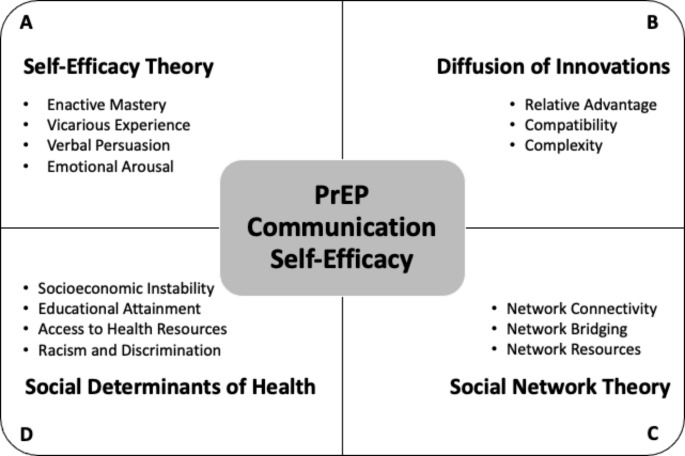
HIV prevention interventions that leverage endogenous peer leaders to communicate about Pre-Exposure Prophylaxis (PrEP) and other HIV prevention tools in their social networks offer a way to reach greater portions of communities most impacted by HIV like Black/African American gay, bisexual, same gender-loving, and other sexual minority men (BSMM). However, the success of these interventions hinge on the communication self-efficacy of its peer leaders. In this exploratory study, we present a multi-theoretical framework that situates the PrEP communication self-efficacy (PCSE) of a cohort of young BSMM peer leaders (n = 303) in the context of personal, behavioral, social, and structural factors. Using censored regression models, our analysis shows that PCSE is influenced by evaluations of PrEP itself (its relative advantage, complexity, and compatibility), network embeddedness (degree centrality) among other BSMM, social media network exposure to HIV information, and medical mistrust. We conclude with a discussion of the practical implications of our findings for intervention design and implementation.
利用内源性同伴领袖在其社交网络中就暴露前预防 (PrEP) 和其他艾滋病毒预防工具进行沟通的艾滋病毒预防干预措施为接触受艾滋病毒影响最大的社区(如黑人/非裔美国男同性恋者、双性恋者、同性爱人以及其他性少数群体男性 (BSMM))提供了一种途径。然而,这些干预措施的成功取决于同伴领袖的沟通自我效能感。在这项探索性研究中,我们提出了一个多理论框架,将一群年轻的 BSMM 同伴领袖(n=303)的 PrEP 沟通自我效能感(PCSE)置于个人、行为、社会和结构因素的背景下。通过删截回归模型,我们的分析表明,PCSE 受到对 PrEP 本身的评价(其相对优势、复杂性和兼容性)、与其他 BSMM 之间的网络嵌入度(中心度)、对 HIV 信息的社交媒体网络接触以及对医疗服务的不信任等因素的影响。最后,我们讨论了我们研究结果对干预设计和实施的实际意义。