• 文献检索
  • 文档翻译
  • 深度研究
  • 学术资讯
  • Suppr Zotero 插件Zotero 插件
  • 邀请有礼
  • 套餐&价格
  • 历史记录
应用&插件
Suppr Zotero 插件Zotero 插件浏览器插件Mac 客户端Windows 客户端微信小程序
定价
高级版会员购买积分包购买API积分包
服务
文献检索文档翻译深度研究API 文档MCP 服务
关于我们
关于 Suppr公司介绍联系我们用户协议隐私条款
关注我们

Suppr 超能文献

核心技术专利:CN118964589B侵权必究
粤ICP备2023148730 号-1Suppr @ 2026

文献检索

告别复杂PubMed语法,用中文像聊天一样搜索,搜遍4000万医学文献。AI智能推荐,让科研检索更轻松。

立即免费搜索

文件翻译

保留排版,准确专业,支持PDF/Word/PPT等文件格式,支持 12+语言互译。

免费翻译文档

深度研究

AI帮你快速写综述,25分钟生成高质量综述,智能提取关键信息,辅助科研写作。

立即免费体验

印度的剖宫产是否公平:使用受益归属分析进行评估。

Are cesarean deliveries equitable in India: assessment using benefit incidence analysis.

机构信息

International Institute for Population Sciences, Mumbai, India.

Department of Population and Development, International Institute for Population Sciences, Mumbai, India.

出版信息

BMC Health Serv Res. 2022 May 18;22(1):670. doi: 10.1186/s12913-022-07984-6.

DOI:10.1186/s12913-022-07984-6
PMID:35585584
原文链接:https://pmc.ncbi.nlm.nih.gov/articles/PMC9118745/
Abstract

BACKGROUND

In the last two decades, cesarean section (CS) deliveries in India have increased by six-fold and created economic hardship for families and households. Although several schemes and policies under the National Health Mission (NHM) have reduced the inequality in the use of maternal care services in India, the distributive effect of public health subsidies on CS deliveries remains unclear. In this context, this paper examines the usage patterns of CS delivery and estimates the share of public health subsidies on CS deliveries among mothers by different background characteristics in India.

DATA

Data from the fourth round of the National Family Health Survey (NFHS-4) was used for the study. Out-of-pocket (OOP) payment for CS delivery was used as a dependent variable and was analyzed by level of care that is, primary (PHC, UHC, other) and secondary (government/municipal, rural hospital). Descriptive statistics, binary logistic regression, benefit incidence analysis, concentration curve and concentration index were used for the analysis.

RESULTS

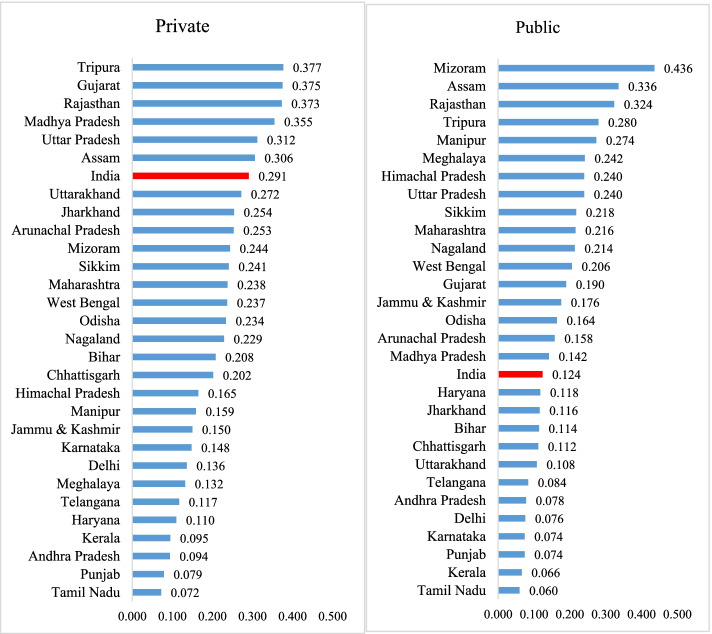
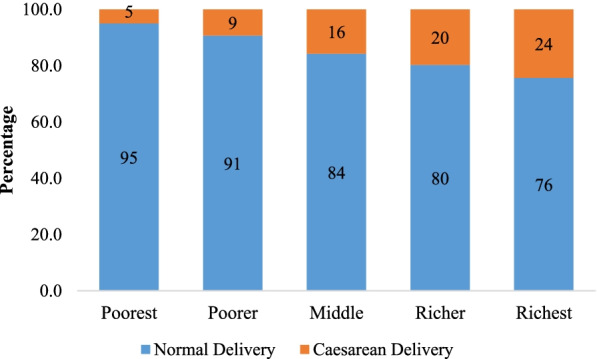
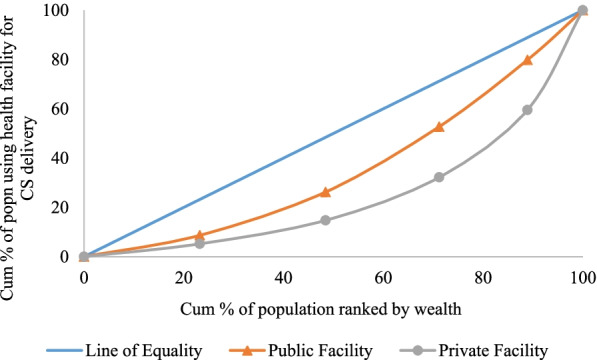
A strong economic gradient was observed in the utilization of CS delivery from public health facilities. Among mothers using any public health facility, 23% from the richest quintile did not pay for CS delivery compared to 13% from the poorest quintile. The use of the public subsidy among mothers using any type of public health facility for CS delivery was pro-rich in nature; 9% in the poorest quintile, 16.1% in the poorer, 24.5% in the middle, 27.5% among richer and 23% in the richest quintile. The pattern of utilization and distribution of public subsidy was similar across the primary and secondary health facilities but the magnitude varied. The findings from the benefit-incidence analysis are supported by those obtained from the inequality analysis. The concentration index of CS was 0.124 for public health centers and 0.291 for private health centers. The extent of inequality in the use of CS delivery in public health centers was highest in the state of Mizoram (0.436), followed by Assam (0.336), and the lowest in Tamil Nadu (0.060), followed by Kerala (0.066).

CONCLUSION

The utilization of CS services from public health centers in India is pro-rich. Periodically monitoring and evaluating of the cash incentive schemes for CS delivery and generating awareness among the poor would increase the use of CS delivery services in public health centers and reduce the inequality in CS delivery in India.

摘要

背景

在过去的二十年中,印度的剖宫产(CS)分娩增加了六倍,给家庭和家庭带来了经济困难。尽管国家健康使命(NHM)下的几项计划和政策减少了印度产妇护理服务使用方面的不平等,但公共卫生补贴对 CS 分娩的分配效果仍不清楚。在这种情况下,本文研究了 CS 分娩的使用模式,并估计了按不同背景特征的印度母亲的 CS 分娩中公共卫生补贴的份额。

数据

本研究使用了第四次国家家庭健康调查(NFHS-4)的数据。CS 分娩的自付费用被用作因变量,并按护理水平进行分析,即初级(PHC、UHC、其他)和二级(政府/市政、农村医院)。使用描述性统计、二元逻辑回归、受益发生率分析、集中曲线和集中指数进行分析。

结果

从公共卫生设施使用 CS 分娩的情况来看,存在强烈的经济梯度。在使用任何公共卫生设施的母亲中,最富裕的五分之一中有 23%的人没有支付 CS 分娩费用,而最贫穷的五分之一中有 13%的人没有支付 CS 分娩费用。在使用任何类型的公共卫生设施进行 CS 分娩的母亲中,使用公共补贴具有亲富性质;最贫穷的五分之一中有 9%,较贫穷的五分之一中有 16.1%,中等的五分之一中有 24.5%,较富裕的五分之一中有 27.5%,最富裕的五分之一中有 23%。公共补贴的利用和分配模式在初级和二级卫生设施中相似,但幅度不同。受益发生率分析的结果得到了不平等分析的支持。CS 的集中指数为公立卫生中心 0.124,私立卫生中心 0.291。公立卫生中心 CS 分娩使用率的不平等程度最高的是米佐拉姆邦(0.436),其次是阿萨姆邦(0.336),最低的是泰米尔纳德邦(0.060),其次是喀拉拉邦(0.066)。

结论

印度公立卫生中心 CS 服务的利用情况是亲富的。定期监测和评估 CS 分娩的现金激励计划,并提高贫困人口的认识,将增加公立卫生中心 CS 分娩服务的使用,并减少印度 CS 分娩的不平等。
https://cdn.ncbi.nlm.nih.gov/pmc/blobs/4b0e/9118745/982869ad0f48/12913_2022_7984_Fig4_HTML.jpg
https://cdn.ncbi.nlm.nih.gov/pmc/blobs/4b0e/9118745/729048e85b1d/12913_2022_7984_Fig1_HTML.jpg
https://cdn.ncbi.nlm.nih.gov/pmc/blobs/4b0e/9118745/d544fcfa2ad7/12913_2022_7984_Fig2_HTML.jpg
https://cdn.ncbi.nlm.nih.gov/pmc/blobs/4b0e/9118745/b7640d4dbca1/12913_2022_7984_Fig3_HTML.jpg
https://cdn.ncbi.nlm.nih.gov/pmc/blobs/4b0e/9118745/982869ad0f48/12913_2022_7984_Fig4_HTML.jpg
https://cdn.ncbi.nlm.nih.gov/pmc/blobs/4b0e/9118745/729048e85b1d/12913_2022_7984_Fig1_HTML.jpg
https://cdn.ncbi.nlm.nih.gov/pmc/blobs/4b0e/9118745/d544fcfa2ad7/12913_2022_7984_Fig2_HTML.jpg
https://cdn.ncbi.nlm.nih.gov/pmc/blobs/4b0e/9118745/b7640d4dbca1/12913_2022_7984_Fig3_HTML.jpg
https://cdn.ncbi.nlm.nih.gov/pmc/blobs/4b0e/9118745/982869ad0f48/12913_2022_7984_Fig4_HTML.jpg

相似文献

1
Are cesarean deliveries equitable in India: assessment using benefit incidence analysis.印度的剖宫产是否公平:使用受益归属分析进行评估。
BMC Health Serv Res. 2022 May 18;22(1):670. doi: 10.1186/s12913-022-07984-6.
2
Understanding equity of institutional delivery in public health centre by level of care in India: an assessment using benefit incidence analysis.理解印度公共卫生中心按护理水平提供机构分娩服务的公平性:使用受益归属分析进行评估。
Int J Equity Health. 2020 Dec 9;19(1):217. doi: 10.1186/s12939-020-01331-z.
3
Are institutional deliveries equitable in the southern states of India? A benefit incidence analysis.印度南部邦的机构分娩公平吗?一项受益情况分析。
Int J Equity Health. 2024 Jan 30;23(1):17. doi: 10.1186/s12939-024-02097-4.
4
Variations in the prevalence of caesarean section deliveries in India between 2016 and 2021 - an analysis of Tamil Nadu and Chhattisgarh.2016 年至 2021 年印度剖宫产率的变化——泰米尔纳德邦和恰蒂斯加尔邦的分析。
BMC Pregnancy Childbirth. 2023 Aug 30;23(1):622. doi: 10.1186/s12884-023-05928-4.
5
Equity in distribution of public subsidy for noncommunicable diseases among the elderly in India: an application of benefit incidence analysis.印度老年人非传染性疾病公共补贴分配中的公平性:受益归属分析的应用。
BMC Public Health. 2019 Dec 26;19(1):1735. doi: 10.1186/s12889-019-8089-y.
6
Assessment of Variation in Cesarean Delivery Rates Between Public and Private Health Facilities in India From 2005 to 2016.评估 2005 年至 2016 年期间印度公立和私立医疗机构之间剖宫产率的差异。
JAMA Netw Open. 2020 Aug 3;3(8):e2015022. doi: 10.1001/jamanetworkopen.2020.15022.
7
Did the poor gain from India's health policy interventions? Evidence from benefit-incidence analysis, 2004-2018.印度的卫生政策干预措施使穷人受益了吗?来自受益-发生率分析的证据,2004-2018 年。
Int J Equity Health. 2021 Jul 10;20(1):159. doi: 10.1186/s12939-021-01489-0.
8
Out of pocket expenditure and distress financing on cesarean delivery in India: evidence from NFHS-5.印度剖宫产的自费支出和困境融资:来自 NFHS-5 的证据。
BMC Health Serv Res. 2023 Sep 7;23(1):966. doi: 10.1186/s12913-023-09980-w.
9
Out-of-pocket expenditure and distress financing on institutional delivery in India.印度机构分娩的自付支出和困境融资。
Int J Equity Health. 2019 Jun 25;18(1):99. doi: 10.1186/s12939-019-1001-7.
10
High prevalence of cesarean section births in private sector health facilities- analysis of district level household survey-4 (DLHS-4) of India.私营部门医疗机构剖宫产率较高——印度第四次地区层面家庭调查(DLHS-4)分析。
BMC Public Health. 2018 May 10;18(1):613. doi: 10.1186/s12889-018-5533-3.

引用本文的文献

1
State-wise variation and inequalities in caesarean delivery rates in India: analysis of the National Family Health Survey-5 (2019-2021) data.印度剖宫产率的邦级差异与不平等:基于第五次全国家庭健康调查(2019 - 2021年)数据的分析
Lancet Reg Health Southeast Asia. 2024 Dec 3;32:100512. doi: 10.1016/j.lansea.2024.100512. eCollection 2025 Jan.
2
Socioeconomic gradient of lean diabetes in India: Evidence from National Family Health Survey, 2019-21.印度瘦型糖尿病的社会经济梯度:来自2019 - 2021年国家家庭健康调查的证据
PLOS Glob Public Health. 2024 May 30;4(5):e0003172. doi: 10.1371/journal.pgph.0003172. eCollection 2024.
3

本文引用的文献

1
Trends in cesarean section rates in private and public facilities in rural eastern Maharashtra, India from 2010-2017.印度马哈拉施特拉邦东部农村地区 2010-2017 年私立和公立医疗机构剖宫产率趋势。
PLoS One. 2021 Aug 12;16(8):e0256096. doi: 10.1371/journal.pone.0256096. eCollection 2021.
2
Effect of overweight/obesity on caesarean section occurrence among reproductive-aged women in Ethiopia: a secondary data analysis.超重/肥胖对埃塞俄比亚育龄妇女剖宫产发生率的影响:一项二次数据分析
BMJ Nutr Prev Health. 2021 Feb 15;4(1):111-114. doi: 10.1136/bmjnph-2020-000121. eCollection 2021.
3
The unending burden of high out-of-pocket expenditure on institutional deliveries in India.
Are institutional deliveries equitable in the southern states of India? A benefit incidence analysis.
印度南部邦的机构分娩公平吗?一项受益情况分析。
Int J Equity Health. 2024 Jan 30;23(1):17. doi: 10.1186/s12939-024-02097-4.
4
Out of pocket expenditure and distress financing on cesarean delivery in India: evidence from NFHS-5.印度剖宫产的自费支出和困境融资:来自 NFHS-5 的证据。
BMC Health Serv Res. 2023 Sep 7;23(1):966. doi: 10.1186/s12913-023-09980-w.
5
Clinical Equivalence of Polyglycolic Acid Suture and Polyglactin 910 Suture for Subcutaneous Tissue Closure After Cesarean Delivery: A Single-Blind Randomized Study.聚乙醇酸缝线与聚乳酸-910缝线用于剖宫产术后皮下组织缝合的临床等效性:一项单盲随机研究
Med Devices (Auckl). 2023 Jan 29;16:27-36. doi: 10.2147/MDER.S385988. eCollection 2023.
6
Does Obesity Influence Women's Decision Making about the Mode of Delivery?肥胖是否会影响女性对分娩方式的决策?
J Clin Med. 2022 Dec 6;11(23):7234. doi: 10.3390/jcm11237234.
印度分娩机构高额自费支出的无尽负担。
Public Health. 2021 Apr;193:43-47. doi: 10.1016/j.puhe.2021.01.029. Epub 2021 Mar 13.
4
Impact of socio-economic inequity in access to maternal health benefits in India: Evidence from Janani Suraksha Yojana using NFHS data.印度在获取孕产妇健康福利方面的社会经济不平等的影响:基于 NFHS 数据的《孕产妇安全保障计划》证据。
PLoS One. 2021 Mar 11;16(3):e0247935. doi: 10.1371/journal.pone.0247935. eCollection 2021.
5
Association between the type of provider and Cesarean section delivery in India: A socioeconomic analysis of the National Family Health Surveys 1999, 2006, 2016.印度提供医疗服务的类型与剖宫产术分娩的关联:基于全国家庭健康调查 1999、2006、2016 年的社会经济分析
PLoS One. 2021 Mar 8;16(3):e0248283. doi: 10.1371/journal.pone.0248283. eCollection 2021.
6
Increasing trend of C-section deliveries in India: A comparative analysis between southern states and rest of India.印度剖宫产率呈上升趋势:印度南部各州与其他地区的比较分析。
Sex Reprod Healthc. 2021 Jun;28:100608. doi: 10.1016/j.srhc.2021.100608. Epub 2021 Feb 24.
7
Understanding equity of institutional delivery in public health centre by level of care in India: an assessment using benefit incidence analysis.理解印度公共卫生中心按护理水平提供机构分娩服务的公平性:使用受益归属分析进行评估。
Int J Equity Health. 2020 Dec 9;19(1):217. doi: 10.1186/s12939-020-01331-z.
8
Assessment of Variation in Cesarean Delivery Rates Between Public and Private Health Facilities in India From 2005 to 2016.评估 2005 年至 2016 年期间印度公立和私立医疗机构之间剖宫产率的差异。
JAMA Netw Open. 2020 Aug 3;3(8):e2015022. doi: 10.1001/jamanetworkopen.2020.15022.
9
Equity in distribution of public subsidy for noncommunicable diseases among the elderly in India: an application of benefit incidence analysis.印度老年人非传染性疾病公共补贴分配中的公平性:受益归属分析的应用。
BMC Public Health. 2019 Dec 26;19(1):1735. doi: 10.1186/s12889-019-8089-y.
10
Socioeconomic inequalities in the use of caesarean section delivery in Ghana: a cross-sectional study using nationally representative data.加纳剖宫产利用中的社会经济不平等:使用全国代表性数据的横断面研究。
Int J Equity Health. 2019 Oct 25;18(1):162. doi: 10.1186/s12939-019-1063-6.