Department of Haematology, Churchill Hospital, Oxford University Hospitals NHS Foundation Trust, Oxford.
King's College London and Guy's and St Thomas' PET Centre, School of Biomedical Engineering and Imaging Sciences, King's College London, King's Health Partners, London.
Haematologica. 2023 Mar 1;108(3):785-796. doi: 10.3324/haematol.2021.280287.
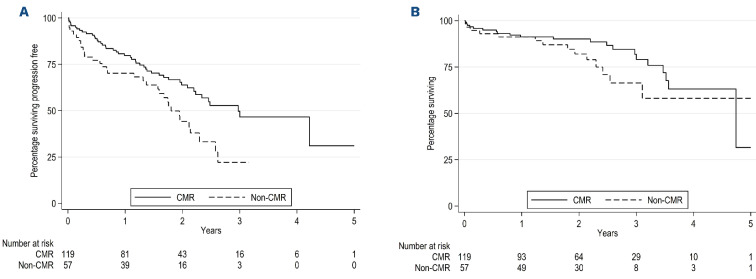
The optimum management approach for patients with relapsed or refractory follicular lymphoma remains uncertain. Autologous stem cell transplantation (autoSCT) is considered a standard option in suitable, younger patients with relapsed follicular lymphoma. AutoSCT is associated with very durable remissions in a minority of subjects, but also with significant, well-established toxicities. Although positron emission tomography (PET) status prior to autoSCT is an established prognostic factor in diffuse large B-cell lymphoma and Hodgkin lymphoma, no data exist in follicular lymphoma. We describe survival outcomes according to pre-transplant PET status, classified by the Lugano criteria into complete metabolic remission (CMR) versus non-CMR, in 172 patients with relapsed or refractory follicular lymphoma within a national, multicenter, retrospective British Society of Blood and Marrow Transplantation and Cellular Therapy registry study. The median number of lines of therapy prior to SCT was three (range, 1-6). The median follow-up after SCT was 27 months (range, 3-70). The median progression-free survival for all patients after autoSCT was 28 months (interquartile range, 23- 36). There was no interaction between age at transplantation, sex, number of months since last relapse, Karnofsky performance status or comorbidity index and achieving CMR prior to autoSCT. Superior progression-free survival was observed in 115 (67%) patients obtaining CMR versus 57 (33%) non-CMR patients (3-year progression-free survival 50% vs. 22%, P=0.011) and by pre-SCT Deauville score (continuous variable 1-5, hazard ratio [HR]=1.32, P=0.049). PET status was independently associated with progression-free status (non-CMR HR=2.02, P=0.003), overall survival (non-CMR HR=3.08, P=0.010) and risk of relapse (non-CMR HR=1.64, P=0.046) after autoSCT by multivariable analysis. Our data suggest that pre- SCT PET status is of clear prognostic value and may help to improve the selection of patients for autoSCT.
对于复发或难治性滤泡性淋巴瘤患者,最佳的治疗方法仍不确定。自体干细胞移植(autoSCT)被认为是适合年轻复发滤泡性淋巴瘤患者的标准选择。在少数患者中,autoSCT 可带来非常持久的缓解,但也伴随着显著且已确立的毒性。虽然在弥漫性大 B 细胞淋巴瘤和霍奇金淋巴瘤中,autoSCT 前的正电子发射断层扫描(PET)状态是一个既定的预后因素,但在滤泡性淋巴瘤中尚无相关数据。我们根据 Lugano 标准,将移植前 PET 状态分为完全代谢缓解(CMR)和非 CMR,描述了在一项全国性多中心回顾性英国血液和骨髓移植及细胞治疗协会登记研究中 172 例复发或难治性滤泡性淋巴瘤患者的生存结果。在 SCT 前,患者的中位治疗线数为 3 线(范围 1-6 线)。SCT 后中位随访时间为 27 个月(范围 3-70 个月)。所有患者 autoSCT 后的中位无进展生存期为 28 个月(四分位距 23-36 个月)。在 autoSCT 前达到 CMR 的患者与未达到 CMR 的患者之间,移植时年龄、性别、上次复发后月数、卡氏功能状态或合并症指数均无交互作用。在获得 CMR 的 115 例(67%)患者中,无进展生存期优于获得非 CMR 的 57 例(33%)患者(3 年无进展生存率为 50%比 22%,P=0.011),并且与 SCT 前的 Deauville 评分(连续变量 1-5,风险比[HR]=1.32,P=0.049)相关。多变量分析表明,PET 状态与无进展状态(非 CMR HR=2.02,P=0.003)、总生存(非 CMR HR=3.08,P=0.010)和 autoSCT 后复发风险(非 CMR HR=1.64,P=0.046)独立相关。我们的数据表明,SCT 前的 PET 状态具有明确的预后价值,并且可能有助于改善 autoSCT 患者的选择。