Dyson School of Design Engineering, Imperial College, London, United Kingdom.
Biosciences Institute, Newcastle University, Newcastle, United Kingdom.
PLoS Comput Biol. 2022 May 19;18(5):e1009666. doi: 10.1371/journal.pcbi.1009666. eCollection 2022 May.
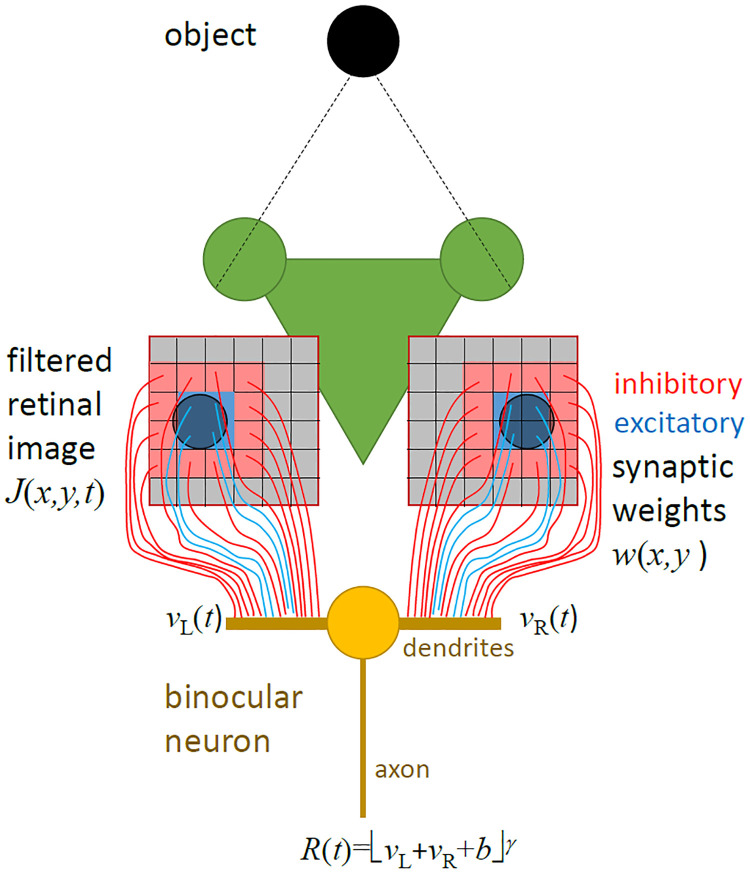
We present a simple model which can account for the stereoscopic sensitivity of praying mantis predatory strikes. The model consists of a single "disparity sensor": a binocular neuron sensitive to stereoscopic disparity and thus to distance from the animal. The model is based closely on the known behavioural and neurophysiological properties of mantis stereopsis. The monocular inputs to the neuron reflect temporal change and are insensitive to contrast sign, making the sensor insensitive to interocular correlation. The monocular receptive fields have a excitatory centre and inhibitory surround, making them tuned to size. The disparity sensor combines inputs from the two eyes linearly, applies a threshold and then an exponent output nonlinearity. The activity of the sensor represents the model mantis's instantaneous probability of striking. We integrate this over the stimulus duration to obtain the expected number of strikes in response to moving targets with different stereoscopic disparity, size and vertical disparity. We optimised the parameters of the model so as to bring its predictions into agreement with our empirical data on mean strike rate as a function of stimulus size and disparity. The model proves capable of reproducing the relatively broad tuning to size and narrow tuning to stereoscopic disparity seen in mantis striking behaviour. Although the model has only a single centre-surround receptive field in each eye, it displays qualitatively the same interaction between size and disparity as we observed in real mantids: the preferred size increases as simulated prey distance increases beyond the preferred distance. We show that this occurs because of a stereoscopic "false match" between the leading edge of the stimulus in one eye and its trailing edge in the other; further work will be required to find whether such false matches occur in real mantises. Importantly, the model also displays realistic responses to stimuli with vertical disparity and to pairs of identical stimuli offering a "ghost match", despite not being fitted to these data. This is the first image-computable model of insect stereopsis, and reproduces key features of both neurophysiology and striking behaviour.
我们提出了一个简单的模型,可以解释螳螂捕食性攻击的立体灵敏度。该模型由一个单一的“视差传感器”组成:一个对立体视差敏感的双目神经元,因此对动物的距离敏感。该模型紧密基于螳螂立体视的已知行为和神经生理学特性。该神经元的单眼输入反映了时间变化,并且对对比度符号不敏感,从而使传感器对眼间相关性不敏感。单眼感受野具有兴奋性中心和抑制性环绕,使其对大小进行调谐。视差传感器对来自两只眼睛的输入进行线性组合,应用阈值,然后应用指数输出非线性。传感器的活动代表了模型螳螂的瞬时打击概率。我们对刺激持续时间进行积分,以获得对具有不同立体视差、大小和垂直视差的运动目标的预期打击次数。我们优化了模型的参数,以使模型的预测与我们关于刺激大小和视差作为平均打击率函数的经验数据相一致。该模型能够再现螳螂攻击行为中对大小的相对广泛调谐以及对立体视差的狭窄调谐。尽管该模型在每只眼睛中只有一个中心-环绕感受野,但它定性地显示了与我们在真实螳螂中观察到的大小和视差之间的相同相互作用:随着模拟猎物距离超出最佳距离,最佳大小增加。我们表明,这是由于刺激在一只眼中的前缘和另一只眼中的后缘之间的立体“假匹配”所致;需要进一步的工作来确定这种假匹配是否发生在真实的螳螂中。重要的是,该模型还对具有垂直视差的刺激以及提供“幽灵匹配”的一对相同刺激显示出真实的响应,尽管没有针对这些数据进行拟合。这是第一个可计算昆虫立体视的图像模型,再现了神经生理学和攻击行为的关键特征。