Universidade Estadual de Londrina, Departamento de Medicina Interna, Londrina, PR, Brazil.
Universidade Estadual de Londrina, Departamento de Microbiologia, Londrina, PR, Brazil.
Braz J Infect Dis. 2022 May-Jun;26(3):102366. doi: 10.1016/j.bjid.2022.102366. Epub 2022 May 18.
E. coli is the main pathogen of UTI. It is important to be aware the local epidemiological data for an appropriate initial treatment. Resistance to antimicrobial agents has increased, especially to first-choice antibiotics in the treatment of cystitis. There are few studies on the sensivity profile of community uropathogen in our region.
To characterize antimicrobials the sensitivity profile to E. coli isolated from urocultures of women treated at Basic Health Units and Emergency Care Units of Londrina- Paraná- Brazil during a period of 12 months (June 1, 2016 to June 1, 2017).
A cross-sectional study was carried out from June 2016 to June 2017. All urine samples collected in the Basic Health Units and Emergency Departments in the city of Londrina (Paraná State, Brazil) were sent to a Central Laboratory where the identification and antimicrobial susceptibility testing were performed. Clinical Laboratory Standards Institute (CLSI) breakpoints were used for the interpretation of susceptibility testing results.
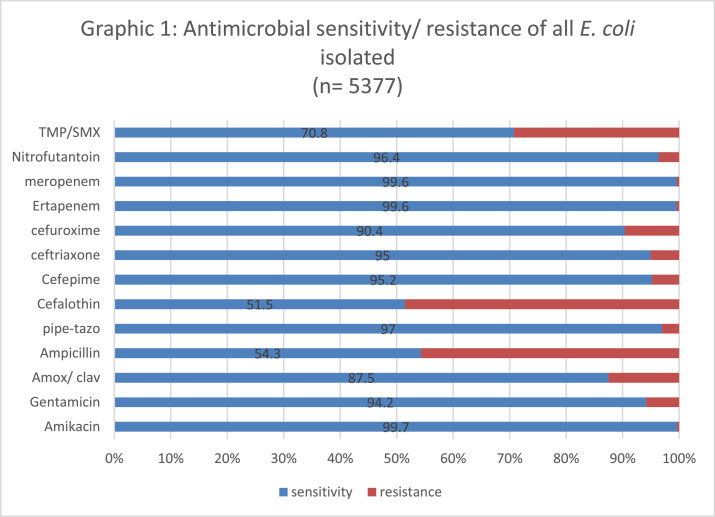
56,555 urine cultures were performed in the period, of which 8,832 were positive, of which 5,377 were women. Of these samples, 4.7% were enterobacteria producing extended-spectrum beta-lactamases (ESBL) and 15.5% resistant to quinolones. TMP- SMX was resistant in more than 30% of the samples in all age groups. Among quinolone-resistant isolates, resistance to cephalothin, ampicillin and sulfamethoxazole-trimethoprim was greater than 60%. Nitrofurantoin was the only antimicrobial that showed 90% of sensitivity.
The antimicrobials sensitivity profile was similar to that reported in the literature, with TMP- SMX resistance greater than 30% in the studied samples. Nitrofurantoin maintains high sensitivity rates greater than 90%. Resistance to quinolones increases proportionally with age, as well ESBL.
描述巴西隆德里纳市基本医疗单位和急诊室就诊的女性患者中段尿培养分离的大肠埃希菌对抗菌药物的敏感性特征。
本研究为横断面研究,时间为 2016 年 6 月 1 日至 2017 年 6 月 1 日。从城市的基本医疗单位和急诊室采集的所有尿液样本都被送到一个中央实验室进行鉴定和药敏试验。药敏试验结果采用临床实验室标准化协会(CLSI)的折点进行解读。
在研究期间共进行了 56555 次尿培养,其中 8832 次为阳性,其中 5377 次为女性。这些样本中,4.7%为产超广谱β-内酰胺酶(ESBL)的肠杆菌,15.5%对喹诺酮类药物耐药。在所有年龄段的样本中,TMP-SMX 的耐药率都超过 30%。在喹诺酮类耐药的分离株中,对头孢噻肟、氨苄西林和磺胺甲噁唑-甲氧苄啶的耐药率大于 60%。只有呋喃妥因的敏感性达到 90%。
本研究中抗菌药物的敏感性特征与文献报道相似,在所研究的样本中,TMP-SMX 的耐药率大于 30%。呋喃妥因的敏感性率仍保持在 90%以上。随着年龄的增长,喹诺酮类药物的耐药性呈比例增加,同时 ESBL 的耐药性也增加。