Colton Hayley, Hodgson David, Hornsby Hailey, Brown Rebecca, Mckenzie Joanne, Bradley Kirsty L, James Cameron, Lindsey Benjamin B, Birch Sarah, Marsh Louise, Wood Steven, Bayley Martin, Dickson Gary, James David C, Nicklin Martin J, Sayers Jon R, Zafred Domen, Rowland-Jones Sarah L, Kudesia Goura, Kucharski Adam, Darton Thomas C, de Silva Thushan I, Collini Paul J
South Yorkshire Regional Department of Infection and Tropical Medicine, Sheffield Teaching Hospitals Nhs Foundation Trust, Sheffield, S10 2JF, UK.
Department of Infection, Immunity and Cardiovascular Disease, University of Sheffield, Sheffield, S10 2TN, UK.
Wellcome Open Res. 2022 Jun 10;6:220. doi: 10.12688/wellcomeopenres.17143.3. eCollection 2021.
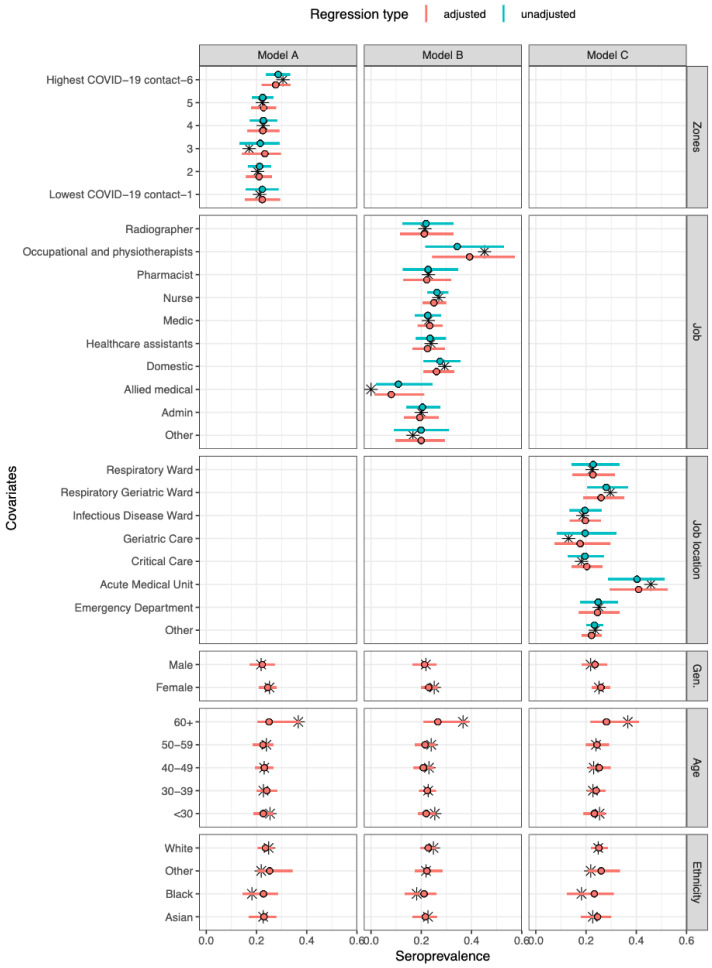
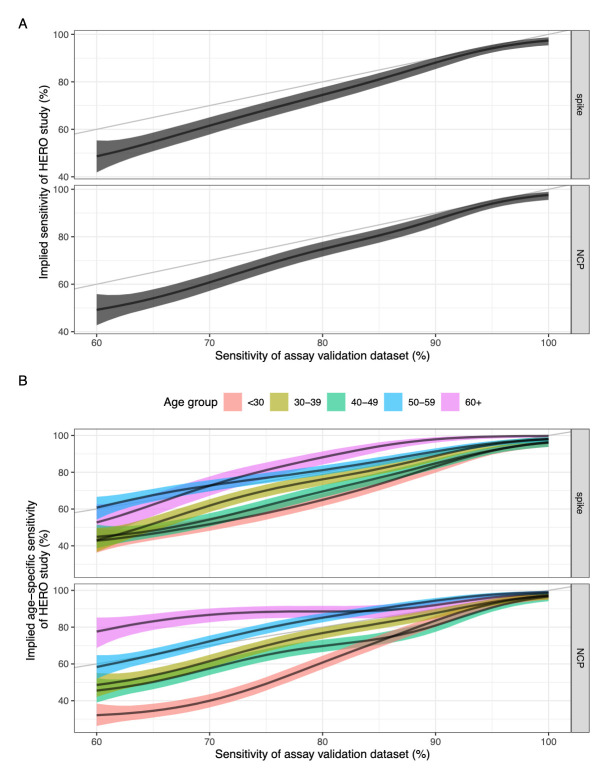
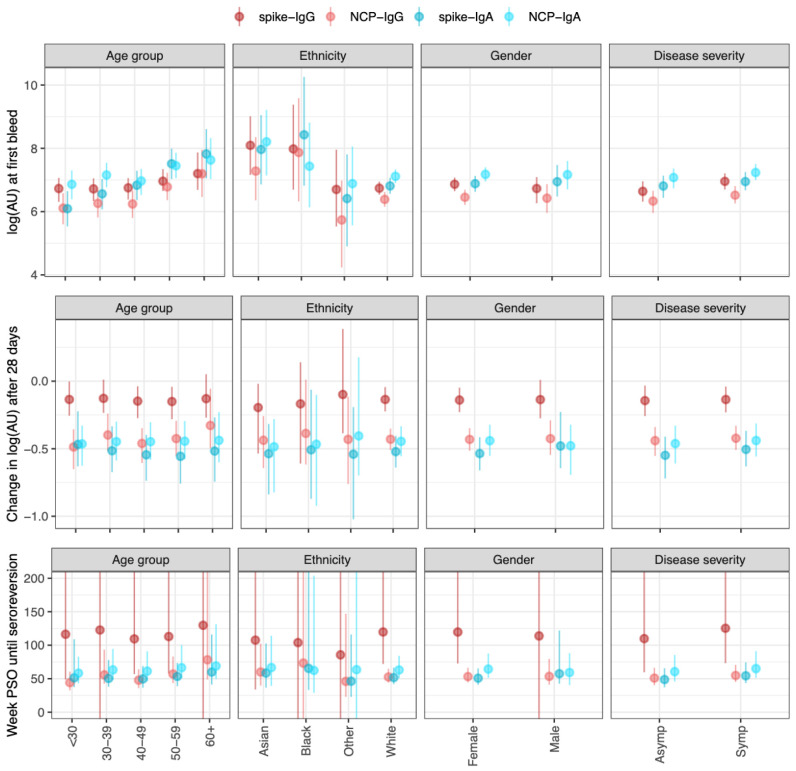
We aimed to measure SARS-CoV-2 seroprevalence in a cohort of healthcare workers (HCWs) during the first UK wave of the COVID-19 pandemic, explore risk factors associated with infection, and investigate the impact of antibody titres on assay sensitivity. HCWs at Sheffield Teaching Hospitals NHS Foundation Trust were prospectively enrolled and sampled at two time points. We developed an in-house ELISA for testing participant serum for SARS-CoV-2 IgG and IgA reactivity against Spike and Nucleoprotein. Data were analysed using three statistical models: a seroprevalence model, an antibody kinetics model, and a heterogeneous sensitivity model. Our in-house assay had a sensitivity of 99·47% and specificity of 99·56%. We found that 24·4% (n=311/1275) of HCWs were seropositive as of 12th June 2020. Of these, 39·2% (n=122/311) were asymptomatic. The highest adjusted seroprevalence was measured in HCWs on the Acute Medical Unit (41·1%, 95% CrI 30·0-52·9) and in Physiotherapists and Occupational Therapists (39·2%, 95% CrI 24·4-56·5). Older age groups showed overall higher median antibody titres. Further modelling suggests that, for a serological assay with an overall sensitivity of 80%, antibody titres may be markedly affected by differences in age, with sensitivity estimates of 89% in those over 60 years but 61% in those ≤30 years. HCWs in acute medical units and those working closely with COVID-19 patients were at highest risk of infection, though whether these are infections acquired from patients or other staff is unknown. Current serological assays may underestimate seroprevalence in younger age groups if validated using sera from older and/or more severe COVID-19 cases.
我们旨在测量英国第一波新冠疫情期间一组医护人员(HCWs)中SARS-CoV-2血清阳性率,探索与感染相关的风险因素,并研究抗体滴度对检测灵敏度的影响。谢菲尔德教学医院国民保健服务信托基金的医护人员被前瞻性纳入研究,并在两个时间点进行采样。我们开发了一种内部酶联免疫吸附测定法(ELISA),用于检测参与者血清中针对刺突蛋白和核蛋白的SARS-CoV-2 IgG和IgA反应性。数据使用三种统计模型进行分析:血清阳性率模型、抗体动力学模型和异质性灵敏度模型。我们的内部检测方法灵敏度为99.47%,特异性为99.56%。我们发现,截至2020年6月12日,24.4%(n = 311/1275)的医护人员血清呈阳性。其中,39.2%(n = 122/311)无症状。急性内科病房的医护人员(41.1%,95%置信区间30.0 - 52.9)以及物理治疗师和职业治疗师(39.2%,95%置信区间24.4 - 56.5)的校正后血清阳性率最高。年龄较大的组总体抗体滴度中位数较高。进一步建模表明,对于总体灵敏度为80%的血清学检测,抗体滴度可能会受到年龄差异的显著影响,60岁以上人群的灵敏度估计为89%,但30岁及以下人群为61%。急性内科病房的医护人员以及与新冠患者密切接触的人员感染风险最高,不过这些感染是从患者还是其他工作人员那里获得尚不清楚。如果使用来自年龄较大和/或病情较重的新冠病例的血清进行验证,目前的血清学检测可能会低估年轻年龄组的血清阳性率。