Li Junlei, Jiang Chao, Lai Yiwei, Li Li, Zhao Xiaoyan, Wang Xiaofang, Li Ling, Du Xin, Ma Changsheng, Dong Jianzeng
Department of Cardiology, Beijing AnZhen Hospital, National Clinical Research Centre for Cardiovascular Diseases, Beijing Advanced Innovation Center for Big Data-Based Precision Medicine for Cardiovascular Diseases, Capital Medical University, Beijing, China.
Department of Cardiology, The First Affiliated Hospital of Zhengzhou University, Zhengzhou, China.
Front Cardiovasc Med. 2022 May 4;9:856246. doi: 10.3389/fcvm.2022.856246. eCollection 2022.
Anemia is common in patients with chronic heart failure (HF) and is associated with adverse outcomes. However, data regarding the prognostic value of on-admission anemia on mortality in patients hospitalized with acute HF were relatively limited and conflicting. This study aimed to investigate the association of on-admission anemia with 1-year mortality and evaluate whether anemia is an independent predictor of mortality in patients hospitalized with acute HF.
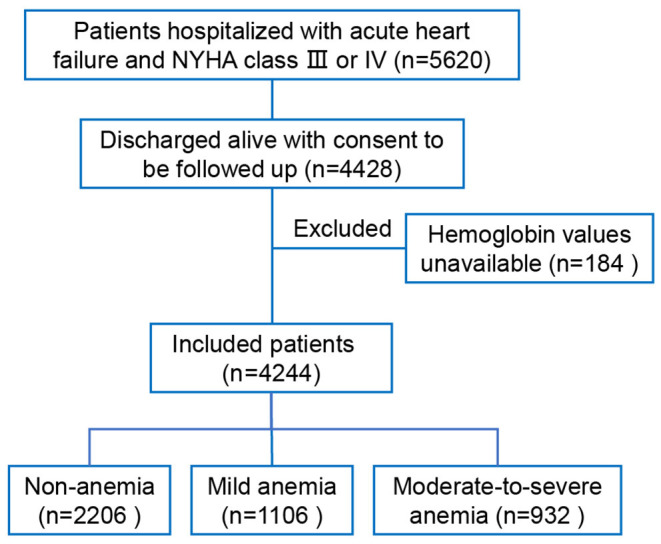
The present analysis included 4,244 patients hospitalized with acute HF from the HERO (Heart Failure Registry of Patient Outcomes) study. On-admission anemia was defined using the World Health Organization (WHO) criteria (hemoglobin <120 g/L in women and <130 g/L in men). Cox proportional hazards models were used to assess the association of anemia with 1-year all-cause and cardiovascular mortality.
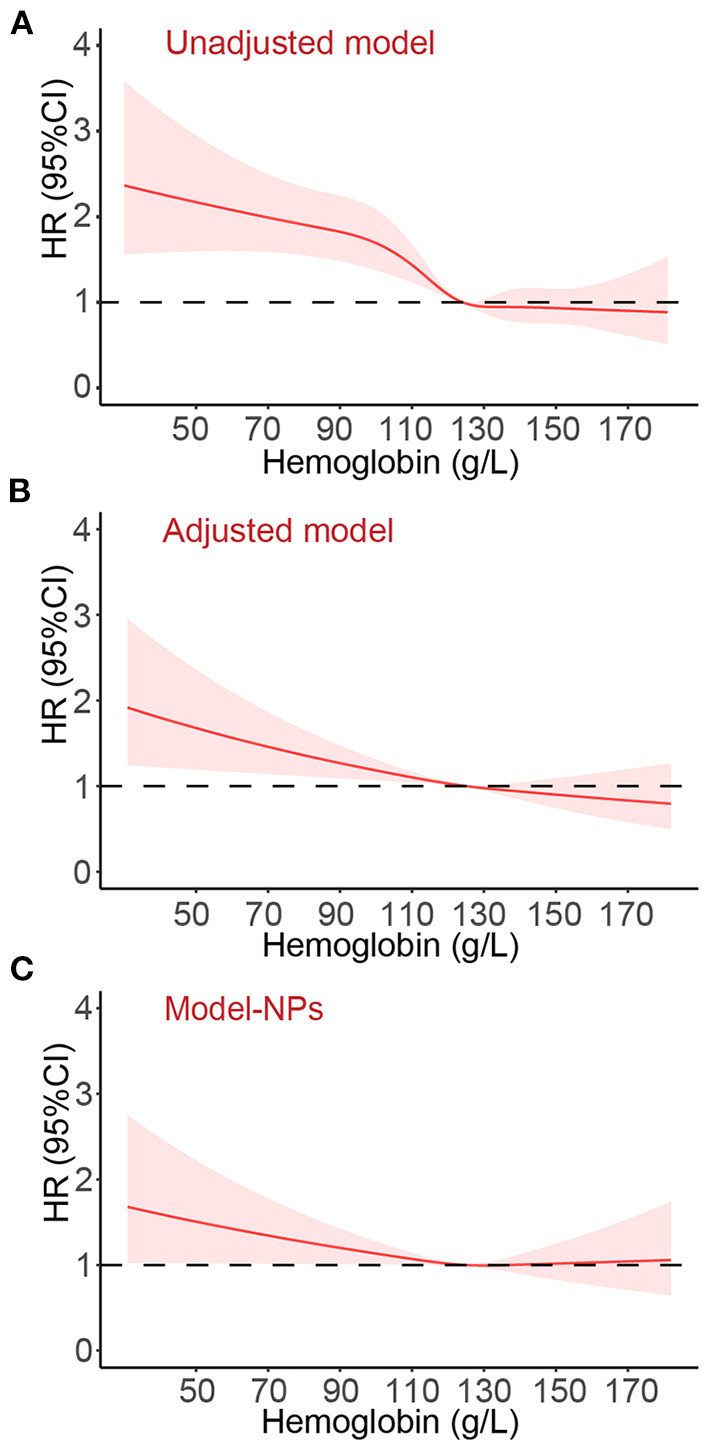
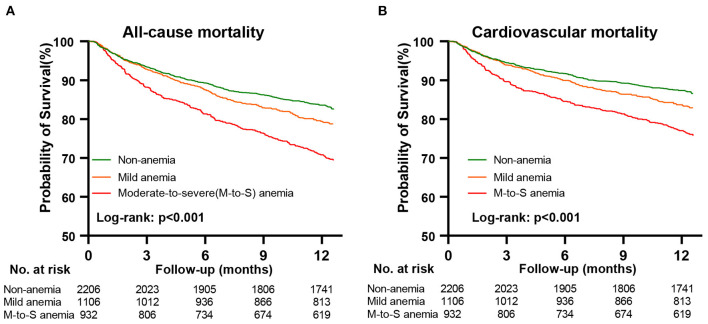
Of 4,244 patients, 2,206 (52.0%) patients had no anemia, 1,106 (26.1%) patients had mild anemia (men 110 ≤ hemoglobin < 130 g/L; women 110 ≤ hemoglobin < 120g/L), and 932 (22.0%) patients had moderate-to-severe anemia (hemoglobin < 110 g/L). After a median follow-up of 12.4 months (interquartile range: 11.9, 12.6), 867 (20.4%) patients died. Among the 742 (85.6%) deaths with confirmed causes, 664 (89.5%) were due to cardiovascular diseases. The mortality rates in patients with no anemia, mild anemia, and moderate-to-severe anemia were 16.6%, 20.4%, and 29.4%, respectively ( < 0.001). The association of anemia with increased all-cause mortality was significant in the unadjusted model (hazard ratio [HR]: 1.54, 95% confidential interval [CI]: 1.35-1.77, < 0.001), and remained statistically significant after adjustment for most potential confounders (HR: 1.20, 95%CI: 1.03-1.40, = 0.020), but no longer significant after additional adjustment for natriuretic peptides (HR: 1.02, 95%CI: 0.86-1.21, = 0.843). When considering the degree of anemia, moderate-to-severe anemia was an independent predictor of all-cause mortality after full adjustment (HR:1.26, 95%CI: 1.03-1.54, = 0.028), whereas mild anemia was not (HR: 0.84, 95%CI: 0.69-1.04, = 0.104). A similar relationship was also found between anemia and cardiovascular mortality.
On-admission anemia, defined by the WHO criteria, is not an independent predictor of mortality in patients hospitalized with acute HF. Moderate-to-severe anemia in patients with acute HF is independently associated with increased mortality.
贫血在慢性心力衰竭(HF)患者中很常见,且与不良预后相关。然而,关于急性HF住院患者入院时贫血对死亡率的预后价值的数据相对有限且存在矛盾。本研究旨在调查入院时贫血与1年死亡率之间的关联,并评估贫血是否为急性HF住院患者死亡率的独立预测因素。
本分析纳入了HERO(心力衰竭患者结局登记研究)中4244例急性HF住院患者。采用世界卫生组织(WHO)标准定义入院时贫血(女性血红蛋白<120g/L,男性血红蛋白<130g/L)。使用Cox比例风险模型评估贫血与1年全因死亡率和心血管死亡率之间的关联。
4244例患者中,2206例(52.0%)无贫血,1106例(26.1%)有轻度贫血(男性血红蛋白110≤<130g/L;女性血红蛋白110≤<120g/L),932例(22.0%)有中度至重度贫血(血红蛋白<110g/L)。中位随访12.4个月(四分位间距:11.9,12.6)后,867例(20.4%)患者死亡。在742例(85.6%)死因明确的死亡病例中,664例(89.5%)死于心血管疾病。无贫血、轻度贫血和中度至重度贫血患者的死亡率分别为16.6%、20.4%和29.4%(<0.001)。在未调整模型中,贫血与全因死亡率增加的关联显著(风险比[HR]:1.54,95%置信区间[CI]:1.35-1.77,<0.001),在对大多数潜在混杂因素进行调整后仍具有统计学意义(HR:1.20,95%CI:1.03-1.40,=0.020),但在进一步调整利钠肽后不再显著(HR:1.02,95%CI:0.86-1.21,=0.843)。在考虑贫血程度时,中度至重度贫血是完全调整后全因死亡率的独立预测因素(HR:1.26,95%CI:1.03-1.54,=0.028),而轻度贫血不是(HR:0.84,95%CI:0.69-1.04,=0.104)。贫血与心血管死亡率之间也发现了类似的关系。
根据WHO标准定义的入院时贫血不是急性HF住院患者死亡率的独立预测因素。急性HF患者的中度至重度贫血与死亡率增加独立相关。