Kirley Terence L, Greis Kenneth D, Norman Andrew B
Department of Pharmacology and Systems Physiology, College of Medicine, University of Cincinnati, 231 Albert Sabin Way, Cincinnati, OH, 45267-0575, USA.
Department of Cancer Biology, Proteomics Laboratory, College of Medicine, University of Cincinnati, 3125 Eden Avenue, Cincinnati, OH, 45267-0521, USA.
Biochem Biophys Rep. 2022 May 14;30:101278. doi: 10.1016/j.bbrep.2022.101278. eCollection 2022 Jul.
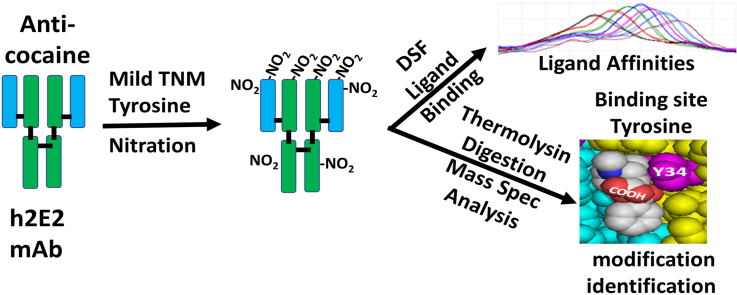
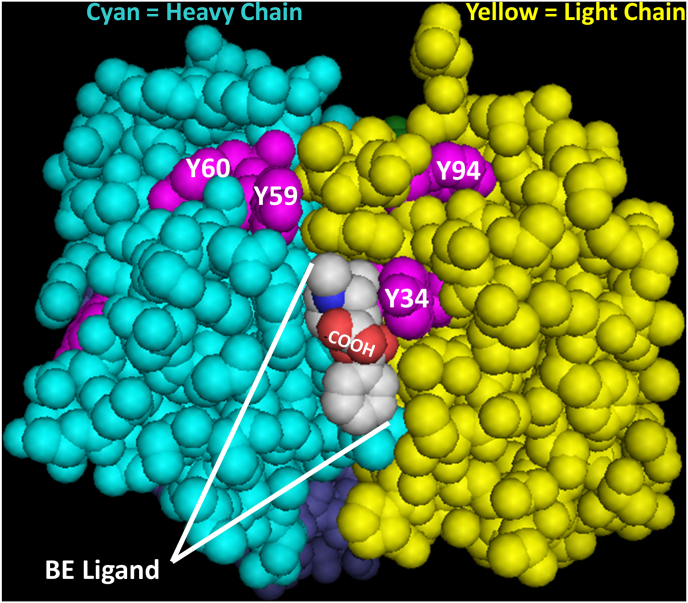
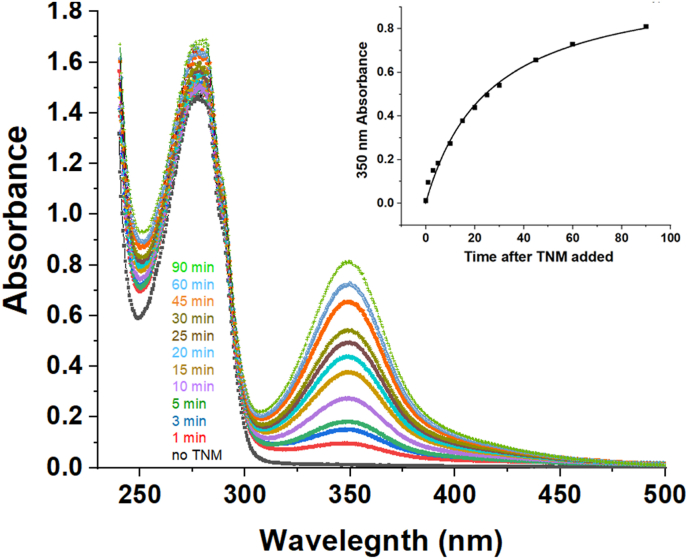
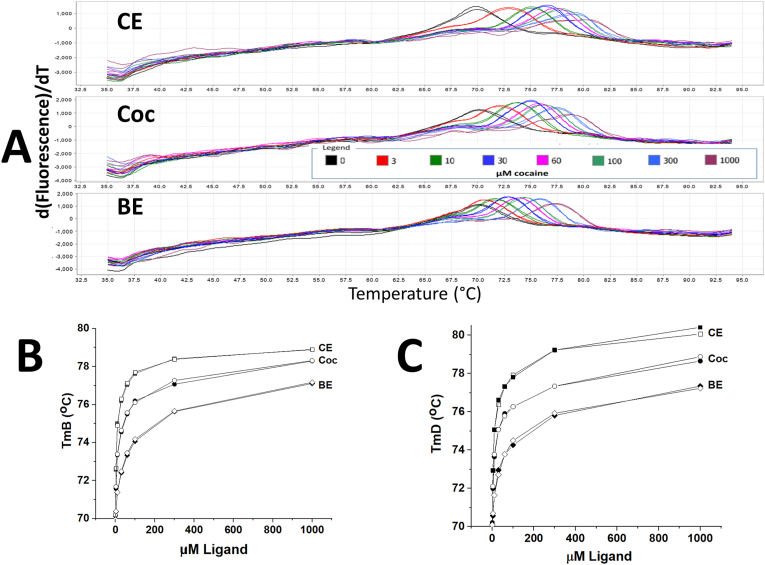
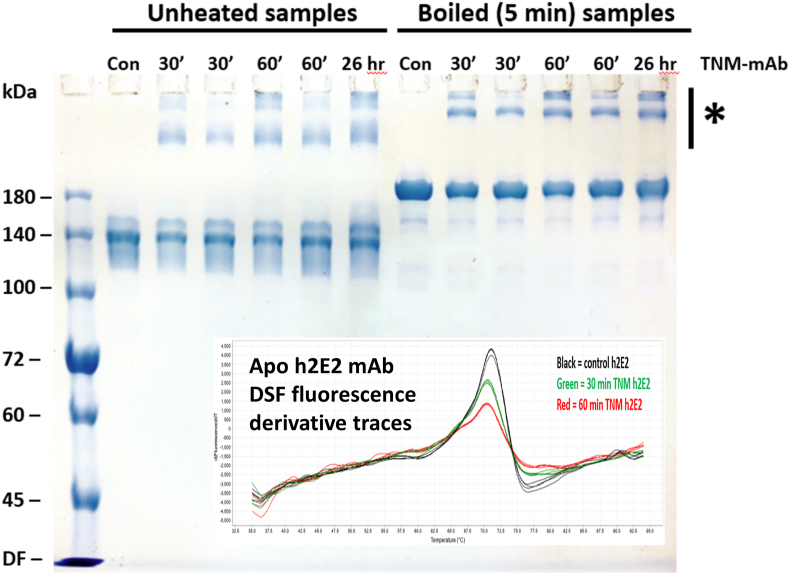
Tetranitromethane was used to selectively modify tyrosine residues of a humanized anti-cocaine mAb (h2E2), under development for the treatment of cocaine use disorders. The effect of mild tyrosine nitration on the affinity of cocaine and two high affinity cocaine metabolites, cocaethylene and benzoylecgonine, was assessed using differential scanning fluorimetry to measure ligand affinities via ligand-induced thermal stabilization of the mAb antigen binding region. Nitrated tyrosine residues were identified by mass spectral analysis of thermolysin peptides. One objective was to understand the binding affinity differences observed for these three ligands, which are not explained by the published crystal structure of the h2E2 mAb Fab fragment co-crystalized with benzoylecgonine, since the carboxylic acid of benzoylecgonine that is esterified to form cocaine and cocaethylene is not in contact with the mAb. Importantly, the binding affinity of the cocaine metabolite benzoylecgonine was not decreased by mild nitration, whereas the binding affinities of cocaine and cocaethylene were decreased about two-fold. These ligands differ only in the substituent attached to the carboxylate moiety of the compound, with benzoylecgonine having an unesterified carboxylate, and cocaine and cocaethylene having methyl and ethyl esters, respectively, at this position. The results are consistent with nitration of light chain tyrosine residue 34, resulting in a less favorable interaction with cocaine and cocaethylene carboxylate esters, while not affecting binding of benzoylecgonine. Thus, light chain Tyr34 residue may have molecular interactions with cocaine and cocaethylene not present for benzoylecgonine, leading to the observed affinity differences for these three ligands.
四硝基甲烷用于选择性修饰一种人源化抗可卡因单克隆抗体(h2E2)的酪氨酸残基,该抗体正处于治疗可卡因使用障碍的研发阶段。使用差示扫描荧光法通过单克隆抗体抗原结合区域的配体诱导热稳定性来测量配体亲和力,评估了轻度酪氨酸硝化对可卡因以及两种高亲和力可卡因代谢物——可卡因乙烯酯和苯甲酰芽子碱亲和力的影响。通过对嗜热菌蛋白酶肽段的质谱分析鉴定硝化的酪氨酸残基。一个目的是了解这三种配体观察到的结合亲和力差异,已发表的与苯甲酰芽子碱共结晶的h2E2单克隆抗体Fab片段的晶体结构无法解释这些差异,因为苯甲酰芽子碱中酯化形成可卡因和可卡因乙烯酯的羧酸不与单克隆抗体接触。重要的是,轻度硝化不会降低可卡因代谢物苯甲酰芽子碱的结合亲和力,而可卡因和可卡因乙烯酯的结合亲和力降低了约两倍。这些配体仅在连接到化合物羧酸根基团的取代基上有所不同,苯甲酰芽子碱在此位置具有未酯化的羧酸盐,而可卡因和可卡因乙烯酯分别具有甲酯和乙酯。结果与轻链酪氨酸残基34的硝化一致,导致与可卡因和可卡因乙烯酯羧酸酯的相互作用不太有利,同时不影响苯甲酰芽子碱的结合。因此,轻链Tyr34残基可能与可卡因和可卡因乙烯酯存在分子相互作用,而苯甲酰芽子碱不存在这种相互作用,从而导致这三种配体观察到的亲和力差异。