González-Martínez Sandra Mónica, Valencia-Ochoa Drochss Pettry, Gálvez-Ruiz Juan Carlos, Leyva-Peralta Mario Alberto, Juárez-Sánchez Octavio, Islas-Osuna María A, Calvillo-Páez Viviana Isabel, Höpfl Herbert, Íñiguez-Palomares Ramón, Rocha-Alonzo Fernando, Ochoa Lara Karen
Departamento de Investigación en Polímeros y Materiales, Universidad de Sonora, Rosales y Encinas s/n, Col. Centro, CP 83000 Hermosillo, Sonora, México.
Departamento de Ciencias Naturales y Matemáticas, Facultad de Ingeniería y Ciencias, Pontificia Universidad Javeriana, Calle 18 No. 118-250, CP 760031 Cali, Colombia.
ACS Omega. 2022 May 3;7(19):16380-16390. doi: 10.1021/acsomega.2c00225. eCollection 2022 May 17.
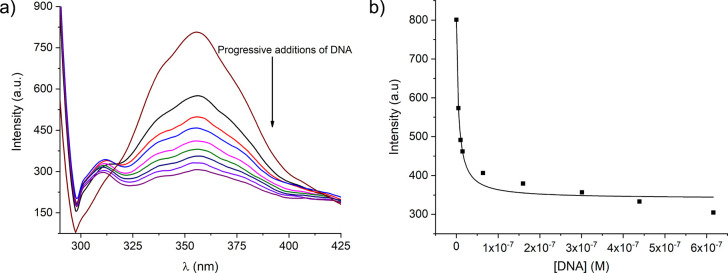
A series of bis--substituted tetrandrine derivatives carrying different aromatic substituents attached to both nitrogen atoms of the natural alkaloid were studied with double-stranded model DNAs (dsDNAs) to examine the binding properties and mechanism. Variable-temperature molecular recognition studies using UV-vis and fluorescence techniques revealed the thermodynamic parameters, Δ, Δ, and Δ, showing that the tetrandrine derivatives exhibit high affinity toward dsDNA ( ≈ 10-10 M), particularly the bis(methyl)anthraquinone (BAqT) and bis(ethyl)indole compounds (BInT). Viscometry experiments, ethidium displacement assays, and molecular modeling studies enabled elucidation of the possible binding mode, indicating that the compounds exhibit a synergic interaction mode involving intercalation of one of the -aryl substituents and interaction of the molecular skeleton in the major groove of the dsDNA. Cytotoxicity tests of the derivatives with tumor and nontumor cell lines demonstrated low cytotoxicity of these compounds, with the exception of the bis(methyl)pyrene (BPyrT) derivative, which is significantly more cytotoxic than the remaining derivatives, with IC values against the LS-180, A-549, and ARPE-19 cell lines that are similar to natural tetrandrine. Finally, complementary electrochemical characterization studies unveiled good electrochemical stability of the compounds.
研究了一系列在天然生物碱的两个氮原子上连接不同芳基取代基的双取代粉防己碱衍生物与双链模型DNA(dsDNA)的结合特性和机制。利用紫外可见光谱和荧光技术进行的变温分子识别研究揭示了热力学参数ΔH、ΔS和ΔG,表明粉防己碱衍生物对dsDNA表现出高亲和力(K≈10-10 M),特别是双(甲基)蒽醌(BAqT)和双(乙基)吲哚化合物(BInT)。粘度测定实验、溴化乙锭取代实验和分子模拟研究有助于阐明可能的结合模式,表明这些化合物表现出一种协同相互作用模式,涉及一个芳基取代基的插入以及分子骨架在dsDNA大沟中的相互作用。用肿瘤细胞系和非肿瘤细胞系对这些衍生物进行细胞毒性测试表明,除双(甲基)芘(BPyrT)衍生物外,这些化合物的细胞毒性较低,该衍生物的细胞毒性明显高于其余衍生物,其对LS-180、A-549和ARPE-19细胞系的IC值与天然粉防己碱相似。最后,补充的电化学表征研究揭示了这些化合物具有良好的电化学稳定性。