McIver Natalia D, Salas Christina, Menon Nathan, Heifner John, Mercer Deana
Department of Orthopaedics & Rehabilitation, the University of New Mexico Health Sciences Center, Albuquerque, NM.
St George's University School of Medicine, Great River, NY.
J Hand Surg Glob Online. 2022 Apr 4;4(3):135-140. doi: 10.1016/j.jhsg.2022.02.007. eCollection 2022 May.
Size options for volar locking plates may provide value for distal radius fixation. We compared excessively narrow plates with plates that were appropriately matched in width for fixation of an multifragmented distal radius fracture model.
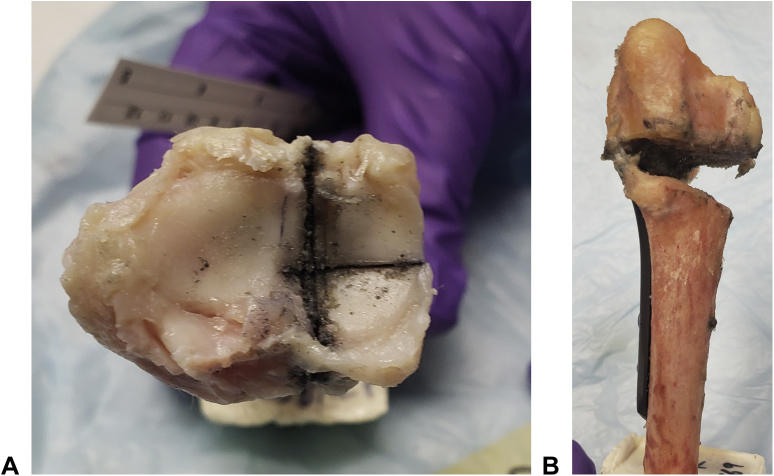
Eighteen matched pairs (right and left wrists) of large, cadaveric male distal radii specimens, prepared with a simulated Arbeitsgemeinschaft für Osteosynthesefragen type C-3 distal radius fractures, were tested. One specimen from each matched pair was randomized to receive a plate that was appropriately matched in width to the distal radius. The contralateral limb received a narrow plate, which in all cases was undersized in width. Fixation stability was tested and compared to the contralateral matched specimen. Specimens were preloaded at 50 N for 30 seconds before cyclic loading from 50-250 N at 1 Hz for 5000 cycles then loaded to failure.
Loss of fixation under cyclic loading was significantly greater in the specimens fixed with excessively narrow plates compared with plates of appropriate width. When loaded to failure, the plates of appropriate width were stiffer, with higher force at failure and compressive strength than narrow plates. The primary mode of failure was displacement of the distal lunate facet fragment.
These findings suggest that optimally matching the volar locking plate width to the radius may provide advantages for stability of the fixation construct and fragment capture. This may be due to reduced stress concentration from the distribution of forces across a larger surface area.
Optimizing the plate width to the radial width may improve fracture stability and may carry additional importance in comminuted fractures, where narrow plates may not completely capture small bone fragments.
掌侧锁定钢板的尺寸选择可能对桡骨远端固定具有重要意义。我们将过窄的钢板与宽度适配的钢板用于多片段桡骨远端骨折模型固定,并进行比较。
对18对(左右腕)大型男性尸体桡骨远端标本进行测试,制备成模拟 Arbeitsgemeinschaft für Osteosynthesefragen C-3型桡骨远端骨折。每对匹配标本中的一个随机接受一块宽度与桡骨远端适配的钢板。对侧肢体接受一块窄钢板,在所有情况下其宽度均过小。测试固定稳定性并与对侧匹配标本进行比较。标本在50 N预加载30秒,然后以1 Hz频率从50 - 250 N进行5000次循环加载,之后加载直至破坏。
与宽度合适的钢板相比,使用过窄钢板固定的标本在循环加载下固定丢失明显更多。在加载至破坏时,宽度合适的钢板更硬,破坏时的力和抗压强度均高于窄钢板。主要破坏模式是月骨远端小关节面骨折块移位。
这些发现表明,使掌侧锁定钢板宽度与桡骨最佳匹配可能为固定结构的稳定性和骨折块固定提供优势。这可能是由于力分布在更大表面积上导致应力集中减小。
使钢板宽度与桡骨宽度相匹配可能会提高骨折稳定性,在粉碎性骨折中可能具有额外的重要性,因为窄钢板可能无法完全固定小骨碎片。