Department of Dermato-Venereology & Wound Healing Centre, Bispebjerg Hospital, Copenhagen, Denmark.
Department of Dermatology, University of Zürich, Zürich, Switzerland.
Br J Dermatol. 2022 Oct;187(4):523-530. doi: 10.1111/bjd.21673. Epub 2022 Jun 28.
Prolonged systemic antibiotic treatment is often a part of management of hidradenitis suppurativa (HS). Although biologic therapies are now available, the patient's treatment journey leading to biologic therapy is unclear.
To examine treatment patterns and duration of systemic treatment use in patients with HS preceding biologic therapy.
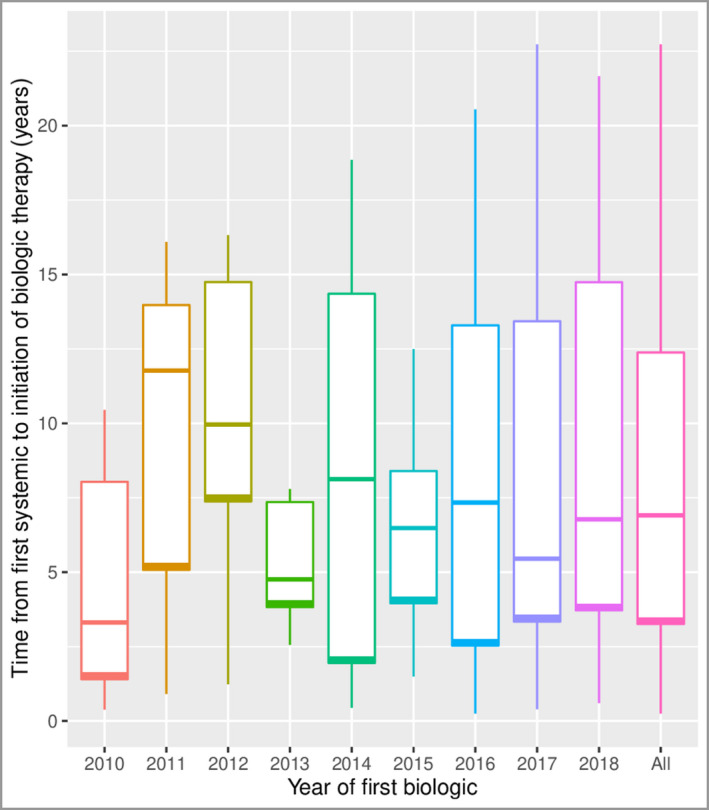
We identified all patients with HS receiving treatment with biologics in the Danish National Patient Registry from 2010 to 2018 and extracted their entire prescription history of specific systemic treatments from the Danish National Prescription Registry since its inception in 1995. The patients' treatment journeys are graphically displayed through Sankey diagrams and box plots generated to show temporal distributions. Descriptive patient characteristics were presented as frequencies with percentages for categorical variables and as means with SDs or medians with interquartile ranges (IQRs) for continuous variables.
A total of 225 patients with HS were included. Patients had most frequently been treated with penicillin (n = 214; 95·1%), dicloxacillin (n = 194; 86·2%), tetracycline (n = 145; 64·4%) and rifampicin/clindamycin (n = 111; 49·3%), as well as the retinoids isotretinoin and acitretin, and dapsone. Prior to biologic therapy, patients received a mean of 4·0 (SD 1·3) different systemic therapies, across a mean of 16·9 (SD 11·3) different treatment series. The mean time from first systemic therapy until biologic therapy was initiated was 15·3 (SD 5·1) years [8·2 (SD 5·9) years when excluding penicillin and dicloxacillin].
Patients with HS who receive biologic therapy have long preceding treatment histories with multiple drug classes and treatment series, many of which are supported by relatively weak evidence in HS. Delay in the initiation of biologic therapy may represent a missed opportunity to prevent disease progression. What is already known about this topic? The treatment journey leading to biologic therapy in patients with HS has not previously been investigated. What does this study add? Our data from 225 patients with HS illustrate that patients who receive biologic therapy have long preceding treatment histories with multiple drug classes and treatment series, many of which are supported by relatively weak evidence in HS.
化脓性汗腺炎(HS)的治疗通常包括长期全身应用抗生素。虽然现在有生物疗法,但患者接受生物疗法前的治疗过程尚不清楚。
检查接受生物疗法治疗的 HS 患者在接受生物疗法前的治疗模式和全身治疗的持续时间。
我们从 2010 年至 2018 年在丹麦国家患者登记处确定了所有接受生物制剂治疗的 HS 患者,并从丹麦国家处方登记处提取了他们自 1995 年成立以来特定全身治疗的完整处方史。通过 Sankey 图和箱线图显示患者的治疗过程,以显示时间分布。描述性患者特征以分类变量的频率和百分比以及连续变量的均值和标准差或中位数和四分位距(IQR)表示。
共纳入 225 例 HS 患者。患者最常接受青霉素(n=214;95.1%)、双氯西林(n=194;86.2%)、四环素(n=145;64.4%)和利福平/克林霉素(n=111;49.3%)治疗,以及维甲酸类药物异维 A 酸和阿维 A 酯,以及氨苯砜。在接受生物疗法之前,患者接受了平均 4.0(SD 1.3)种不同的全身治疗,共接受了平均 16.9(SD 11.3)种不同的治疗系列。从首次全身治疗到开始生物治疗的平均时间为 15.3(SD 5.1)年[排除青霉素和双氯西林后为 8.2(SD 5.9)年]。
接受生物疗法治疗的 HS 患者在接受生物疗法前有很长的治疗史,涉及多种药物类别和治疗系列,其中许多在 HS 中的证据相对较弱。生物疗法的启动延迟可能代表着预防疾病进展的机会丧失。
关于这个话题,已知哪些信息?
患者接受生物疗法治疗 HS 的治疗过程尚未得到调查。
本研究有哪些新发现?
我们对 225 例 HS 患者的数据表明,接受生物疗法治疗的患者在接受生物疗法前有很长的治疗史,涉及多种药物类别和治疗系列,其中许多在 HS 中的证据相对较弱。