Department of Chemistry, University of Warwick, Coventry CV4 7AL, United Kingdom.
UCB, 216 Bath Road, Slough SL1 3WE, United Kingdom.
J Am Soc Mass Spectrom. 2022 Jul 6;33(7):1126-1133. doi: 10.1021/jasms.1c00353. Epub 2022 May 23.
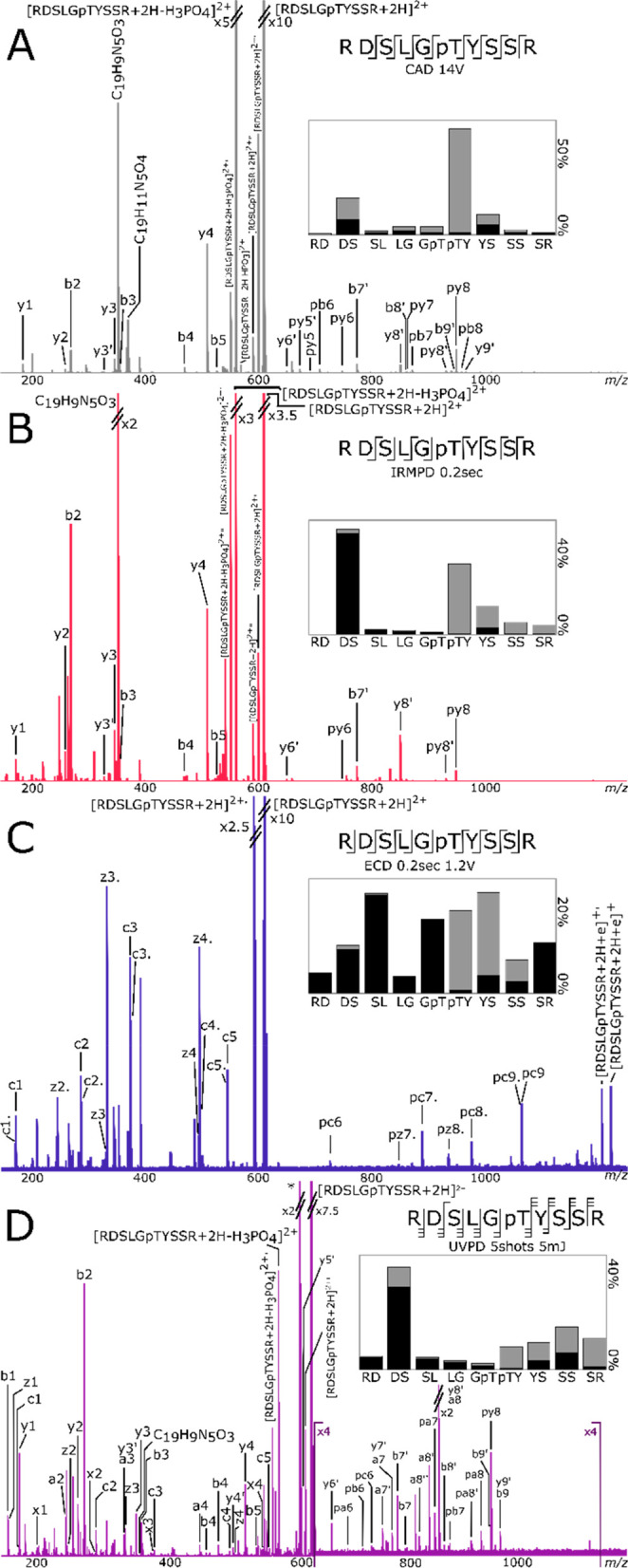
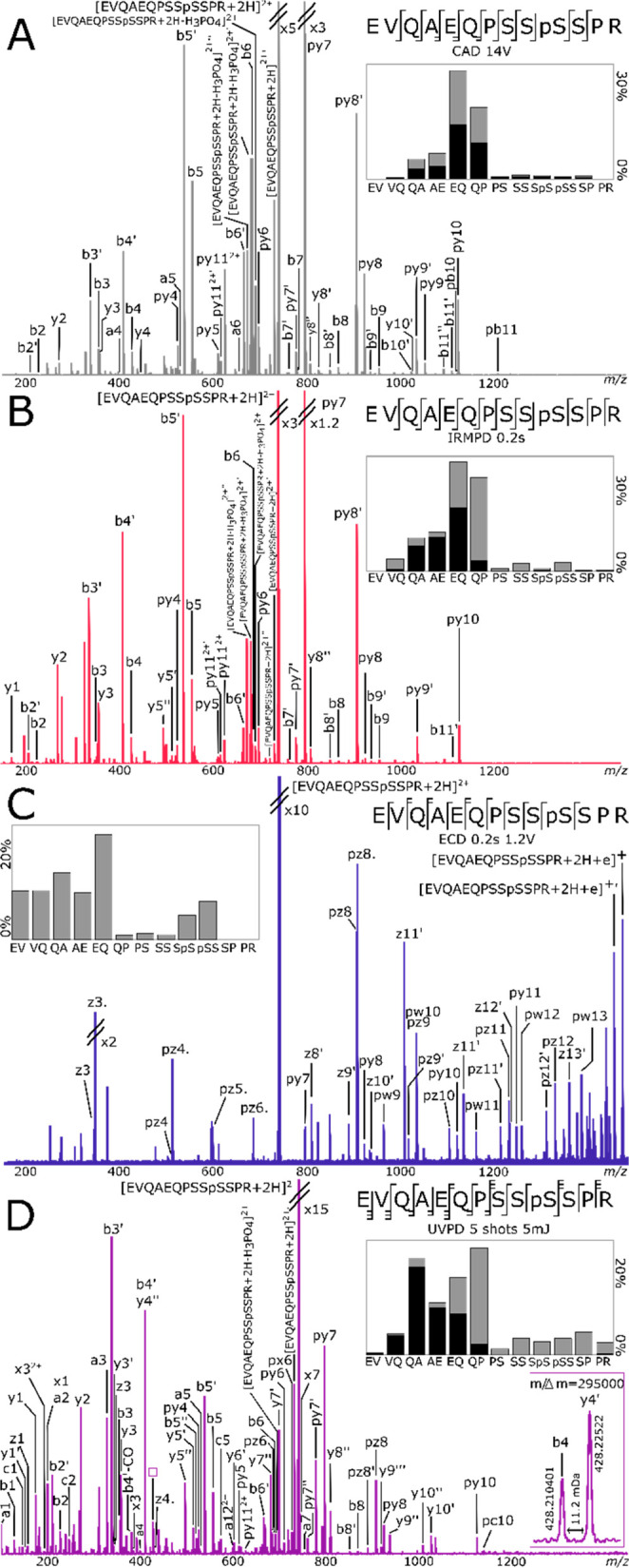
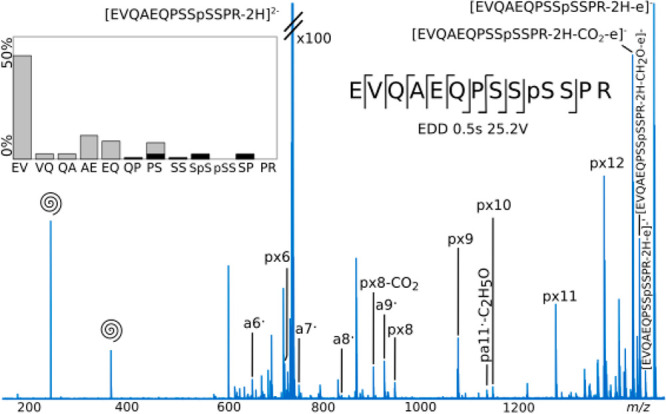
Collisionally activated dissociation (CAD), infrared multiphoton dissociation (IRMPD), ultraviolet photodissociation (UVPD), electron capture dissociation and electron detachment dissociation (EDD) experiments were conducted on a set of phosphopeptides, in a Fourier transform ion cyclotron resonance mass spectrometer. The fragmentation patterns were compared and varied according to the fragmentation mechanisms and the composition of the peptides. CAD and IRMPD produced similar fragmentation profiles of the phosphopeptides, while UVPD produced a large number of complementary fragments. Electron-based dissociation techniques displayed lower fragmentation efficiencies, despite retaining the labile phosphate group, and drastically different fragmentation profiles. EDD produced complex spectra whose interpretation proved challenging.
在傅里叶变换离子回旋共振质谱仪上,对一组磷酸肽进行了碰撞激活解离(CAD)、红外多光子解离(IRMPD)、紫外光解离(UVPD)、电子俘获解离和电子脱附解离(EDD)实验。根据碎裂机制和肽的组成,比较和改变了碎裂模式。CAD 和 IRMPD 对磷酸肽产生了相似的碎裂谱,而 UVPD 则产生了大量互补的片段。基于电子的解离技术尽管保留了不稳定的磷酸基团,但显示出较低的碎裂效率和截然不同的碎裂谱。EDD 产生了复杂的光谱,其解释具有挑战性。