Mater Research Institute, the University of Queensland, Brisbane, QLD, Australia.
Department of Gastroenterology and Hepatology, Princess Alexandra Hospital, Brisbane, QLD, Australia.
Medicine (Baltimore). 2022 May 20;101(20):e29217. doi: 10.1097/MD.0000000000029217.
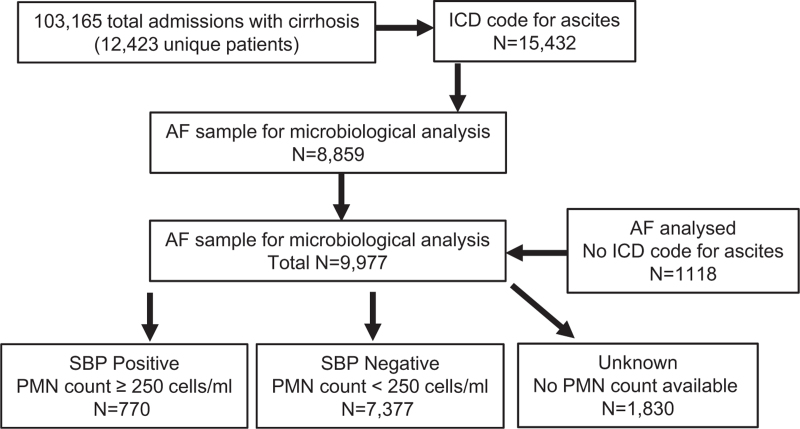
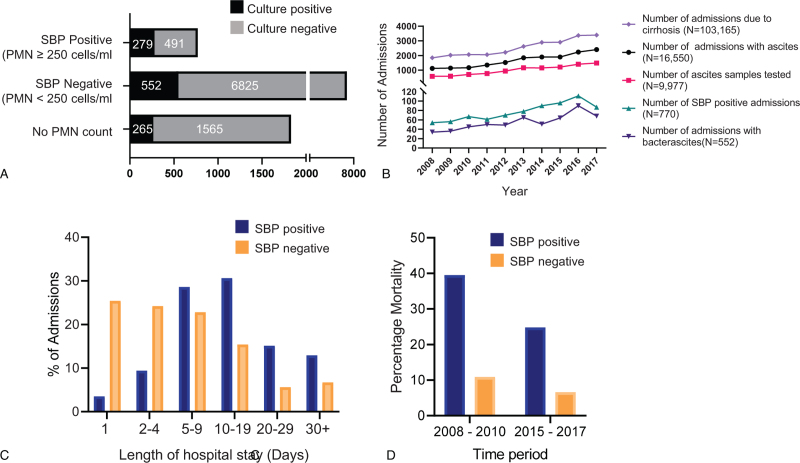
Spontaneous bacterial peritonitis (SBP), a common infection in patients with cirrhosis and ascites, is associated with high morbidity and mortality. The aim of this study was to investigate changes in the epidemiology of ascites fluid infections over time in an Australian population, including patient demographics, trends in mortality, length of hospital stay and the nature and antibiotic resistance profile of causative organisms.An observational descriptive population-based epidemiological study of patients with cirrhosis admitted to public hospitals in Queensland during 2008-2017 was performed, linking demographic/clinical and microbiology data.Among 103,165 hospital admissions of patients with cirrhosis, ascites was present in 16,550 and in 60% (9977) a sample of ascitic fluid was tested. SBP was diagnosed in 770 admissions (neutrophil count >250/ml) and bacterascites in 552 (neutrophil count <250/ml with positive culture). The number of admissions with an ascites fluid infection increased by 76% from 2008 to 2017, paralleling an 84% increase in cirrhosis admissions over the same timeframe. Patients with SBP had a longer hospital stay (median 15.7 vs 8.3 days for patients without SBP, P < .001) and higher in-hospital mortality, although this decreased from 39.5% in 2008 to 2010 to 24.8% in 2015 to 2017 (P < .001). Common Gram-positive isolates included coagulase negative staphylococci (37.9%), viridans group streptococci (12.1%), and Staphylococcus aureus (7.2%). Common Gram-negative isolates included Escherichia coli (13.0%), Klebsiella pneumoniae (3.1%) and Enterobacter cloacae (2.6%). The prevalence of resistance to any tested antibiotic was <10%.SBP remains associated with high in-hospital mortality and long hospital stay. Typical skin and bowel pathogens were common, therefore, empirical antibiotic therapy should target these pathogens. This study provides valuable evidence informing infection management strategies in this vulnerable patient population.
自发性细菌性腹膜炎(SBP)是肝硬化和腹水患者的常见感染,与高发病率和死亡率相关。本研究旨在调查澳大利亚人群中腹水感染的流行病学随时间的变化,包括患者人口统计学、死亡率趋势、住院时间以及病原体的性质和抗生素耐药谱。
对 2008 年至 2017 年期间在昆士兰州公立医院住院的肝硬化患者进行了一项观察性描述性基于人群的流行病学研究,将人口统计学/临床和微生物学数据进行了关联。
在 103165 例肝硬化住院患者中,有 16550 例存在腹水,其中 60%(9977 例)进行了腹水样本检测。诊断为 770 例 SBP(中性粒细胞计数>250/ml),552 例为菌性腹水(中性粒细胞计数<250/ml,培养阳性)。2008 年至 2017 年,腹水感染住院人数增加了 76%,同期肝硬化住院人数增加了 84%。SBP 患者的住院时间更长(中位数 15.7 天,无 SBP 患者为 8.3 天,P<0.001),住院死亡率更高,尽管这一比例从 2008 年至 2010 年的 39.5%下降到 2015 年至 2017 年的 24.8%(P<0.001)。常见的革兰氏阳性菌包括凝固酶阴性葡萄球菌(37.9%)、草绿色链球菌(12.1%)和金黄色葡萄球菌(7.2%)。常见的革兰氏阴性菌包括大肠杆菌(13.0%)、肺炎克雷伯菌(3.1%)和阴沟肠杆菌(2.6%)。对任何测试抗生素的耐药率均<10%。
SBP 仍然与高住院死亡率和长住院时间相关。常见的皮肤和肠道病原体,因此,经验性抗生素治疗应针对这些病原体。本研究提供了有价值的证据,为这一脆弱患者群体的感染管理策略提供了信息。