Department of Medical and Surgical Specialties and Dentistry, University of Campania "Luigi Vanvitelli", via De Crecchio, 4, 80138, Naples, Italy.
Department of Physical and Mental Health and Preventive Medicine, University of Campania "Luigi Vanvitelli", Naples, Italy.
Adv Ther. 2022 Jul;39(7):3308-3315. doi: 10.1007/s12325-022-02179-1. Epub 2022 May 25.
Bone loss is a major issue in patients affected by Duchenne muscular dystrophy (DMD), a rare musculoskeletal disorder, particularly in those treated with glucocorticoids (GCs). We aimed to assess the effectiveness of neridronate in terms of bone mineral density (BMD) changes in this population.
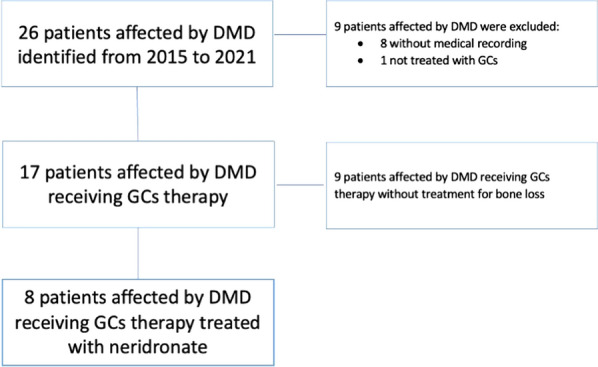
We retrospectively reviewed the records of patients affected by DMD receiving GCs referred to our outpatient from 2015 to 2020. All patients were treated with an intramuscular (IM) injection of neridronate (25 mg every month). Bone density was measured at the lumbar spine (LS; L1-L4 tract) using dual-energy x-ray absorptiometry (DXA) (GE Lunar), no more than 4 weeks before (T0) and after 1 year from neridronate treatment (T1).
Eight boys with DMD were included with a mean age at diagnosis of 4.75 ± 2.81 years. Six of them were non-ambulant and two of them had previous low-trauma fractures (a distal femur fracture and a vertebral compression fracture, respectively). All patients were receiving deflazacort [median duration of therapy 11.5 years (interquartile range 2-25)]. At the DXA evaluation (T0), the mean L1-L4 BMD value was 0.716 ± 0.164 g/cm. Six patients (75%) showed an L1-L4 Z-score height-adjusted of less than - 2. The mean age of neridronate initiation was 18.87 ± 6.81 years. All patients were supplemented with calcium carbonate and vitamin D at baseline. After 12 months of treatment (T1), the mean L1-L4 BMD value was 0.685 ± 0.190 g/cm. Seven patients (87.5%) showed an L1-L4 Z-score of less than - 2. Changes in LS BMD and Z-score were not significant between T0 and T1 in our cohort (p = 0.674 and p = 0.208, respectively) as well as among non-ambulant patients with DMD without previous fragility fractures.
In this study, we reported for the first time that neridronate may slow bone loss in GC-treated patients with DMD at 1-year follow-up.
骨丢失是杜氏肌营养不良症(DMD)患者的一个主要问题,DMD 是一种罕见的肌肉骨骼疾病,尤其是在接受糖皮质激素(GCs)治疗的患者中。我们旨在评估奈立膦酸盐在该人群中对骨密度(BMD)变化的疗效。
我们回顾性分析了 2015 年至 2020 年间在我院门诊就诊的接受 GCs 治疗的 DMD 患者的病历。所有患者均接受奈立膦酸盐(每月 25mg,肌内注射)治疗。使用双能 X 线吸收法(DXA)(GE Lunar)在腰椎(LS;L1-L4 节段)测量骨密度,在接受奈立膦酸盐治疗前不超过 4 周(T0)和治疗 1 年后(T1)进行。
纳入 8 例 DMD 男孩,平均诊断年龄为 4.75±2.81 岁。其中 6 例为非卧床患者,其中 2 例有既往低创伤性骨折(分别为股骨远端骨折和椎体压缩性骨折)。所有患者均接受地夫可特治疗[中位治疗时间 11.5 年(四分位距 2-25)]。在 DXA 评估(T0)时,L1-L4 的平均 BMD 值为 0.716±0.164g/cm。6 例患者(75%)的 L1-L4 Z 评分高度调整后低于-2。奈立膦酸盐起始年龄的平均值为 18.87±6.81 岁。所有患者在基线时均补充碳酸钙和维生素 D。治疗 12 个月后(T1),L1-L4 的平均 BMD 值为 0.685±0.190g/cm。7 例患者(87.5%)的 L1-L4 Z 评分低于-2。在我们的队列中,LS BMD 和 Z 评分在 T0 和 T1 之间没有显著变化(p=0.674 和 p=0.208),并且在没有既往脆性骨折的非卧床 DMD 患者中也是如此。
本研究首次报道,奈立膦酸盐可能在 1 年随访时减缓接受 GCs 治疗的 DMD 患者的骨丢失。