Friends of Cancer Research, Washington, D.C.
Clin Cancer Res. 2023 Jul 5;29(13):2371-2374. doi: 10.1158/1078-0432.CCR-22-0983.
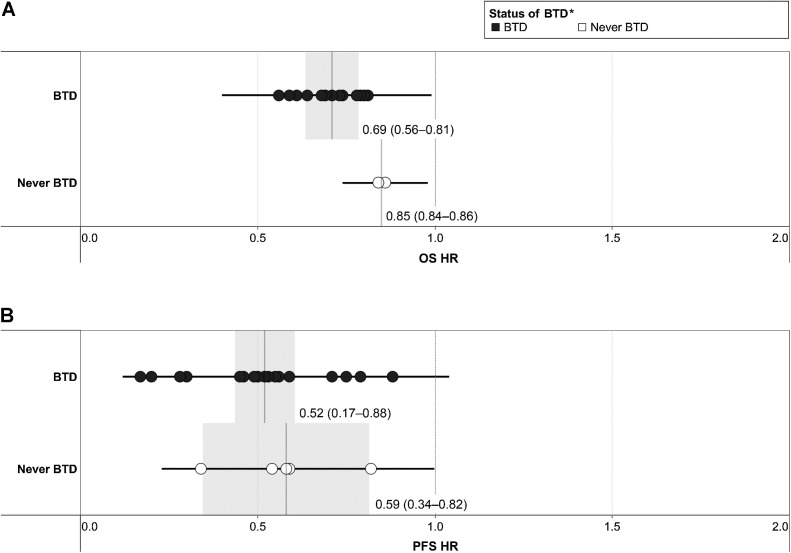
The breakthrough therapy designation (BTD) process was created to expedite clinical development timelines for drugs intended to treat serious conditions and preliminary clinical evidence indicates the drug may demonstrate substantial improvement over existing therapies. This analysis demonstrates that BTD is a valuable tool for expediting approval of promising therapies in oncology. By comparing drugs indicated to treat non-small cell lung cancer (NSCLC) approved with BTD or without BTD between January 2013 and October 2021, BTD drugs reduced the risk of death by a median of 31% and progression by a median of 48%, while drugs never receiving BTD reduced the risk of death and progression by a median of 15% and 41.9%, respectively. These findings show that BTD criteria accurately identify drugs that improve long-term outcomes for patients with cancer and warrant coordinated efforts to ensure timely coverage decisions and access for patients.
突破性治疗药物认定(BTD)程序旨在加快治疗严重疾病的药物的临床开发时间表,初步临床证据表明该药物可能比现有疗法有实质性的改善。本分析表明,BTD 是加快批准肿瘤学中有前途的治疗方法的一个有价值的工具。通过比较 2013 年 1 月至 2021 年 10 月期间获得 BTD 认定或未获得 BTD 认定的用于治疗非小细胞肺癌(NSCLC)的药物,获得 BTD 认定的药物将死亡风险中位数降低了 31%,将进展风险中位数降低了 48%,而从未获得 BTD 认定的药物将死亡风险中位数降低了 15%,将进展风险中位数降低了 41.9%。这些发现表明,BTD 标准准确地识别出能够改善癌症患者长期结局的药物,因此需要协调努力,确保患者能够及时获得覆盖和治疗。