Suwannaying Kunanya, Techavichit Piti, Komvilaisak Patcharee, Laoaroon Napat, Narkbunnam Nattee, Sanpakit Kleebsabai, Chiengthong Kanhatai, Chotsampancharoen Thirachit, Sathitsamitphong Lalita, Santong Chalongpon, Seksarn Panya, Hongeng Suradej, Wiangnon Surapon
Division of Hematology-Oncology, Department of Pediatrics, Faculty of Medicine, Khon Kaen University, Khon Kaen, Thailand.
Integrative and Innovative Hematology/Oncology Research Unit, Department of Pediatrics, Faculty of Medicine, Chulalongkorn University, Bangkok, Thailand.
Clin Exp Pediatr. 2022 Sep;65(9):453-458. doi: 10.3345/cep.2022.00437. Epub 2022 May 24.
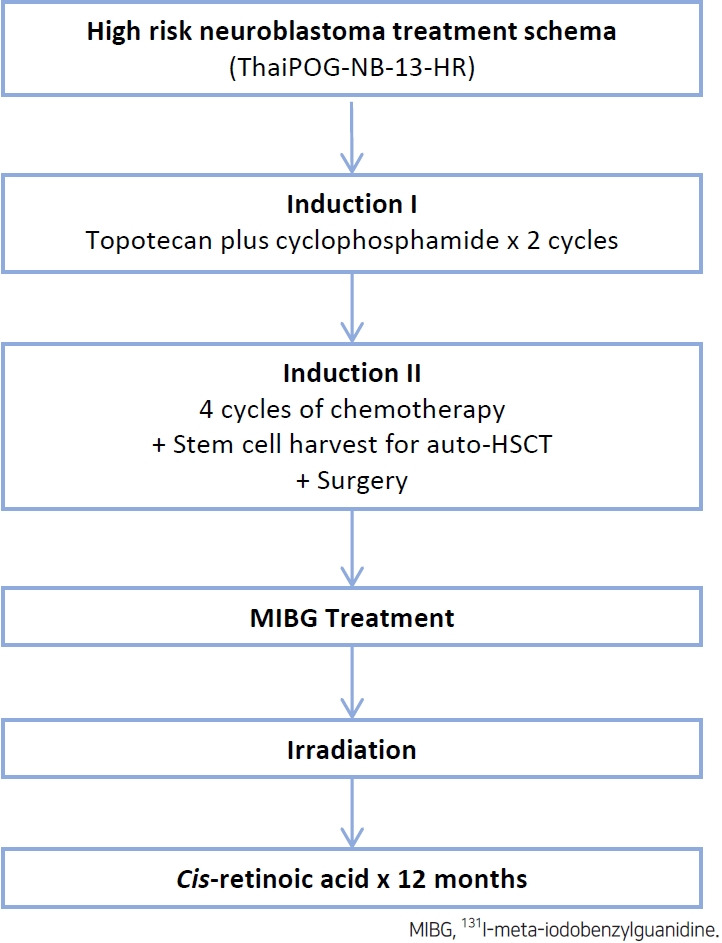
In 2013, the Thai Pediatric Oncology Group (ThaiPOG) introduced a national protocol in which high-dose chemotherapy plus stem cell rescue is performed without immunotherapy.
This study aimed to elucidate the outcomes of high-risk neuroblastoma (HR-NB) patients treated with the ThaiPOG protocol. This retrospective cohort review included 48 patients (30 males, 18 females) with a median age of 3 years (range, 8 months to 18 years) who were treated at 5 ThaiPOG treatment centers in Thailand in 2000-2018.
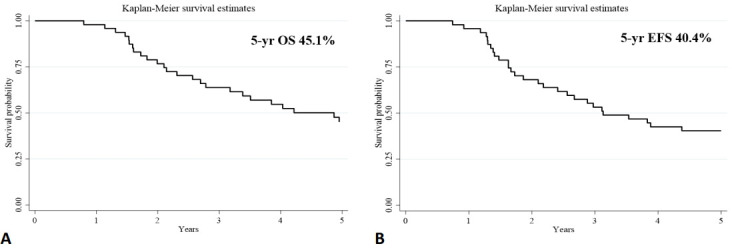
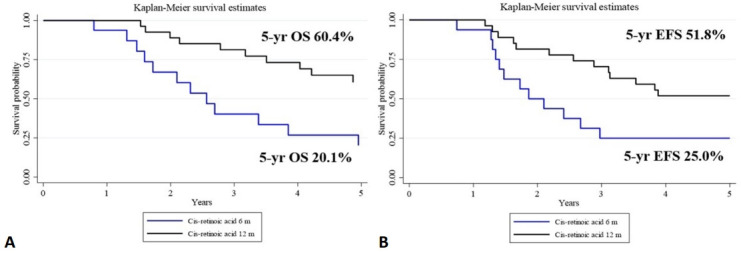
Eight of the 48 patients showed MYCN amplification. Twenty-three patients (48%) received 131I-meta-iodobenzylguanidine prior to high-dose chemotherapy and stem cell rescue. The majority of patients achieved a complete or very good response prior to consolidation treatment. The 5-year overall survival (OS) and event-free survival (EFS) rates were 45.1% and 40.4%, respectively. Patients aged >2 years had a nonsignificantly higher mortality risk (hazard ratio [HR], 2.66; 95% confidence interval [CI], 0.92-7.68; P=0.07). The MYCN amplification group had lower OS and EFS rates than the MYCN nonamplification group, but the difference was not statistically significant (45% OS and 37.5% EFS vs. 33.3% OS and 16.6% EFS; P=0.67 and P=0.67, respectively). Cis-retinoic acid treatment for 12 months was a strong prognostic factor that could reduce mortality rates among HR-NB patients (HR, 0.27; 95% CI, 0.09-0.785; P=0.01).
High-dose chemotherapy plus stem cell rescue followed by cis-retinoic acid for 12 months was well tolerated and could improve the survival rates of patients with HR-NB.
2013年,泰国儿科肿瘤学组(ThaiPOG)推出了一项全国性方案,即进行高剂量化疗加干细胞救援,不进行免疫治疗。
本研究旨在阐明接受ThaiPOG方案治疗的高危神经母细胞瘤(HR-NB)患者的治疗结果。这项回顾性队列研究纳入了2000年至2018年期间在泰国5个ThaiPOG治疗中心接受治疗的48例患者(30例男性,18例女性),中位年龄为3岁(范围为8个月至18岁)。
48例患者中有8例显示MYCN扩增。23例患者(48%)在高剂量化疗和干细胞救援前接受了131I-间碘苄胍治疗。大多数患者在巩固治疗前达到了完全缓解或非常好的缓解。5年总生存率(OS)和无事件生存率(EFS)分别为45.1%和40.4%。年龄>2岁的患者死亡风险略高(风险比[HR],2.66;95%置信区间[CI],0.92-7.68;P=0.07)。MYCN扩增组的OS和EFS率低于MYCN非扩增组,但差异无统计学意义(OS分别为45%和37.5%,EFS分别为33.3%和16.6%;P分别为0.67和0.67)。12个月的顺式维甲酸治疗是一个强有力的预后因素,可降低HR-NB患者的死亡率(HR,0.27;95%CI,0.09-0.785;P=0.01)。
高剂量化疗加干细胞救援,随后进行12个月的顺式维甲酸治疗,耐受性良好,可提高HR-NB患者的生存率。