Department of Rheumatology and Clinical Immunology, Maasstad Hospital, Rotterdam, Netherlands.
Department of Immunology, Erasmus Medical Center, Rotterdam, Netherlands.
Mediators Inflamm. 2022 May 17;2022:6600264. doi: 10.1155/2022/6600264. eCollection 2022.
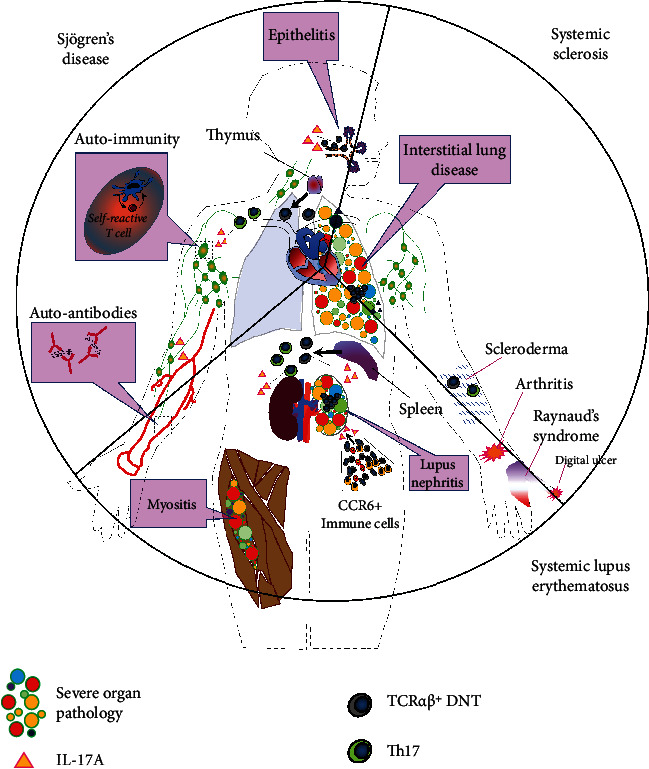
Interleukin 17A (IL-17A) has been put forward as a strong ally in our fight against invading pathogens across exposed epithelial surfaces by serving an antimicrobial immunosurveillance role in these tissues to protect the barrier integrity. Amongst other mechanisms that prevent tissue injury mediated by potential microbial threats and promote restoration of epithelial homeostasis, IL-17A attracts effector cells to the site of inflammation and support the host response by driving the development of ectopic lymphoid structures. Accumulating evidence now underscores an integral role of IL-17A in driving the pathophysiology and clinical manifestations in three potentially life-threatening autoimmune diseases, namely, systemic lupus erythematosus, Sjögren's syndrome, and systemic sclerosis. Available studies provide convincing evidence that the abundance of IL-17A in target tissues and its prime source, which is T helper 17 cells (Th17) and double negative T cells (DNT), is not an innocent bystander but in fact seems to be prerequisite for organ pathology. In this regard, IL-17A has been directly implicated in critical steps of autoimmunity. This review reports on the synergistic interactions of IL-17A with other critical determinants such as B cells, neutrophils, stromal cells, and the vasculature that promote the characteristic immunopathology of these autoimmune diseases. The summary of observations provided by this review may have empowering implications for IL-17A-based strategies to prevent clinical manifestations in a broad spectrum of autoimmune conditions.
白细胞介素 17A(IL-17A)被认为是我们对抗暴露于上皮表面的入侵病原体的有力盟友,它在这些组织中发挥抗菌免疫监视作用,以保护屏障完整性。在其他防止潜在微生物威胁介导的组织损伤和促进上皮稳态恢复的机制中,IL-17A 吸引效应细胞到炎症部位,并通过驱动异位淋巴样结构的发育来支持宿主反应。越来越多的证据强调了 IL-17A 在驱动三种潜在危及生命的自身免疫性疾病的病理生理学和临床表现中的重要作用,即系统性红斑狼疮、干燥综合征和系统性硬化症。现有研究提供了令人信服的证据,表明靶组织中 IL-17A 的丰度及其主要来源,即辅助性 T 细胞 17 细胞(Th17)和双阴性 T 细胞(DNT),不是无辜的旁观者,而是实际上似乎是器官病理学的必要条件。在这方面,IL-17A 直接参与了自身免疫的关键步骤。本综述报告了 IL-17A 与其他关键决定因素(如 B 细胞、中性粒细胞、基质细胞和血管)的协同相互作用,这些因素促进了这些自身免疫性疾病的特征性免疫病理学。本综述提供的观察结果总结可能对基于 IL-17A 的策略具有重要意义,这些策略可以预防广泛自身免疫性疾病的临床表现。