Ali Julfikar, Aziz Md Abdul, Rashid Md Mamun Or, Basher Mohammad Anwarul, Islam Mohammad Safiqul
Department of Pharmacy, Faculty of Science Noakhali Science and Technology University Noakhali Bangladesh.
Laboratory of Pharmacogenomics and Molecular Biology, Department of Pharmacy Noakhali Science and Technology University Noakhali Bangladesh.
Health Sci Rep. 2022 May 23;5(3):e650. doi: 10.1002/hsr2.650. eCollection 2022 May.
Lipid peroxidation end products are the major culprit for inducing chronic diseases in elderly people. Along with the elevated level of lipid peroxide biomarkers, there is a significant disruption of antioxidants balance, which combinedly propagate the diseases of elderly people. The aim of the present review is to bridge the connection of changes in lipid peroxides biomarkers and antioxidants level with age-associated diseases in elderly people.
This narrative review was performed following a comprehensive search for suitable articles in multiple online databases, including PubMed, Google Scholar, EMBASE, Web of Science, Cochrane Library, and ScienceDirect using selected search terms. The most appropriate literature was included based on the selection criteria.
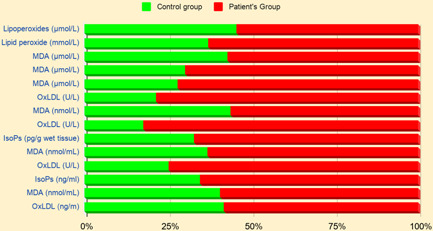
From the review, it is found that many age-related diseases propagated with an increased level of the end products of lipid peroxide and reduced levels of antioxidants in elderly people. When the end products of lipid peroxidation increase in the body, it creates oxidative stress, which ultimately leads to many complicated diseases, including cancers, cardiovascular and neurogenic diseases, and many other chronic inflammatory diseases. The oxidative stress induced by peroxidation can be assessed by different lipid peroxide end products such as malondialdehyde, oxidized low-density lipoprotein, isoprostanes, neuroprostanes, lipoperoxides, oxysterols (7-ketocholesterol, 7β-hydroxycholesterol), and many more.
This study definitively answers the correlation between the changes in lipid peroxides and antioxidants level and age-related diseases. Our narrative article recommends future investigations for elucidating the mechanisms rigorously to establish a compact correlation.
脂质过氧化终产物是诱发老年人慢性疾病的主要元凶。随着脂质过氧化物生物标志物水平的升高,抗氧化剂平衡会遭到显著破坏,二者共同促使老年人患病。本综述的目的是建立脂质过氧化物生物标志物和抗氧化剂水平变化与老年人年龄相关疾病之间的联系。
本叙述性综述是在多个在线数据库(包括PubMed、谷歌学术、EMBASE、科学网、考克兰图书馆和ScienceDirect)中使用选定的检索词全面搜索合适文章之后进行的。根据选择标准纳入最合适的文献。
通过综述发现,许多与年龄相关的疾病在老年人中随着脂质过氧化物终产物水平的升高和抗氧化剂水平的降低而蔓延。当体内脂质过氧化终产物增加时,会产生氧化应激,最终导致许多复杂疾病,包括癌症、心血管疾病和神经源性疾病以及许多其他慢性炎症性疾病。过氧化诱导的氧化应激可以通过不同的脂质过氧化物终产物来评估,如丙二醛、氧化型低密度脂蛋白、异前列腺素、神经前列腺素、脂过氧化物、氧固醇(7-酮胆固醇、7β-羟基胆固醇)等等。
本研究明确回答了脂质过氧化物和抗氧化剂水平变化与年龄相关疾病之间的相关性。我们的叙述性文章建议未来进行研究,以严格阐明其机制,建立紧密的相关性。