Sánchez Jorge, Loewe Axel
Institute of Biomedical Engineering, Karlsruhe Institute of Technology (KIT), Karlsruhe, Germany.
Front Physiol. 2022 May 10;13:908069. doi: 10.3389/fphys.2022.908069. eCollection 2022.
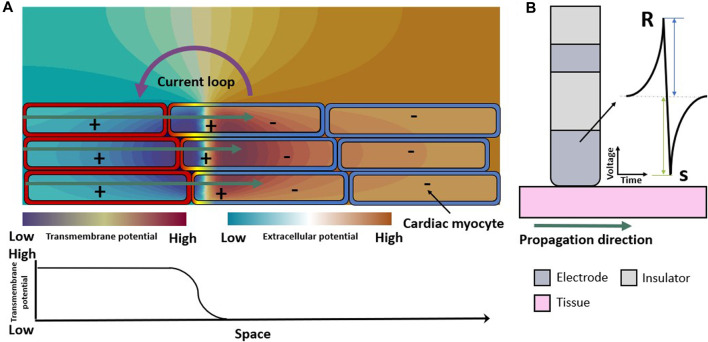
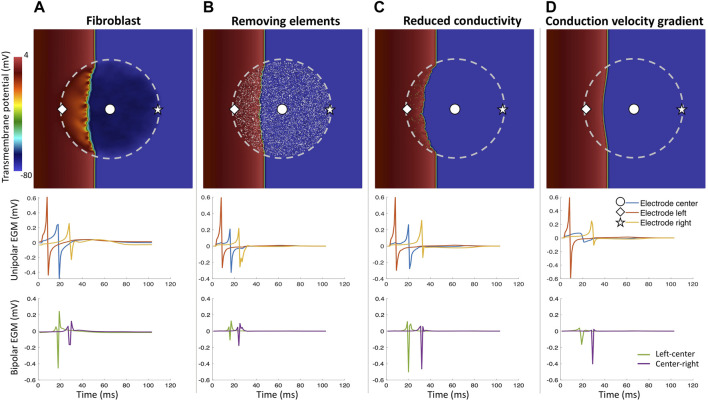
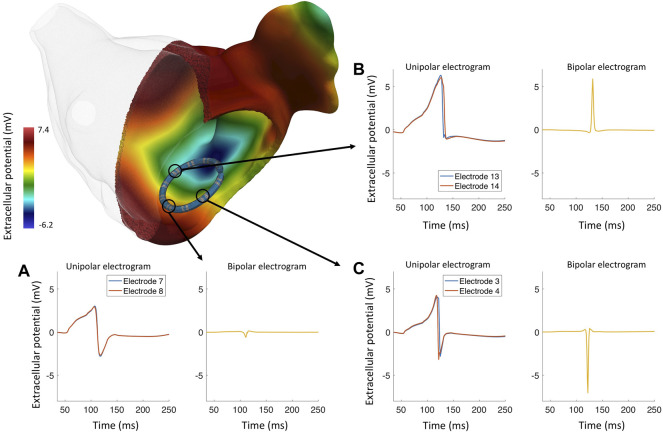
Computational simulations of cardiac electrophysiology provide detailed information on the depolarization phenomena at different spatial and temporal scales. With the development of new hardware and software, experiments have gained more importance in cardiac electrophysiology research. For plane waves in healthy tissue, and electrograms at the surface of the tissue demonstrate symmetric morphology and high peak-to-peak amplitude. Simulations provided insight into the factors that alter the morphology and amplitude of the electrograms. The situation is more complex in remodeled tissue with fibrotic infiltrations. Clinically, different changes including fractionation of the signal, extended duration and reduced amplitude have been described. , numerous approaches have been proposed to represent the pathological changes on different spatial and functional scales. Different modeling approaches can reproduce distinct subsets of the clinically observed electrogram phenomena. This review provides an overview of how different modeling approaches to incorporate fibrotic and structural remodeling affect the electrogram and highlights open challenges to be addressed in future research.
心脏电生理学的计算模拟提供了不同空间和时间尺度下关于去极化现象的详细信息。随着新硬件和软件的发展,实验在心脏电生理学研究中变得更加重要。对于健康组织中的平面波,组织表面的心电图显示出对称形态和较高的峰峰值幅度。模拟为改变心电图形态和幅度的因素提供了见解。在伴有纤维化浸润的重塑组织中情况更为复杂。临床上,已描述了包括信号碎裂、持续时间延长和幅度降低在内的不同变化。为此,人们提出了许多方法来在不同空间和功能尺度上表征病理变化。不同的建模方法可以重现临床观察到的心电图现象的不同子集。本综述概述了纳入纤维化和结构重塑的不同建模方法如何影响心电图,并强调了未来研究中有待解决的开放性挑战。