Esato Masahiro, An Yoshimori, Ogawa Hisashi, Wada Hiromichi, Hasegawa Koji, Tsuji Hikari, Abe Mitsuru, Akao Masaharu
Department of Cardiology, Heart Rhythm Section, Ogaki Tokushukai Hospital, Gifu, Japan.
Department of Cardiology, National Hospital Organization Kyoto Medical Center, Kyoto, Japan.
Int J Cardiol Heart Vasc. 2022 May 19;41:101055. doi: 10.1016/j.ijcha.2022.101055. eCollection 2022 Aug.
The risk for thromboembolism depending on the different age subgroups in patients with atrial fibrillation (AF) has not been fully elucidated.
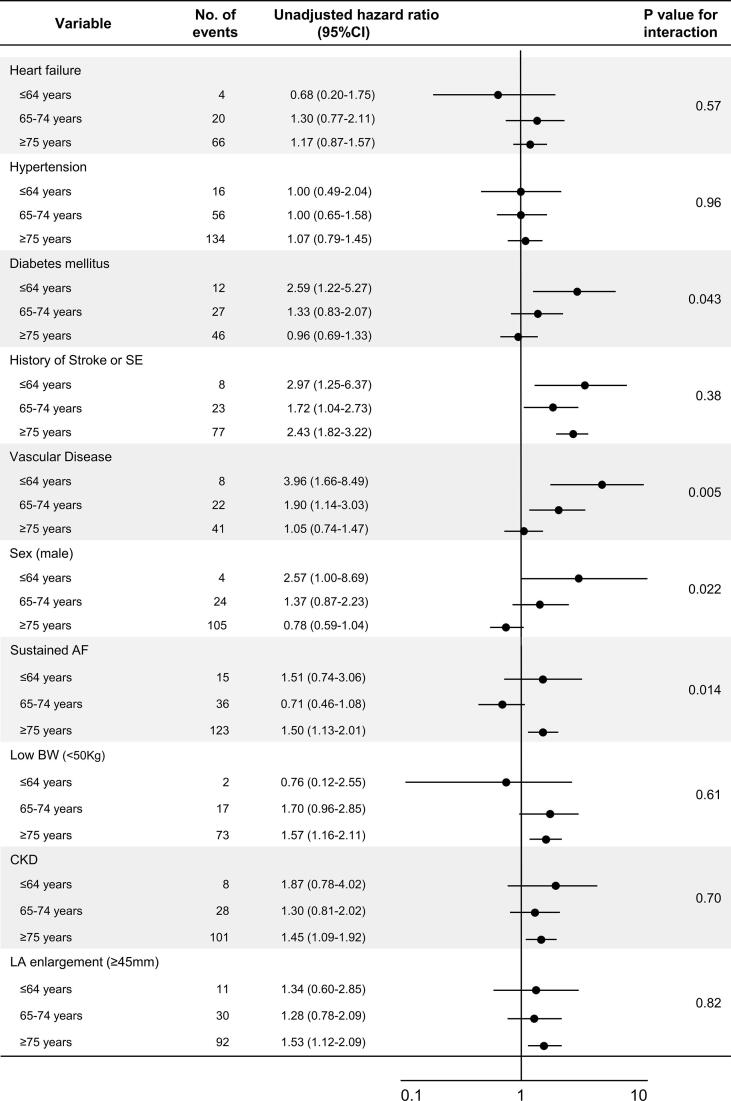
The Fushimi AF Registry is a community-based prospective survey of patients with AF in Fushimi-ku, Kyoto. Follow-up data were available for 4,466 patients by the end of 2019. Clinical determinants and the description of variables which interact and lead to the incidence of thromboembolism (the composite of ischemic stroke and systemic embolism [SE]) were identified in overall population and in age subgroups (≤64, 65-74, and ≥ 75 years).
A total of 314 patients developed thromboembolism during the median follow-up of 1,610 days (1.56 per 100 person-years). The independent determinants were age advance (per 10 years, hazard ratio [HR]: 1.51, 95% confidence interval [CI]: 1.221.86, P < 0.001), low body weight (HR: 1.91, 95% CI: 1.352.70, P < 0.001), history of stroke or SE (HR: 2.06, 95% CI: 1.542.76, P < 0.001), chronic kidney disease (HR: 1.34, 95% CI: 1.011.78, P = 0.043), and left atrial enlargement (HR: 1.57, 95% CI: 1.182.10, P = 0.0021). With regard to the age subgroup analysis, diabetes mellitus (P = 0.043), vascular disease (P = 0.005), male sex (P = 0.022), and sustained AF (P = 0.014) indicated significantly relevant interactions between the age subgroups and thromboembolism.
The risk and the impact of baseline characteristics on thromboembolism in patients with AF varied depending on the age subgroups.
房颤(AF)患者中,不同年龄亚组的血栓栓塞风险尚未完全阐明。
伏见房颤登记研究是一项针对京都伏见区房颤患者的基于社区的前瞻性调查。截至2019年底,有4466例患者的随访数据。在总体人群和年龄亚组(≤64岁、65 - 74岁和≥75岁)中确定了临床决定因素以及相互作用并导致血栓栓塞(缺血性卒中和全身性栓塞[SE]的复合事件)发生的变量描述。
在1610天的中位随访期内,共有314例患者发生血栓栓塞(每100人年1.56例)。独立决定因素包括年龄增长(每10年,风险比[HR]:1.51,95%置信区间[CI]:1.22 - 1.86,P < 0.001)、低体重(HR:1.91,95% CI:1.35 - 2.70,P < 0.001)、卒中或SE病史(HR:2.06,95% CI:1.54 - 2.76,P < 0.001)、慢性肾脏病(HR:1.34,95% CI:1.01 - 1.78,P = 0.043)和左心房扩大(HR:1.57,95% CI:1.18 - 2.10,P = 0.0021)。关于年龄亚组分析,糖尿病(P = 0.043)、血管疾病(P = 0.005)、男性(P = 0.022)和持续性房颤(P = 0.014)表明年龄亚组与血栓栓塞之间存在显著的相关相互作用。
房颤患者血栓栓塞的风险以及基线特征对其的影响因年龄亚组而异。