Department of Pharmacy, UF Health Shands Hospital, College of Pharmacy, University of Florida, Gainesville, FL, United States.
Division of Pulmonary, Critical Care and Sleep Medicine, UF Lung Transplant Program, College of Medicine, University of Florida Health Hospital, Gainesville, FL, United States.
Transpl Int. 2022 May 3;35:10433. doi: 10.3389/ti.2022.10433. eCollection 2022.
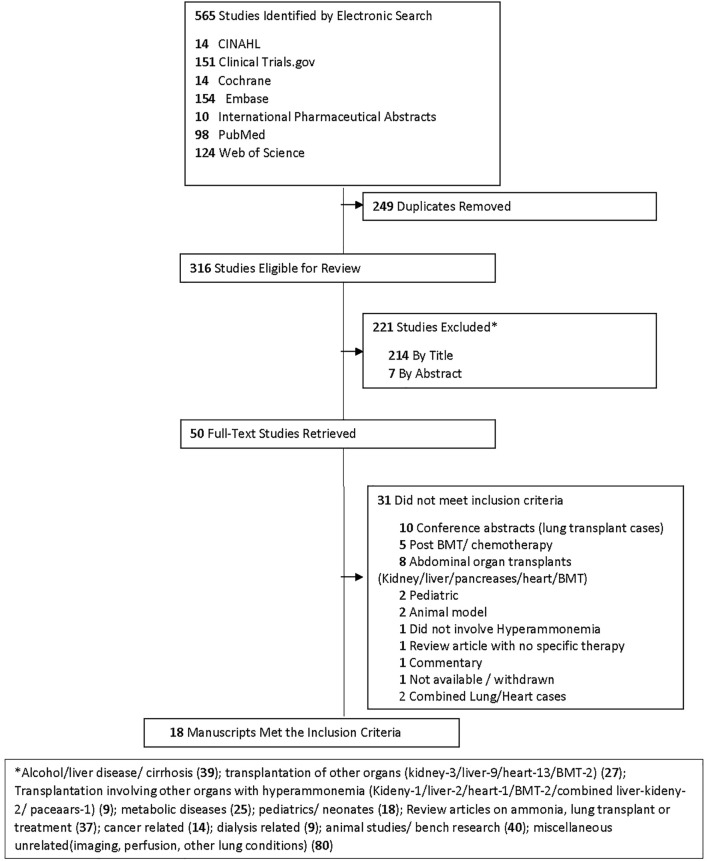
Hyperammonemia after lung transplantation (HALT) is a rare but serious complication with high mortality. This systematic review delineates possible etiologies of HALT and highlights successful strategies used to manage this fatal complication. Seven biomedical databases and grey literature sources were searched using keywords relevant to hyperammonemia and lung transplantation for publications between 1995 and 2020. Additionally, we retrospectively analyzed HALT cases managed at our institution between January 2016 and August 2018. The systematic review resulted in 18 studies with 40 individual cases. The mean peak ammonia level was 769 μmol/L at a mean of 14.1 days post-transplant. The mortality due to HALT was 57.5%. In our cohort of 120 lung transplants performed, four cases of HALT were identified. The mean peak ammonia level was 180.5 μmol/L at a mean of 11 days after transplantation. HALT in all four patients was successfully treated using a multimodal approach with an overall mortality of 25%. The incidence of HALT (3.3%) in our institution is comparable to prior reports. Nonetheless, ammonia levels in our cohort were not as high as previously reported and peaked earlier. We attributed these significant differences to early recognition and prompt institution of multimodal treatment approach.
肺移植后高氨血症(HALT)是一种罕见但严重的并发症,死亡率很高。本系统评价阐述了 HALT 的可能病因,并强调了成功用于治疗这种致命并发症的策略。
使用与高氨血症和肺移植相关的关键词,从 1995 年至 2020 年,在 7 个生物医学数据库和灰色文献来源中进行了检索。此外,我们回顾性分析了我们机构在 2016 年 1 月至 2018 年 8 月期间管理的 HALT 病例。
系统评价结果为 18 项研究,涉及 40 个单独的病例。移植后平均 14.1 天氨峰值水平为 769 μmol/L。HALT 死亡率为 57.5%。在我们进行的 120 例肺移植中,发现了 4 例 HALT。移植后平均 11 天氨峰值水平为 180.5 μmol/L。所有 4 例患者均采用多模式方法成功治疗 HALT,总死亡率为 25%。
我们机构的 HALT 发生率(3.3%)与先前的报告相当。尽管如此,我们队列中的氨水平并没有像之前报道的那么高,而且达到峰值的时间更早。我们将这些显著差异归因于早期识别和及时采用多模式治疗方法。