Zughaibi Torki A, Sheikh Ishfaq Ahmad, Beg Mohd Amin
Department of Medical Laboratory Sciences, Faculty of Applied Medical Sciences, King Abdulaziz University, Jeddah 21589, Saudi Arabia.
King Fahd Medical Research Center, King Abdulaziz University, Jeddah 21589, Saudi Arabia.
Toxics. 2022 May 19;10(5):263. doi: 10.3390/toxics10050263.
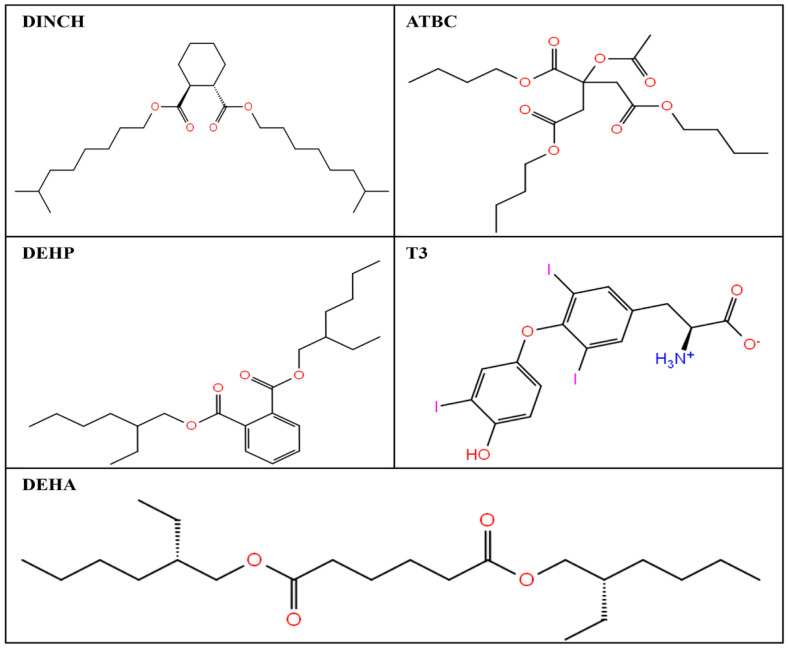
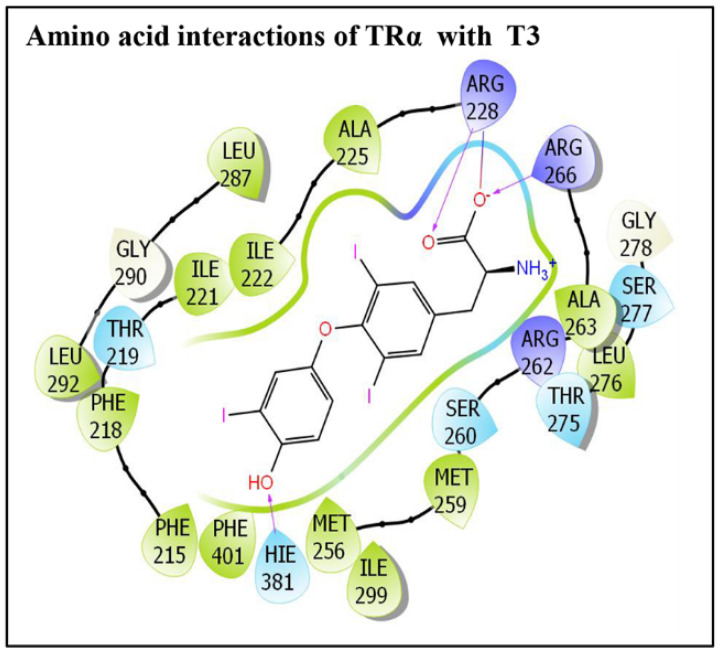
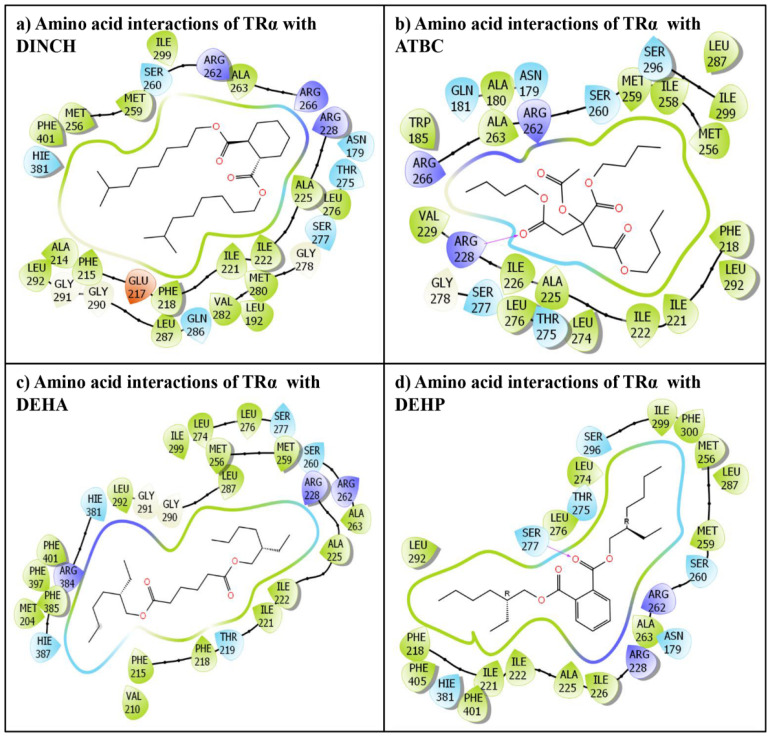
Many endocrine-disrupting chemicals (EDCs) have a ubiquitous presence in our environment due to anthropogenic activity. These EDCs can disrupt hormone signaling in the human and animal body systems including the very important hypothalamic-pituitary-thyroid (HPT) axis causing adverse health effects. Thyroxine (T4) and triiodothyronine (T3) are hormones of the HPT axis which are essential for regulation of metabolism, heart rate, body temperature, growth, development, etc. In this study, potential endocrine-disrupting activity of the most common phthalate plasticizer, DEHP, and emerging non-phthalate alternate plasticizers, DINCH, ATBC, and DEHA against thyroid hormone receptor (TRα) were characterized. The structural binding characterization of indicated ligands was performed against the TRα ligand binding site employing Schrodinger's induced fit docking (IFD) approach. The molecular simulations of interactions of the ligands against the residues lining a TRα binding pocket, including bonding interactions, binding energy, docking score, and IFD score were analyzed. In addition, the structural binding characterization of TRα native ligand, T3, was also done for comparative analysis. The results revealed that all ligands were placed stably in the TRα ligand-binding pocket. The binding energy values were highest for DINCH, followed by ATBC, and were higher than the values estimated for TRα native ligand, T3, whereas the values for DEHA and DEHP were similar and comparable to that of T3. This study suggested that all the indicated plasticizers have the potential for thyroid hormone disruption with two alternate plasticizers, DINCH and ATBC, exhibiting higher potential for thyroid dysfunction compared to DEHA and DEHP.
由于人为活动,许多内分泌干扰化学物质(EDC)在我们的环境中普遍存在。这些EDC会干扰人体和动物体系统中的激素信号,包括非常重要的下丘脑 - 垂体 - 甲状腺(HPT)轴,从而对健康产生不利影响。甲状腺素(T4)和三碘甲状腺原氨酸(T3)是HPT轴的激素,对调节新陈代谢、心率、体温、生长、发育等至关重要。在本研究中,表征了最常见的邻苯二甲酸酯类增塑剂DEHP以及新型非邻苯二甲酸酯类替代增塑剂DINCH、ATBC和DEHA对甲状腺激素受体(TRα)的潜在内分泌干扰活性。采用薛定谔诱导契合对接(IFD)方法,针对TRα配体结合位点对所示配体进行结构结合表征。分析了配体与TRα结合口袋内残基相互作用的分子模拟,包括键合相互作用、结合能、对接分数和IFD分数。此外,还对TRα天然配体T3进行了结构结合表征以作比较分析。结果表明,所有配体均稳定地位于TRα配体结合口袋中。DINCH的结合能值最高,其次是ATBC,且高于TRα天然配体T3的估计值,而DEHA和DEHP的值与T3相似且相当。本研究表明,所有所示增塑剂都有干扰甲状腺激素的潜力,其中两种替代增塑剂DINCH和ATBC与DEHA和DEHP相比,表现出更高的甲状腺功能障碍潜力。