Shindo Takayuki, Tanaka Megumu, Kamiyoshi Akiko, Ichikawa-Shindo Yuka, Kawate Hisaka, Sakurai Takayuki
Department of Cardiovascular Research, Shinshu University School of Medicine, Matsumoto 390-8621, Japan.
Department of Life Innovation, Institute for Biomedical Sciences, Interdisciplinary Cluster for Cutting Edge Research, Shinshu University, Matsumoto 390-8621, Japan.
Biology (Basel). 2022 May 21;11(5):788. doi: 10.3390/biology11050788.
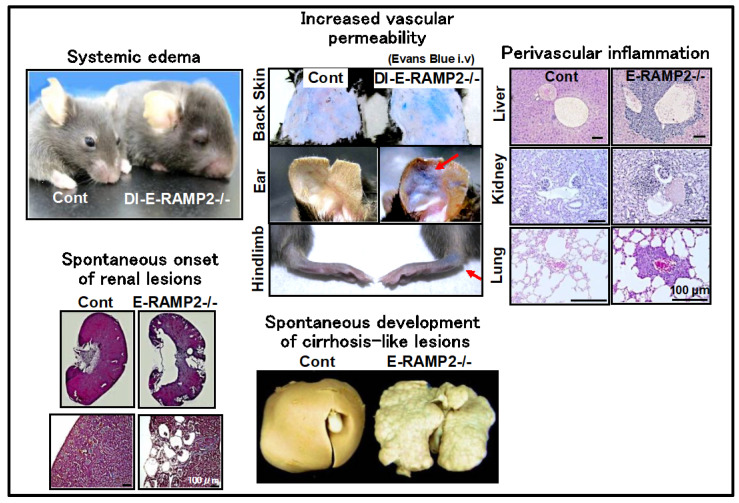
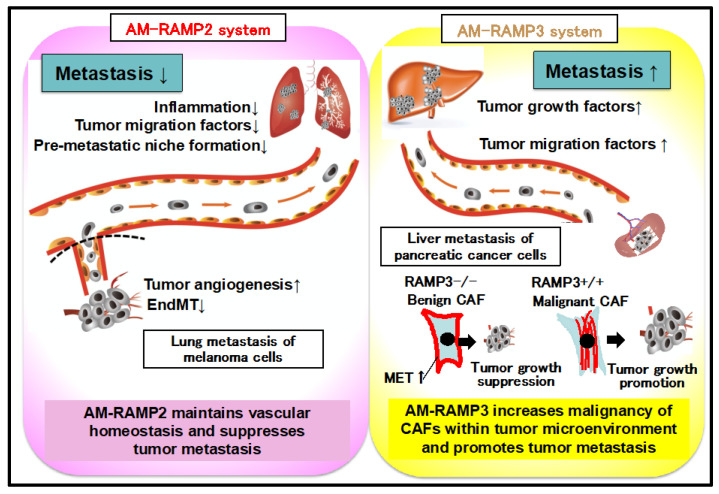
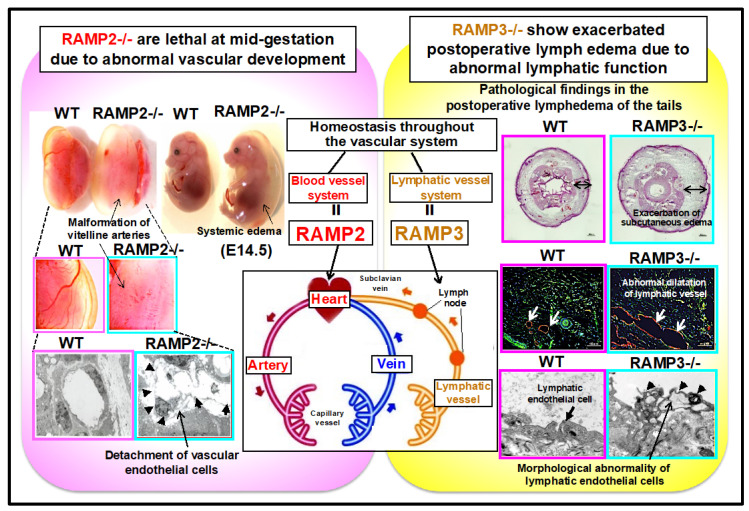
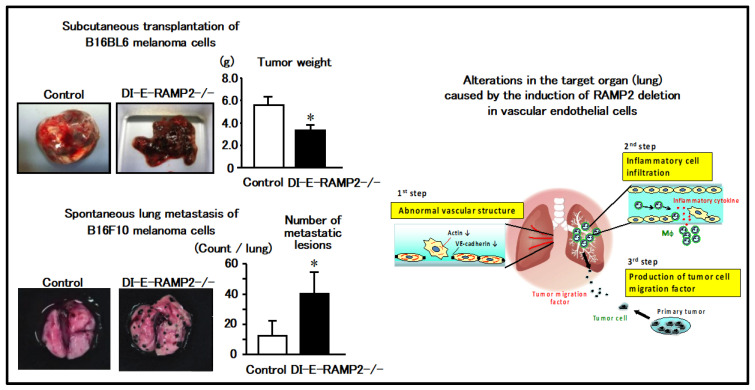
AM knockout (AM-/-) and RAMP2 knockout (RAMP2-/-) proved lethal for mice due to impaired embryonic vascular development. Although most vascular endothelial cell-specific RAMP2 knockout (E-RAMP2-/-) mice also died during the perinatal period, a few E-RAMP2-/- mice reached adulthood. Adult E-RAMP2-/- mice developed spontaneous organ damage associated with vascular injury. In contrast, adult RAMP3 knockout (RAMP3-/-) mice showed exacerbated postoperative lymphedema with abnormal lymphatic drainage. Thus, RAMP2 is essential for vascular development and homeostasis and RAMP3 is essential for lymphatic vessel function. Cardiac myocyte-specific RAMP2 knockout mice showed early onset of heart failure as well as abnormal mitochondrial morphology and function, whereas RAMP3-/- mice exhibited abnormal cardiac lymphatics and a delayed onset of heart failure. Thus, RAMP2 is essential for maintaining cardiac mitochondrial function, while RAMP3 is essential for cardiac lymphangiogenesis. Transplantation of cancer cells into drug-inducible vascular endothelial cell-specific RAMP2 knockout mice resulted in enhanced metastasis to distant organs, whereas metastasis was suppressed in RAMP3-/- mice. RAMP2 suppresses cancer metastasis by maintaining vascular homeostasis and inhibiting vascular inflammation and pre-metastatic niche formation, while RAMP3 promotes cancer metastasis via malignant transformation of cancer-associated fibroblasts. Focusing on the diverse physiological functions of AM and the functional differentiation of RAMP2 and RAMP3 may lead to the development of novel therapeutic strategies.
由于胚胎血管发育受损,AM基因敲除(AM-/-)和RAMP2基因敲除(RAMP2-/-)的小鼠被证明是致死的。尽管大多数血管内皮细胞特异性RAMP2基因敲除(E-RAMP2-/-)小鼠在围产期也死亡,但少数E-RAMP2-/-小鼠存活至成年。成年E-RAMP2-/-小鼠出现与血管损伤相关的自发性器官损伤。相比之下,成年RAMP3基因敲除(RAMP3-/-)小鼠术后淋巴水肿加剧,伴有异常的淋巴引流。因此,RAMP2对血管发育和稳态至关重要,而RAMP3对淋巴管功能至关重要。心肌细胞特异性RAMP2基因敲除小鼠表现出心力衰竭的早期发作以及线粒体形态和功能异常,而RAMP3-/-小鼠表现出心脏淋巴管异常和心力衰竭发作延迟。因此,RAMP2对维持心脏线粒体功能至关重要,而RAMP3对心脏淋巴管生成至关重要。将癌细胞移植到药物诱导的血管内皮细胞特异性RAMP2基因敲除小鼠中会导致远处器官转移增强,而在RAMP3-/-小鼠中转移受到抑制。RAMP2通过维持血管稳态、抑制血管炎症和转移前生态位形成来抑制癌症转移,而RAMP3通过癌症相关成纤维细胞的恶性转化促进癌症转移。关注AM的多种生理功能以及RAMP2和RAMP3的功能分化可能会导致新治疗策略的发展。