Dia Yacouba, Adadey Samuel Mawuli, Diop Jean Pascal Demba, Aboagye Elvis Twumasi, Ba Seydi Abdoul, De Kock Carmen, Ly Cheikh Ahmed Tidjane, Oluwale Oluwafemi Gabriel, Sène Andrea Regina Gnilane, Sarr Pierre Diaga, Diallo Bay Karim, Diallo Rokhaya Ndiaye, Wonkam Ambroise
Division of Human Genetics, Faculty of Medicine, Pharmacy and Odontology, University Cheikh Anta Diop (UCAD), Dakar 10700, Senegal.
Division of Human Genetics, Faculty of Health Sciences, University of Cape Town, Cape Town 7925, South Africa.
Biology (Basel). 2022 May 23;11(5):795. doi: 10.3390/biology11050795.
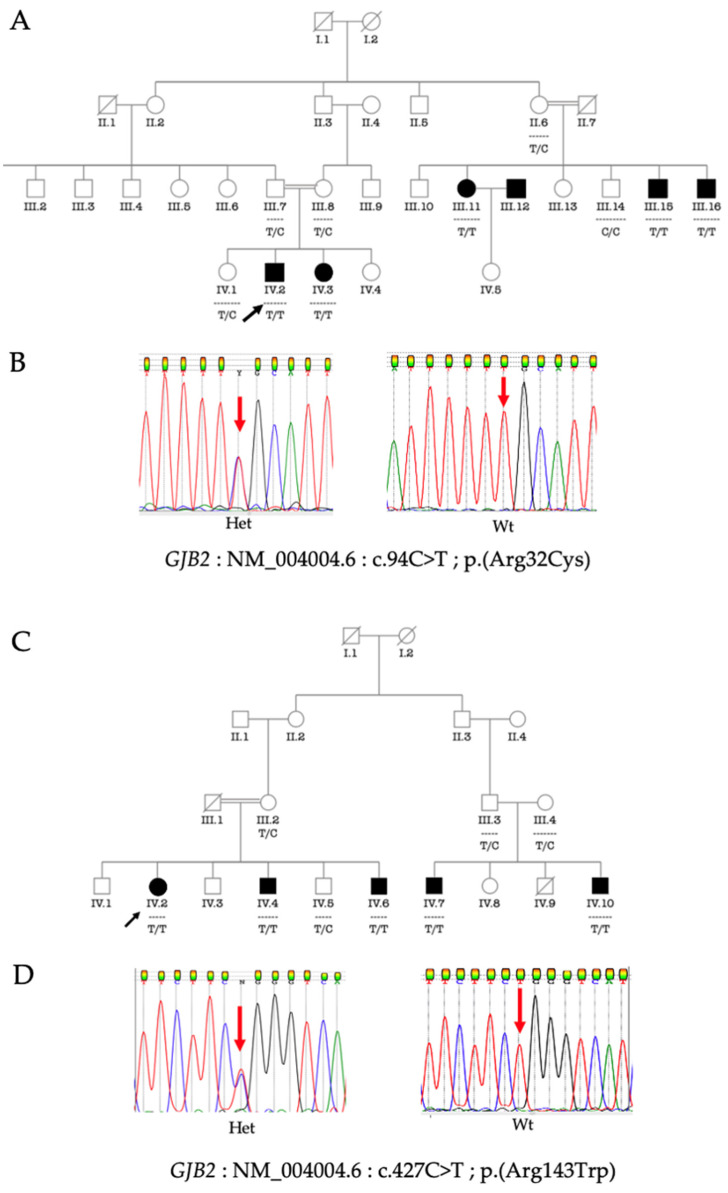
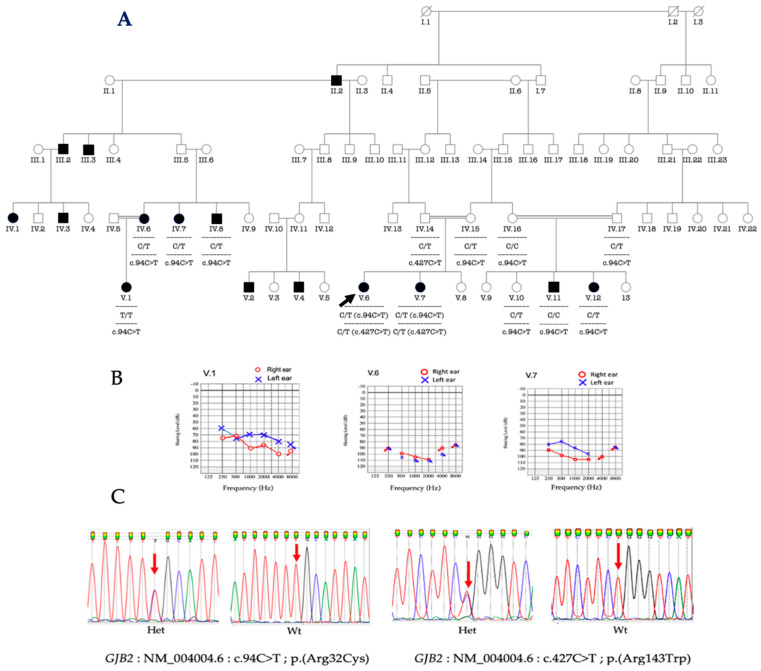
This study aimed to investigate GJB2 (MIM: 121011) and GJB6 (MIM: 604418) variants associated with familial non-syndromic hearing impairment (HI) in Senegal. We investigated a total of 129 affected and 143 unaffected individuals from 44 multiplex families by segregating autosomal recessive non-syndromic HI, 9 sporadic HI cases of putative genetic origin, and 148 control individuals without personal or family history of HI. The DNA samples were screened for GJB2 coding-region variants and GJB6-D3S1830 deletions. The mean age at the medical diagnosis of the affected individuals was 2.93 ± 2.53 years [range: 1−15 years]. Consanguinity was present in 40 out of 53 families (75.47%). Variants in GJB2 explained HI in 34.1% (n = 15/44) of multiplex families. A bi-allelic pathogenic variant, GJB2: c.94C>T: p.(Arg32Cys) accounted for 25% (n = 11/44 families) of familial cases, of which 80% (n = 12/15) were consanguineous. Interestingly, the previously reported “Ghanaian” founder variant, GJB2: c.427C>T: p.(Arg143Trp), accounted for 4.5% (n = 2/44 families) of the families investigated. Among the normal controls, the allele frequency of GJB2: c.94C>T and GJB2: c.427C>T was estimated at 1% (2/148 ∗ 2) and 2% (4/148 ∗ 2), respectively. No GJB6-D3S1830 deletion was identified in any of the HI patients. This is the first report of a genetic investigation of HI in Senegal, and suggests that GJB2: c.94C>T: p.(Arg32Cys) and GJB2: c.427C>T: p.(Arg143Trp) should be tested in clinical practice for congenital HI in Senegal.
本研究旨在调查与塞内加尔家族性非综合征性听力损失(HI)相关的GJB2(MIM:121011)和GJB6(MIM:604418)基因变异。我们通过分离常染色体隐性非综合征性HI,对来自44个复合家庭的129名受影响个体和143名未受影响个体、9例推测有遗传起源的散发性HI病例以及148名无个人或家族HI病史的对照个体进行了研究。对DNA样本进行了GJB2编码区变异和GJB6 - D3S1830缺失的筛查。受影响个体的医学诊断平均年龄为2.93±2.53岁[范围:1 - 15岁]。53个家庭中有40个(75.47%)存在近亲结婚情况。GJB2基因变异在34.1%(n = 15/44)的复合家庭中可解释HI。一种双等位基因致病性变异,GJB2:c.94C>T:p.(Arg32Cys)占家族性病例的25%(n = 11/44个家庭),其中80%(n = 12/15)为近亲结婚家庭。有趣的是,先前报道的“加纳人”始祖变异,GJB2:c.427C>T:p.(Arg143Trp),占所研究家庭的4.5%(n = 2/44个家庭)。在正常对照中,GJB2:c.94C>T和GJB2:c.427C>T的等位基因频率估计分别为1%((2/148)×2)和2%((4/148)×2)。在任何HI患者中均未发现GJB6 - D3S1830缺失。这是塞内加尔关于HI基因研究的首份报告,并表明在塞内加尔的先天性HI临床实践中应检测GJB2:c.94C>T:p.(Arg32Cys)和GJB2:c.427C>T:p.(Arg143Trp)。