Bednarikova Marketa, Hausnerova Jitka, Ehrlichova Lucie, Matulova Kvetoslava, Gazarkova Eliska, Minar Lubos, Weinberger Vit
Department of Internal Medicine, Hematology and Oncology, Masaryk University and University Hospital, 625 00 Brno, Czech Republic.
Department of Pathology, Masaryk University and University Hospital, 625 00 Brno, Czech Republic.
Cancers (Basel). 2022 May 10;14(10):2353. doi: 10.3390/cancers14102353.
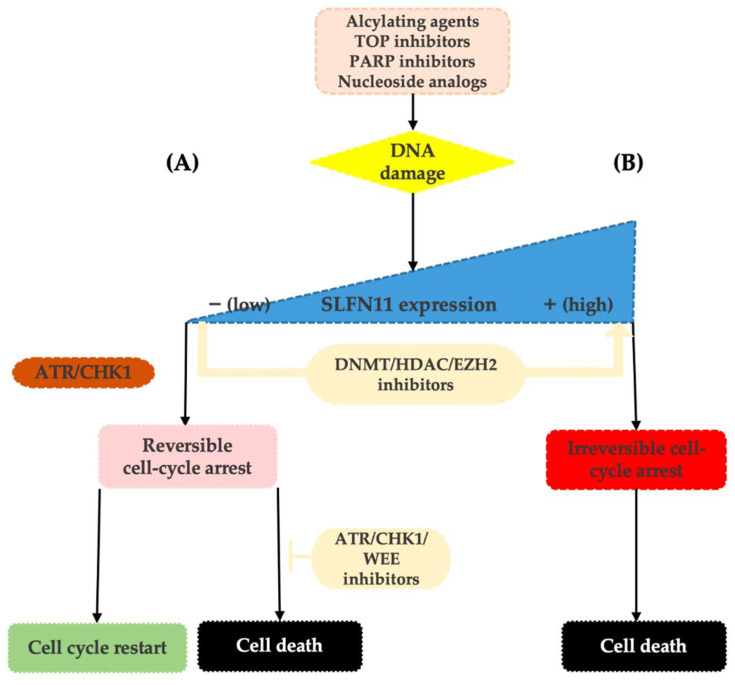
Platinum-based chemotherapy has been the cornerstone of systemic treatment in ovarian cancer. Since no validated molecular predictive markers have been identified yet, the response to platinum-based chemotherapy has been evaluated clinically, based on platinum-free interval. The new promising marker Schlafen 11 seems to correlate with sensitivity or resistance to DNA-damaging agents, including platinum compounds or PARP inhibitors in various types of cancer. We provide background information about the function of Schlafen 11, its evaluation in tumor tissue, and its prevalence in ovarian cancer. We discuss the current evidence of the correlation of Schlafen 11 expression in ovarian cancer with treatment outcomes and the potential use of Schlafen 11 as the key predictive and prognostic marker that could help to better stratify ovarian cancer patients treated with platinum-based chemotherapy or PARP inhibitors. We also provide perspectives on future directions in the research on this promising marker.
铂类化疗一直是卵巢癌全身治疗的基石。由于尚未确定经过验证的分子预测标志物,基于无铂间期,临床上对铂类化疗的反应进行了评估。新的有前景的标志物Schlafen 11似乎与各种类型癌症中对包括铂化合物或PARP抑制剂在内的DNA损伤剂的敏感性或耐药性相关。我们提供了关于Schlafen 11功能、其在肿瘤组织中的评估及其在卵巢癌中的患病率的背景信息。我们讨论了目前卵巢癌中Schlafen 11表达与治疗结果相关性的证据,以及Schlafen 11作为关键预测和预后标志物的潜在用途,这有助于更好地对接受铂类化疗或PARP抑制剂治疗的卵巢癌患者进行分层。我们还提供了关于这一有前景的标志物未来研究方向的观点。