Department of Genetics, Physiology and Microbiology, School of Biology, Complutense University, 28040 Madrid, Spain.
Fundación Jiménez Díaz University Hospital Health Research Institute, Fundación Jiménez Díaz University Hospital, 28040 Madrid, Spain.
Int J Mol Sci. 2022 May 22;23(10):5802. doi: 10.3390/ijms23105802.
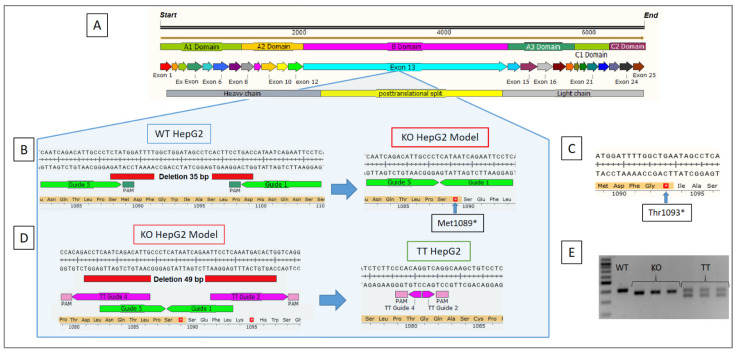
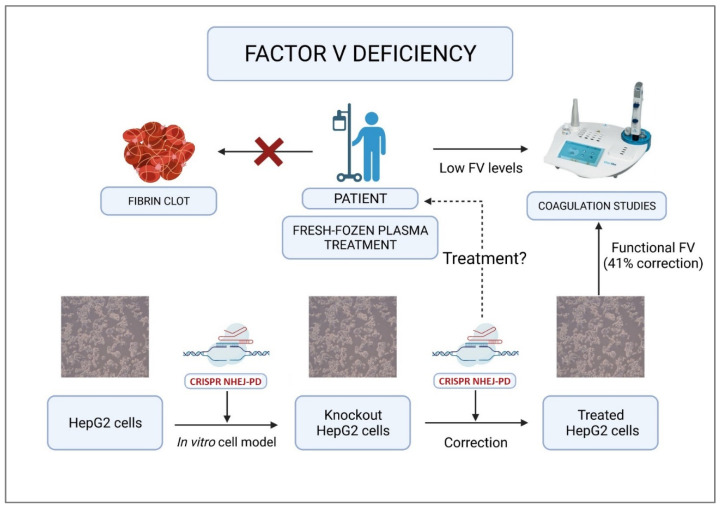
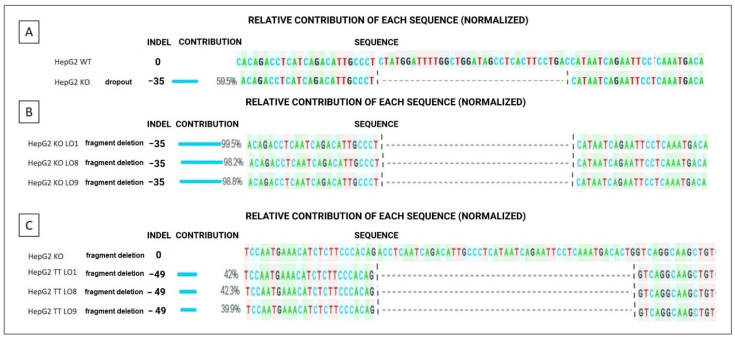
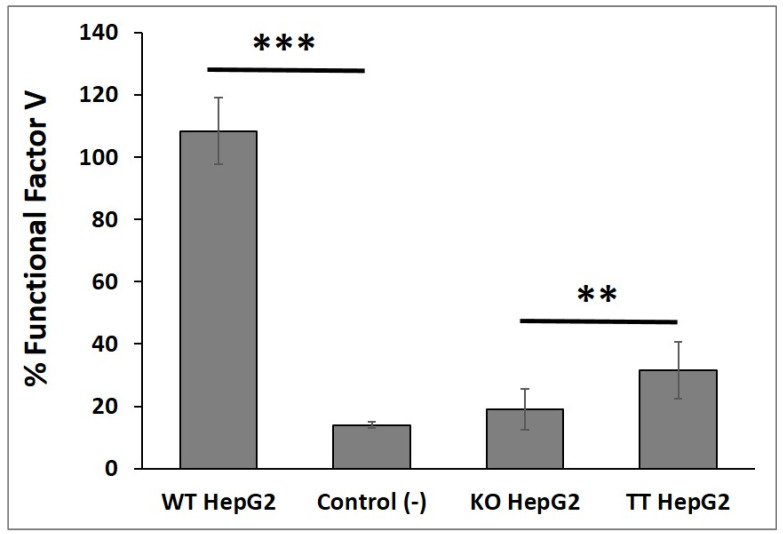
Factor V deficiency, an ultra-rare congenital coagulopathy, is characterized by bleeding episodes that may be more or less intense as a function of the levels of coagulation factor activity present in plasma. Fresh-frozen plasma, often used to treat patients with factor V deficiency, is a scarcely effective palliative therapy with no specificity to the disease. CRISPR/Cas9-mediated gene editing, following precise deletion by non-homologous end-joining, has proven to be highly effective for modeling on a HepG2 cell line a mutation similar to the one detected in the factor V-deficient patient analyzed in this study, thus simulating the pathological phenotype. Additional CRISPR/Cas9-driven non-homologous end-joining precision deletion steps allowed correction of 41% of the factor V gene mutated cells, giving rise to a newly developed functional protein. Taking into account the plasma concentrations corresponding to the different levels of severity of factor V deficiency, it may be argued that the correction achieved in this study could, in ideal conditions, be sufficient to turn a severe phenotype into a mild or asymptomatic one.
因子 V 缺乏症是一种超罕见的先天性凝血障碍,其特征是出血发作,其严重程度取决于血浆中凝血因子活性的水平。新鲜冷冻血浆常用于治疗因子 V 缺乏症患者,但作为一种缺乏特异性的姑息性治疗方法,其效果甚微。CRISPR/Cas9 介导的基因编辑,通过非同源末端连接进行精确缺失,已被证明在 HepG2 细胞系上对与本研究中分析的因子 V 缺乏症患者检测到的突变类似的突变进行建模非常有效,从而模拟了病理性表型。通过 CRISPR/Cas9 驱动的非同源末端连接精确缺失步骤,可纠正 41%的突变因子 V 基因细胞,产生一种新开发的功能性蛋白质。考虑到与因子 V 缺乏症严重程度不同相对应的血浆浓度,可认为本研究中实现的纠正程度,在理想条件下,足以将严重表型转变为轻度或无症状表型。