Laboratory for the Study of Neurohormonal Control of the Circulation, Department of Pharmaceutical Sciences, Nova Southeastern University College of Pharmacy, Fort Lauderdale, FL 33328-2018, USA.
Int J Mol Sci. 2022 May 22;23(10):5803. doi: 10.3390/ijms23105803.
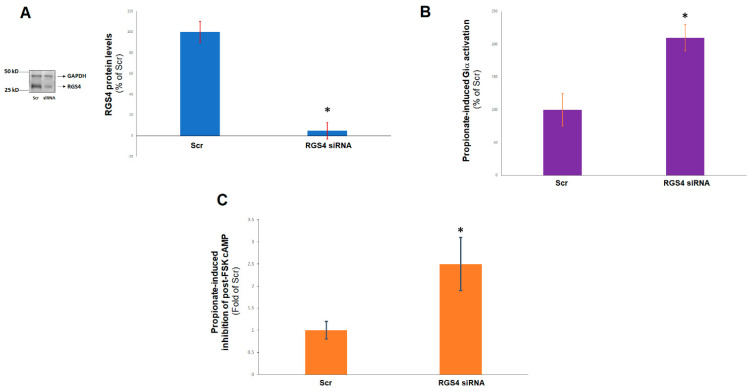
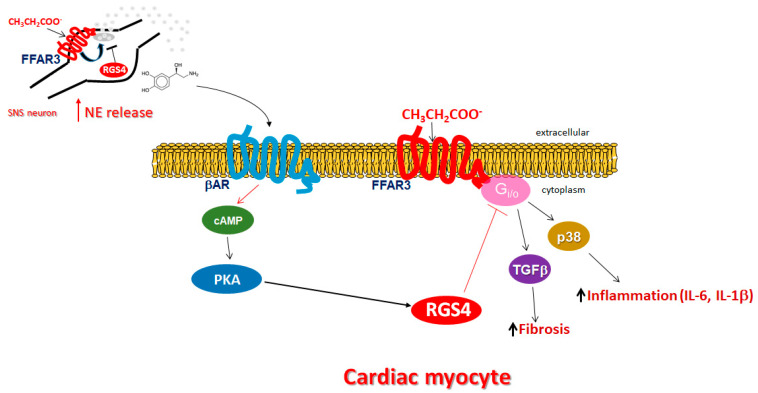
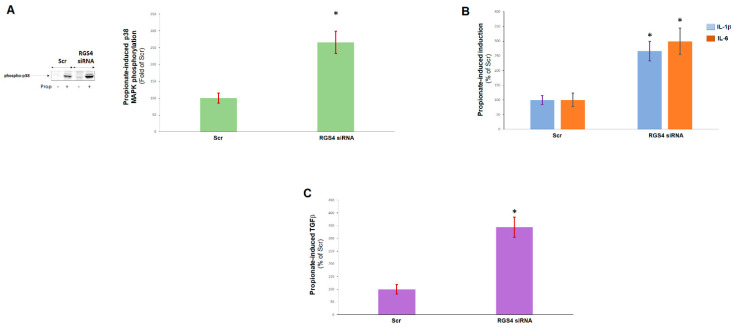
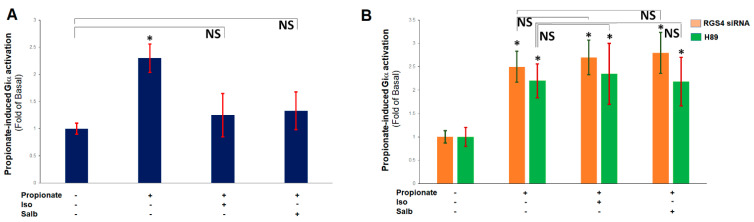
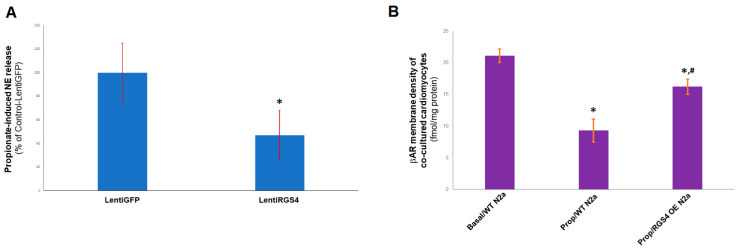
Propionic acid is a cell nutrient but also a stimulus for cellular signaling. Free fatty acid receptor (FFAR)-3, also known as GPR41, is a Gi/o protein-coupled receptor (GPCR) that mediates some of the propionate's actions in cells, such as inflammation, fibrosis, and increased firing/norepinephrine release from peripheral sympathetic neurons. The regulator of G-protein Signaling (RGS)-4 inactivates (terminates) both Gi/o- and Gq-protein signaling and, in the heart, protects against atrial fibrillation via calcium signaling attenuation. RGS4 activity is stimulated by β-adrenergic receptors (ARs) via protein kinase A (PKA)-dependent phosphorylation. Herein, we examined whether RGS4 modulates cardiac FFAR3 signaling/function. We report that RGS4 is essential for dampening of FFAR3 signaling in H9c2 cardiomyocytes, since siRNA-mediated RGS4 depletion significantly enhanced propionate-dependent cAMP lowering, Gi/o activation, p38 MAPK activation, pro-inflammatory interleukin (IL)-1β and IL-6 production, and pro-fibrotic transforming growth factor (TGF)-β synthesis. Additionally, catecholamine pretreatment blocked propionic acid/FFAR3 signaling via PKA-dependent activation of RGS4 in H9c2 cardiomyocytes. Finally, RGS4 opposes FFAR3-dependent norepinephrine release from sympathetic-like neurons (differentiated Neuro-2a cells) co-cultured with H9c2 cardiomyocytes, thereby preserving the functional βAR number of the cardiomyocytes. In conclusion, RGS4 appears essential for propionate/FFAR3 signaling attenuation in both cardiomyocytes and sympathetic neurons, leading to cardioprotection against inflammation/adverse remodeling and to sympatholysis, respectively.
丙酸是一种细胞营养素,但也是细胞信号传导的刺激物。游离脂肪酸受体 (FFAR)-3,也称为 GPR41,是一种 Gi/o 蛋白偶联受体 (GPCR),介导丙酸在细胞中的一些作用,如炎症、纤维化和外周交感神经元的放电/去甲肾上腺素释放增加。G 蛋白信号调节因子 (RGS)-4 使 Gi/o 和 Gq 蛋白信号失活(终止),并且在心脏中通过钙信号衰减来防止心房颤动。RGS4 活性通过蛋白激酶 A (PKA) 依赖性磷酸化被β-肾上腺素能受体 (AR) 刺激。在此,我们研究了 RGS4 是否调节心脏 FFAR3 信号/功能。我们报告说,RGS4 对于抑制 H9c2 心肌细胞中的 FFAR3 信号是必不可少的,因为 siRNA 介导的 RGS4 耗竭显着增强了丙酸盐依赖性 cAMP 降低、Gi/o 激活、p38 MAPK 激活、促炎白细胞介素 (IL)-1β 和 IL-6 产生以及促纤维化转化生长因子 (TGF)-β 合成。此外,儿茶酚胺预处理通过 PKA 依赖性 RGS4 激活阻断了 H9c2 心肌细胞中的丙酸/FFAR3 信号。最后,RGS4 反对交感样神经元(分化的 Neuro-2a 细胞)与 H9c2 心肌细胞共培养时 FFAR3 依赖性去甲肾上腺素释放,从而保持心肌细胞的功能性βAR 数量。总之,RGS4 似乎对于心肌细胞和交感神经元中的丙酸盐/FFAR3 信号衰减是必不可少的,从而分别导致对炎症/不良重塑的心脏保护和交感神经松弛。