VETERM, Equine Surgery Unit, Department for Companion Animals and Horses, Vetmeduni, 1210 Vienna, Austria.
Austrian Cluster for Tissue Regeneration, 1200 Vienna, Austria.
Int J Mol Sci. 2022 May 23;23(10):5858. doi: 10.3390/ijms23105858.
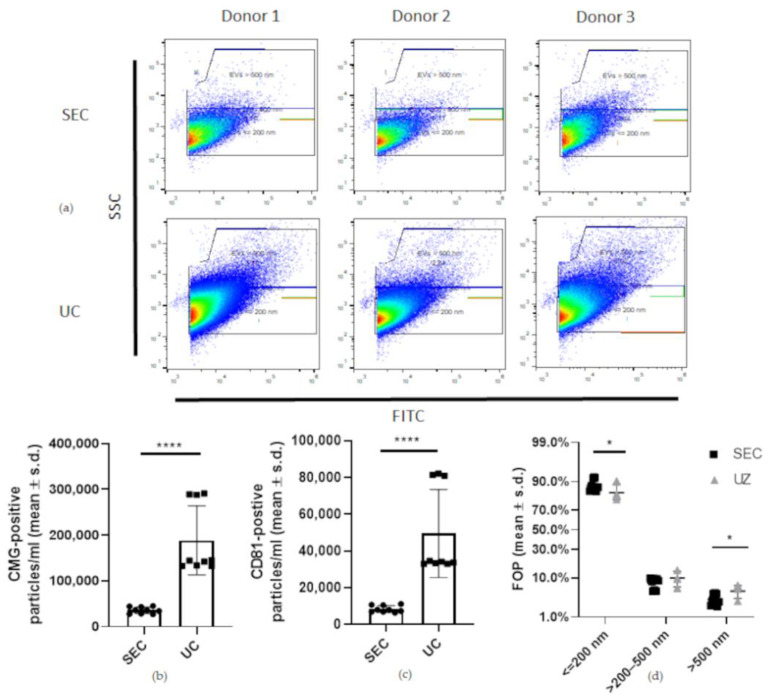
Extracellular vesicles (EVs) are nanosized lipid bilayer-encapsulated particles secreted by virtually all cell types. EVs play an essential role in cellular crosstalk in health and disease. The cellular origin of EVs determines their composition and potential therapeutic effect. Mesenchymal stem/stromal cell (MSC)-derived EVs have shown a comparable therapeutic potential to their donor cells, making them a promising tool for regenerative medicine. The therapeutic application of EVs circumvents some safety concerns associated with the transplantation of viable, replicating cells and facilitates the quality-controlled production as a ready-to-go, off-the-shelf biological therapy. Recently, the International Society for Extracellular Vesicles (ISEV) suggested a set of minimal biochemical, biophysical and functional standards to define extracellular vesicles and their functions to improve standardisation in EV research. However, nonstandardised EV isolation methods and the limited availability of cross-reacting markers for most animal species restrict the application of these standards in the veterinary field and, therefore, the species comparability and standardisation of animal experiments. In this study, EVs were isolated from equine bone-marrow-derived MSCs using two different isolation methods, stepwise ultracentrifugation and size exclusion chromatography, and minimal experimental requirements for equine EVs were established and validated. Equine EVs were characterised using a nanotracking analysis, fluorescence-triggered flow cytometry, Western blot and transelectron microscopy. Based on the ISEV standards, minimal criteria for defining equine EVs are suggested as a baseline to allow the comparison of EV preparations obtained by different laboratories.
细胞外囊泡 (EVs) 是由几乎所有细胞类型分泌的纳米级脂质双层包裹的颗粒。EVs 在健康和疾病中的细胞通讯中发挥着重要作用。EVs 的细胞起源决定了它们的组成和潜在的治疗效果。间充质干细胞 (MSC) 衍生的 EVs 显示出与供体细胞相当的治疗潜力,使它们成为再生医学的有前途的工具。EVs 的治疗应用回避了与活细胞和复制细胞移植相关的一些安全问题,并促进了作为即用型现成生物治疗的质量控制生产。最近,国际细胞外囊泡学会 (ISEV) 提出了一套最小生化、生物物理和功能标准,以定义细胞外囊泡及其功能,从而提高 EV 研究的标准化。然而,非标准化的 EV 分离方法和大多数动物物种缺乏交叉反应标记物限制了这些标准在兽医领域的应用,因此限制了动物实验的物种可比性和标准化。在这项研究中,使用两种不同的分离方法,逐步超速离心和大小排阻色谱法,从马骨髓来源的 MSC 中分离 EVs,并建立和验证了最小的马 EV 实验要求。使用纳米跟踪分析、荧光触发流式细胞术、Western blot 和转电子显微镜对马 EVs 进行了表征。根据 ISEV 标准,建议定义马 EVs 的最小标准作为基线,以允许比较不同实验室获得的 EV 制剂。