McInerney Angela, Marroquin-Donday Luis, Tirado-Conte Gabriela, Hennessey Breda, Espejo Carolina, Pozo Eduardo, de Agustín Alberto, Gonzalo Nieves, Salinas Pablo, Núñez-Gil Iván, Fernández-Ortiz Antonio, Mejía-Rentería Hernan, Macaya Fernando, Escaned Javier, Nombela-Franco Luis, Jiménez-Quevedo Pilar
Unit of Interventional Cardiology, Department of Cardiology, Cardiovascular Institute, Hospital Clínico San Carlos, Instituto de Investigación Sanitaria del Hospital Clínico San Carlos (IdISSC), Calle del Prof Martín Lagos, s/n, 28084 Madrid, Spain.
J Clin Med. 2022 May 22;11(10):2921. doi: 10.3390/jcm11102921.
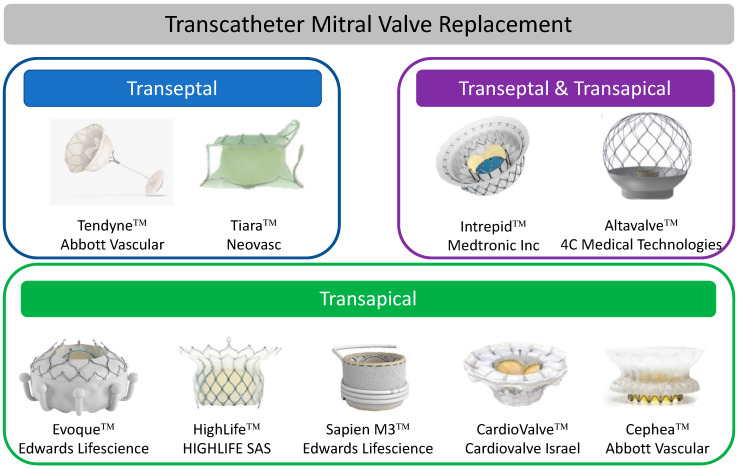
Mitral valve disease, and in particular mitral regurgitation, is a common clinical entity. Until recently, surgical repair and replacement were the only therapeutic options available, leaving many patients untreated mostly due to excessive surgical risk. Over the last number of years, huge strides have been made regarding percutaneous, catheter-based solutions for mitral valve disease. Transcatheter repair procedures have most commonly been used, and in recent years there has been exponential growth in the number of devices available for transcatheter mitral valve replacement. Furthermore, the evolution of these devices has resulted in both smaller delivery systems and a shift towards transeptal access, negating the need for surgical incisions. In line with these advancements, and clinical trials demonstrating promising outcomes in carefully selected cases, recent guidelines have strengthened their recommendations for these devices. It is appropriate, therefore, to now review the current transcatheter repair and replacement devices available and the evidence for their use.
二尖瓣疾病,尤其是二尖瓣反流,是一种常见的临床病症。直到最近,外科修复和置换仍是仅有的治疗选择,许多患者因手术风险过高而未得到治疗。在过去几年里,针对二尖瓣疾病的经皮导管介入治疗取得了巨大进展。经导管修复手术最为常用,近年来可用于经导管二尖瓣置换的器械数量呈指数级增长。此外,这些器械的发展使得输送系统更小,并转向经房间隔入路,无需手术切口。随着这些进展以及临床试验在精心挑选的病例中显示出有前景的结果,近期的指南加强了对这些器械的推荐。因此,现在回顾一下目前可用的经导管修复和置换器械及其使用证据是恰当的。