Cavaco Maria João, Alcobia Celeste, Oliveiros Bárbara, Mesquita Luís Alcides, Carvalho Aurora, Matos Fernando, Carvalho José Miguel, Villar Miguel, Duarte Raquel, Mendes João, Ribeiro Carolina, Cordeiro Carlos Robalo, Regateiro Fernando, Silva Henriqueta Coimbra
Oeste Hospital Center, 2560-295 Lisboa, Portugal.
Department of Pneumology, Coimbra Hospital and Universitary Centre, 3004-561 Coimbra, Portugal.
J Pers Med. 2022 May 13;12(5):790. doi: 10.3390/jpm12050790.
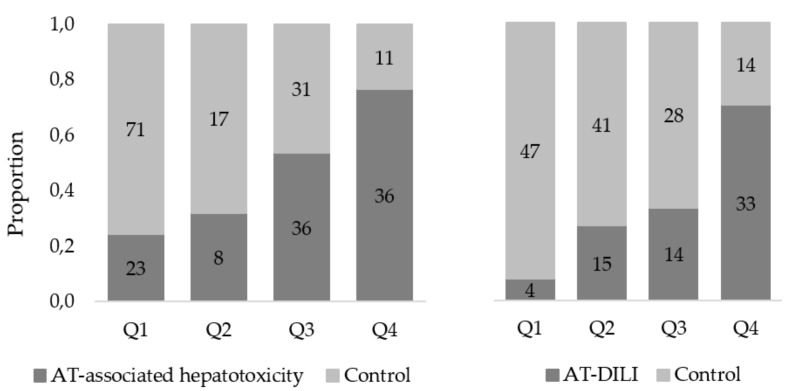
Drug-induced liver injury (DILI) is an unpredictable and feared side effect of antituberculosis treatment (AT). The present study aimed to identify clinical and genetic variables associated with susceptibility to AT-associated hepatotoxicity in patients with pulmonary tuberculosis treated with a standard protocol. Of 233 patients enrolled, 90% prospectively, 103 developed liver injury: 37 with mild and 66 with severe phenotype (DILI). All patients with mild hepatitis had a RUCAM score ≥4 and all patients with DILI had a RUCAM score ≥ 6. Eight clinical variables and variants in six candidate genes were assessed. A logistic multivariate regression analysis identified four risk factors for AT-DILI: age ≥ 55 years (OR:3.67; 95% CI:1.82−7.41; p < 0.001), concomitant medication with other hepatotoxic drugs (OR:2.54; 95% CI:1.23−5.26; p = 0.012), NAT2 slow acetylator status (OR:2.46; 95% CI:1.25−4.84; p = 0.009), and carriers of p.Val444Ala variant for ABCB11 gene (OR:2.06; 95%CI:1.02−4.17; p = 0.044). The statistical model explains 24.9% of the susceptibility to AT-DILI, with an 8.9 times difference between patients in the highest and in the lowest quartiles of risk scores. This study sustains the complex architecture of AT-DILI. Prospective studies should evaluate the benefit of NAT2 and ABCB11 genotyping in AT personalization, particularly in patients over 55 years.
药物性肝损伤(DILI)是抗结核治疗(AT)一种不可预测且令人担忧的副作用。本研究旨在确定在接受标准方案治疗的肺结核患者中,与AT相关肝毒性易感性相关的临床和基因变量。在纳入的233例患者中,90%为前瞻性研究对象,103例发生肝损伤:37例为轻度表型,66例为重度表型(DILI)。所有轻度肝炎患者的RUCAM评分≥4,所有DILI患者的RUCAM评分≥6。评估了八个临床变量和六个候选基因中的变异。多因素逻辑回归分析确定了AT-DILI的四个危险因素:年龄≥55岁(比值比:3.67;95%置信区间:1.82−7.41;p<0.001)、同时使用其他肝毒性药物(比值比:2.54;95%置信区间:1.23−5.26;p = 0.012)、NAT2慢乙酰化状态(比值比:2.46;95%置信区间:1.25−4.84;p = 0.009)以及ABCB11基因p.Val444Ala变异携带者(比值比:2.06;95%置信区间:1.02−4.17;p = 0.044)。该统计模型解释了AT-DILI易感性的24.9%,风险评分最高四分位数与最低四分位数患者之间相差8.9倍。本研究支持AT-DILI的复杂结构。前瞻性研究应评估NAT2和ABCB11基因分型在AT个体化中的益处,尤其是在55岁以上的患者中。