
一种负载于多孔陶瓷膜上的甲基改性二氧化硅层,用于增强从水溶液中分离甲基叔丁基醚
A Methyl-Modified Silica Layer Supported on Porous Ceramic Membranes for the Enhanced Separation of Methyl Tert-Butyl Ether from Aqueous Solution.
作者信息
Xu Ligang, Wang Yali, Li Qunyan, Cui Suping, Tang Mingxue, Nie Zuoren, Wei Qi
机构信息
Faculty of Materials and Manufacturing, Beijing University of Technology, 100 Pingleyuan, Chaoyang District, Beijing 100124, China.
Center for High Pressure Science and Technology Advanced Research, Beijing 100094, China.
出版信息
Membranes (Basel). 2022 Apr 22;12(5):452. doi: 10.3390/membranes12050452.
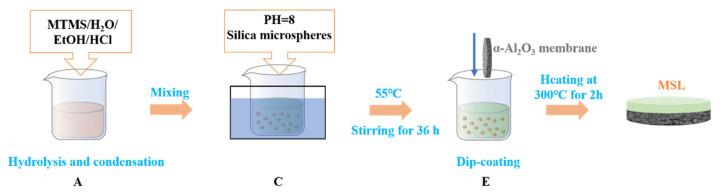
As a kind of volatile organic compound (VOC), methyl tert-butyl ether (MTBE) is hazardous to human health and destructive to the environment if not handled properly. MTBE should be removed before the release of wastewater. The present work supported the methyl-modified silica layer (MSL) on porous α-AlO ceramic membranes with methyltrimethoxysilane (MTMS) as a precursor and pre-synthesized mesoporous silica microspheres as dopants by the sol-gel reaction and dip-coating method. MTMS is an environmentally friendly agent compared to fluorinated alkylsilane. The MSL-supported AlO ceramic membranes were used for MTBE/water separation by pervaporation. The NMR spectra revealed that MTMS evolves gradually from an oligomer to a highly cross-linked methyl-modified silica species. Methyl-modified silica species and pre-synthesized mesoporous silica microspheres combine into hydrophobic mesoporous MSL. MSL makes the α-AlO ceramic membranes transfer from amphiphilic to hydrophobic and oleophilic. The MSL-supported α-AlO ceramic membranes (MSL-10) exhibit an MTBE/water separation factor of 27.1 and a total flux of 0.448 kg m h, which are considerably higher than those of previously reported membranes that are modified by other alkylsilanes via the post-grafting method. The mesopores within the MSL provide a pathway for the transport of MTBE molecules across the membranes. The presence of methyl groups on the external and inner surface is responsible for the favorable separation performance and the outstanding long-term stability of the MSL-supported porous α-AlO ceramic membranes.
作为一种挥发性有机化合物(VOC),甲基叔丁基醚(MTBE)如果处理不当,会对人体健康有害并对环境造成破坏。在废水排放前应去除MTBE。本工作以甲基三甲氧基硅烷(MTMS)为前驱体,以预合成的介孔二氧化硅微球为掺杂剂,通过溶胶-凝胶反应和浸涂法在多孔α-AlO陶瓷膜上负载甲基改性二氧化硅层(MSL)。与氟代烷基硅烷相比,MTMS是一种环境友好型试剂。负载MSL的AlO陶瓷膜用于通过渗透汽化进行MTBE/水分离。核磁共振光谱表明,MTMS逐渐从低聚物演变为高度交联的甲基改性二氧化硅物种。甲基改性二氧化硅物种与预合成的介孔二氧化硅微球结合形成疏水中孔MSL。MSL使α-AlO陶瓷膜从两亲性转变为疏水性和亲油性。负载MSL的α-AlO陶瓷膜(MSL-10)的MTBE/水分离因子为27.1,总通量为0.448 kg m h,这比先前报道的通过后接枝法用其他烷基硅烷改性的膜要高得多。MSL内的介孔为MTBE分子跨膜传输提供了一条途径。外表面和内表面上甲基的存在是负载MSL的多孔α-AlO陶瓷膜具有良好分离性能和出色长期稳定性的原因。



 Zotero 插件