
中国疫苗干预下 H9N2 禽流感病毒血凝素基因变异率。
Hemagglutinin Gene Variation Rate of H9N2 Avian Influenza Virus by Vaccine Intervention in China.
机构信息
State Key Laboratory for Conservation and Utilization of Subtropical Agro-Bioresources & Laboratory of Animal Infectious Diseases, College of Animal Sciences and Veterinary Medicine, Guangxi University, Nanning 530004, China.
Computational Virology Group, Center for Bacteria and Viruses Resources and Bioinformation, Wuhan Institute of Virology, Chinese Academy of Sciences, Wuhan 430071, China.
出版信息
Viruses. 2022 May 13;14(5):1043. doi: 10.3390/v14051043.
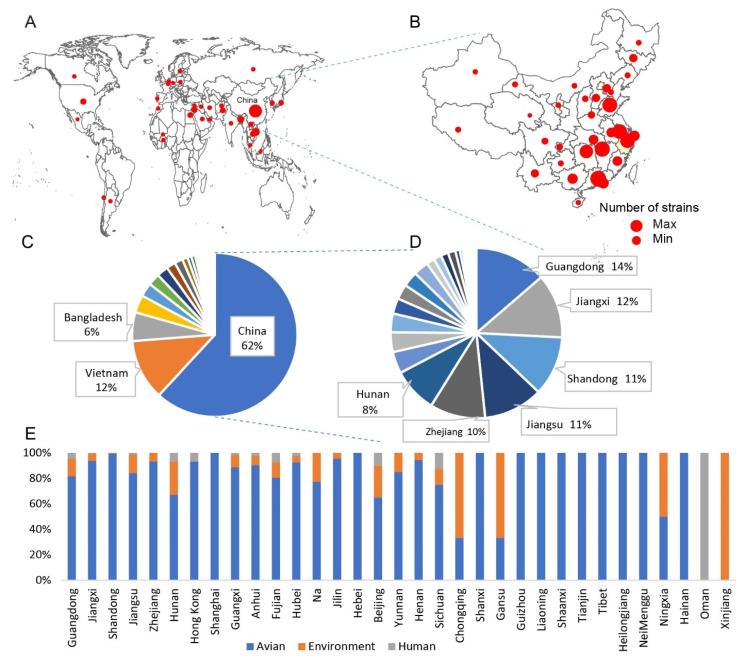
H9N2 subtype avian influenza virus (AIV) is widespread globally, with China being the main epidemic center. Inactivated virus vaccination was adopted as the main prevention method in China. In this study, 22 hemagglutinin () sequences were obtained from all inactivated vaccine strains of H9N2 subtype AIVs in China since its introduction. A phylogenetic analysis of the vaccine sequences and sequences of all published H9N2 subtype AIVs was conducted to investigate the relationship between vaccine use and the virus genetic diversity of the virus. We found that during 2002-2006, when fewer vaccines were used, annual genetic differences between the sequences were mainly distributed between 0.025 and 0.075 and were mainly caused by point mutations. From 2009 to 2013, more vaccines were used, and the genetic distance between sequences was about 10 times greater than between 2002 and 2006, especially in 2013. In addition to the accumulation of point mutations, insertion mutations may be the main reason for the large genetic differences between sequences from 2009 to 2013. These findings suggest that the use of inactivated vaccines affected point mutations in the sequences and that the contribution of high-frequency replacement vaccine strains to the rate of virus evolution is greater than that of low-frequency replacement vaccine strains. The selection pressure of the vaccine antibody plays a certain role in regulating the variation of sequences in H9N2 subtype AIV.
H9N2 亚型禽流感病毒(AIV)在全球广泛流行,中国是主要的流行中心。中国采用灭活病毒疫苗作为主要的预防方法。本研究从中国引进的所有 H9N2 亚型 AIV 灭活疫苗株中获得了 22 个血凝素()序列。对疫苗序列和所有已发表的 H9N2 亚型 AIV 的序列进行了系统进化分析,以研究疫苗使用与病毒遗传多样性之间的关系。我们发现,在 2002-2006 年期间,当使用的疫苗较少时,每年的序列之间的遗传差异主要分布在 0.025 和 0.075 之间,主要是由点突变引起的。从 2009 年到 2013 年,使用的疫苗更多,序列之间的遗传距离大约是 2002-2006 年的 10 倍,尤其是 2013 年。除了点突变的积累外,插入突变可能是 2009 年至 2013 年序列之间遗传差异较大的主要原因。这些发现表明,灭活疫苗的使用影响了序列中的点突变,高频替代疫苗株对病毒进化率的贡献大于低频替代疫苗株。疫苗抗体的选择压力在调节 H9N2 亚型 AIV 序列的变异方面起着一定的作用。



 Zotero 插件