Department of Medical Imaging, The First Affiliated Hospital of Kunming Medical University, Kunming, China.
Department of Radiology, Beijing Jishuitan Hospital, Beijing, China.
Front Endocrinol (Lausanne). 2022 May 13;13:891088. doi: 10.3389/fendo.2022.891088. eCollection 2022.
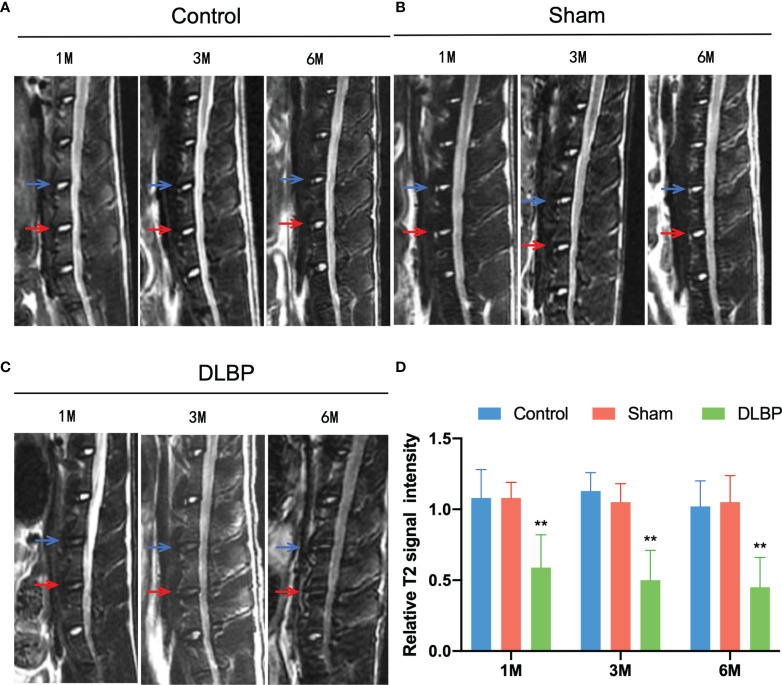
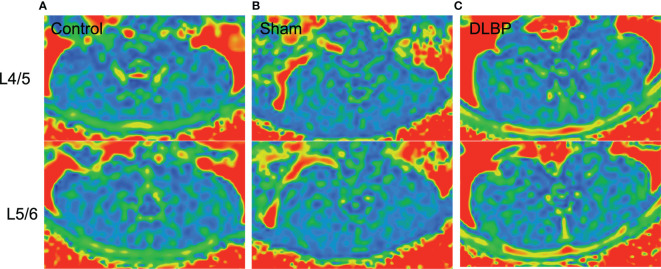
Accompanied with intervertebral disc (IVD) degeneration, increasing fat infiltration of paraspinal muscles may be related to discogenic low back pain (DLBP), but their relationship is still unclear and the classical animal models are not completely applicable. The purpose of this study was to assess the paraspinal muscle fat infiltration in patients with DLBP by quantitative MRI, and to develop a novel DLBP rat model to explore the potential relationship between DLBP paraspinal muscle fat infiltration and TNF-α levels. We measured the proton density fat fraction (PDFF) of the multifidus and erector spinae muscles of 70 DLBP patients and 36 healthy volunteers by using quantitative MRI IDEAL-IQ. In addition, we developed a DLBP experimental rat model by puncturing the L4/5 and L5/6 IVDs under the guidance of X-ray fluoroscopy. Then various behavioral experiments, MRI and pathological examination of IVDs were used to evaluate the performance of the DLBP animal model. The gait analysis, hot plate test, acetone test, grasping test and tail suspension test were used to evaluate the pain and muscle dysfunction in rats. Through quantitative MRI and histological examination, the degeneration of IVDs and fat infiltration in the muscles were observed and ex vivo. Enzyme linked immunosorbent assay detects the level of TNF-α in rat IVDs and paraspinal muscles. In the human study, compared with healthy volunteers, the PDFF of multifidus and erector muscles of DLBP patients increased significantly at L4/5 and L5/S1 levels (p<0.05). In the rat experiment, compared with control group and sham group, DLBP group had reduced gait score, shortened response time to cold and heat stimuli, prolonged bending time, and shortened struggling time. Rat lumbar MRI T2WI showed that the signal intensity of L4/5 and L5/6 IVDs were progressively decreased. Histological examination revealed that IVDs had increased collagen fibers, reduced nucleus pulposus, thickened annulus fibrosus, and distorted shape. The PDFF of multifidus muscle at L4/5 and L5/6 level in the DLBP group were more than that in other groups (p<0.05), and HE staining and oil red O staining of paraspinal muscles showed that the muscle bundle space of the DLBP group muscles increased, and the muscle tissues Increased lipid droplets. Finally, the expression of TNF-α in IVDs and paraspinal muscles in the DLBP group were significantly higher than that in the control group (p<0.05). It is reliable and feasible to establish a DLBP rat model by puncturing the lumbar IVDs under the guidance of X-ray fluoroscopy. The degeneration of lumbar IVDs with DLBP leads to the occurrence of fat infiltration of paraspinal muscles, which is related to the expression of TNF-α.
伴随着椎间盘(IVD)退变,脊柱旁肌肉的脂肪浸润增加可能与椎间盘源性下腰痛(DLBP)有关,但两者之间的关系尚不清楚,经典的动物模型并不完全适用。本研究旨在通过定量 MRI 评估 DLBP 患者的脊柱旁肌肉脂肪浸润,并建立一种新的 DLBP 大鼠模型,以探讨 DLBP 脊柱旁肌肉脂肪浸润与 TNF-α水平之间的潜在关系。我们使用定量 MRI IDEAL-IQ 测量了 70 例 DLBP 患者和 36 名健康志愿者的多裂肌和竖脊肌的质子密度脂肪分数(PDFF)。此外,我们在 X 射线透视引导下通过穿刺 L4/5 和 L5/6 IVD 建立了 DLBP 实验性大鼠模型。然后,通过各种行为实验、IVD 的 MRI 和病理学检查来评估 DLBP 动物模型的性能。步态分析、热板试验、丙酮试验、抓握试验和悬尾试验用于评估大鼠的疼痛和肌肉功能障碍。通过定量 MRI 和组织学检查,观察并体外观察 IVD 退变和肌肉脂肪浸润。酶联免疫吸附试验检测大鼠 IVD 和脊柱旁肌肉中 TNF-α的水平。在人体研究中,与健康志愿者相比,DLBP 患者的 L4/5 和 L5/S1 水平的多裂肌和竖脊肌的 PDFF 显著增加(p<0.05)。在大鼠实验中,与对照组和假手术组相比,DLBP 组的步态评分降低,对冷热刺激的反应时间缩短,弯曲时间延长,挣扎时间缩短。大鼠腰椎 MRI T2WI 显示 L4/5 和 L5/6 IVD 的信号强度逐渐降低。组织学检查显示 IVD 胶原纤维增加,髓核减少,纤维环增厚,形状扭曲。DLBP 组 L4/5 和 L5/6 水平的多裂肌 PDFF 高于其他组(p<0.05),脊柱旁肌肉的 HE 染色和油红 O 染色显示 DLBP 组肌肉束间距增大,肌肉组织中增加了脂质滴。最后,DLBP 组 IVD 和脊柱旁肌肉中 TNF-α的表达明显高于对照组(p<0.05)。在 X 射线透视引导下穿刺腰椎 IVD 建立 DLBP 大鼠模型是可靠和可行的。DLBP 引起的腰椎 IVD 退变导致脊柱旁肌肉脂肪浸润,这与 TNF-α的表达有关。