School of Biological Sciences, The University of Queensland, St. Lucia, Brisbane, QLD 4072, Australia.
Department of International Health and Medical Anthropology, Institute of Tropical Medicine, Nagasaki University, Nagasaki 852-8523, Japan.
Philos Trans R Soc Lond B Biol Sci. 2022 Jul 18;377(1855):20200504. doi: 10.1098/rstb.2020.0504. Epub 2022 May 30.
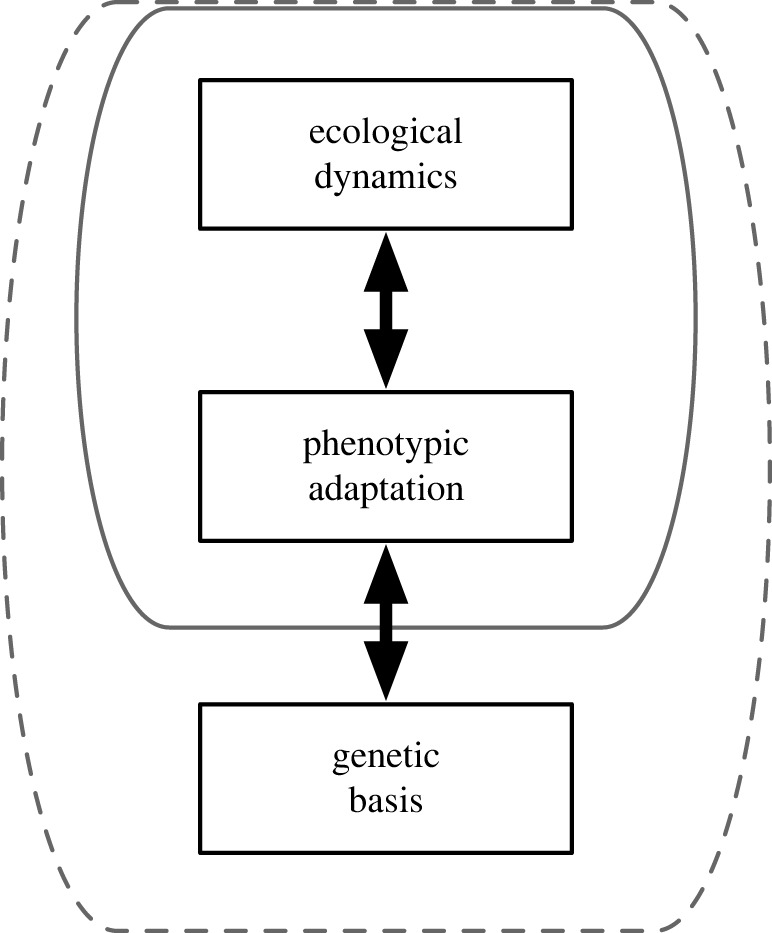
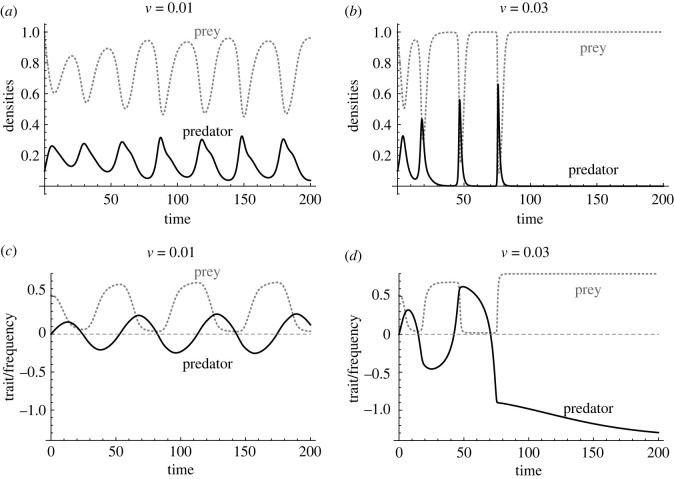
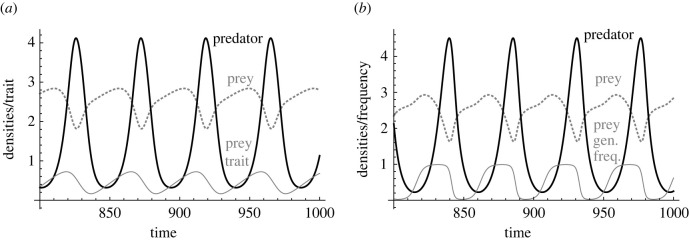
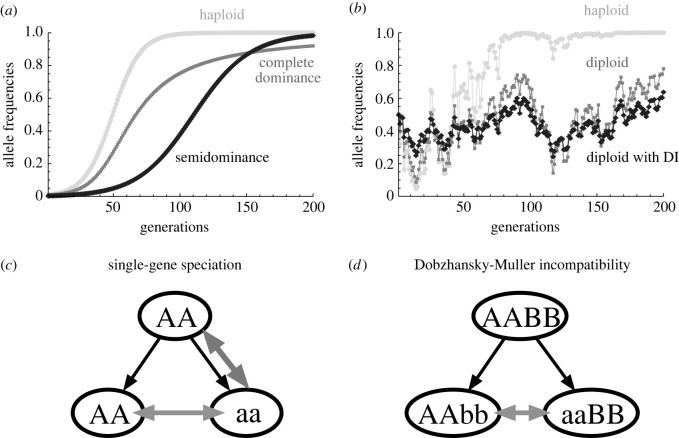
Recent studies have revealed the importance of feedbacks between contemporary rapid evolution (i.e. evolution that occurs through changes in allele frequencies) and ecological dynamics. Despite its inherent interdisciplinary nature, however, studies on eco-evolutionary feedbacks have been mostly ecological and tended to focus on adaptation at the phenotypic level without considering the genetic architecture of evolutionary processes. In empirical studies, researchers have often compared ecological dynamics when the focal species under selection has a single genotype with dynamics when it has multiple genotypes. In theoretical studies, common approaches are models of quantitative traits where mean trait values change adaptively along the fitness gradient and Mendelian traits with two alleles at a single locus. On the other hand, it is well known that genetic architecture can affect short-term evolutionary dynamics in population genetics. Indeed, recent theoretical studies have demonstrated that genetic architecture (e.g. the number of loci, linkage disequilibrium and ploidy) matters in eco-evolutionary dynamics (e.g. evolutionary rescue where rapid evolution prevents extinction and population cycles driven by (co)evolution). I propose that theoretical approaches will promote the synthesis of functional genomics and eco-evolutionary dynamics through models that combine population genetics and ecology as well as nonlinear time-series analyses using emerging big data. This article is part of the theme issue 'Genetic basis of adaptation and speciation: from loci to causative mutations'.
最近的研究揭示了当代快速进化(即通过等位基因频率变化发生的进化)与生态动态之间的反馈的重要性。然而,尽管具有内在的跨学科性质,但关于生态进化反馈的研究主要是生态学方面的,倾向于关注表型水平的适应,而不考虑进化过程的遗传结构。在实证研究中,研究人员经常比较在选择焦点物种具有单一基因型的情况下的生态动态与在具有多个基因型的情况下的生态动态。在理论研究中,常见的方法是数量性状模型,其中特征值的平均值沿着适应度梯度适应性地变化,并且在单个基因座上有两个等位基因的孟德尔性状。另一方面,众所周知,遗传结构会影响群体遗传学中的短期进化动态。事实上,最近的理论研究表明,遗传结构(例如,基因座的数量、连锁不平衡和倍性)在生态进化动态中很重要(例如,快速进化防止灭绝的进化拯救以及由(共同)进化驱动的种群循环)。我提出,理论方法将通过结合群体遗传学和生态学的模型以及使用新兴大数据的非线性时间序列分析来促进功能基因组学和生态进化动态的综合。本文是主题为“适应和物种形成的遗传基础:从基因座到因果突变”的一部分。