
使用移动应用程序进行认知训练作为应对 COVID-19 困扰的应对工具:一项交叉随机对照试验。
Cognitive training using a mobile app as a coping tool against COVID-19 distress: A crossover randomized controlled trial.
机构信息
Department of Psychology, Baskent University, Ankara, Turkey.
Department of Psychology, Hacettepe University, Ankara, Turkey.
出版信息
J Affect Disord. 2022 Aug 15;311:604-613. doi: 10.1016/j.jad.2022.05.118. Epub 2022 May 27.
BACKGROUND
The COVID-19 pandemic has been suggested to constitute a broad base stressor with severe mental health consequences. mHealth applications are accessible self-help tools that can be used to reduce psychological distress during the pandemic. This randomized controlled trial evaluated the effects of mobile-based cognitive training exercises on COVID-19 related distress and maladaptive cognitions.
METHODS
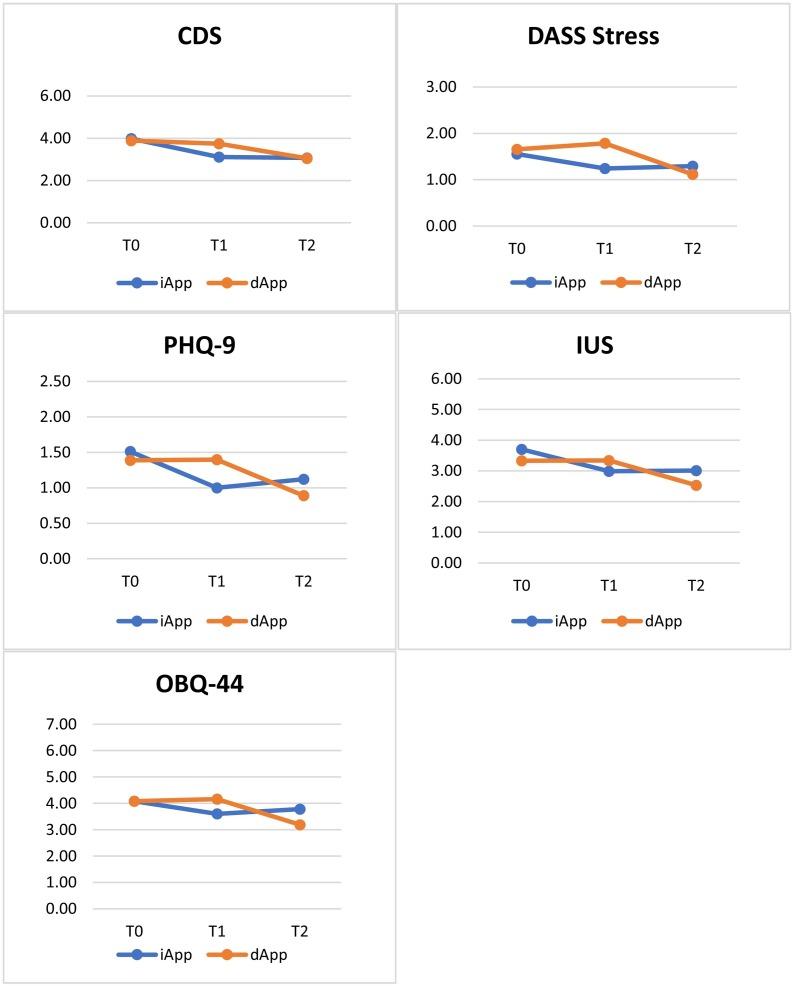
Following initial screening (n = 924), participants scoring 1 standard deviations above the mean of the COVID-19 Distress Scale were randomized into two groups. Participants in the immediate-app group (iApp; n = 25) started using the application at baseline (T0) for 12 days (from T0 to T1). Participants in the delayed-app group (dApp; n = 22) started using the mobile application at T1 (crossover) and used it for the following 12 days (T1 to T2).
RESULTS
Intention to treat analyses indicated that the iApp group exhibited lower COVID-19 distress, lower depression, fewer intolerance of uncertainty and obsessive beliefs than the dApp group at T1. In addition, using the app for 12 consecutive days was associated with large effect-size reductions (Cohen's d ranging from 0.81 to 2.35) in COVID-19 distress and related maladaptive cognitions in the iApp group (from T0 to T1) and the dApp group (from T1 to T2). Moreover, these reductions were maintained at the follow-up.
LIMITATIONS
This study was a crossover trial with a relatively limited sample size and mainly female participants.
CONCLUSION
Our findings underscore the usefulness of brief, low-intensity, portable interventions in alleviating the negative effects of the pandemic on mental health.
背景
COVID-19 大流行被认为是一个广泛的应激源,会导致严重的心理健康后果。移动健康应用程序是一种可获取的自助工具,可用于减轻大流行期间的心理困扰。本随机对照试验评估了基于移动的认知训练练习对与 COVID-19 相关的困扰和适应不良认知的影响。
方法
在初始筛选后(n=924),将 COVID-19 困扰量表得分高于平均值 1 个标准差的参与者随机分为两组。立即应用组(iApp;n=25)在基线(T0)时开始使用应用程序,共 12 天(从 T0 到 T1)。延迟应用组(dApp;n=22)在 T1(交叉)时开始使用移动应用程序,并在接下来的 12 天内(T1 到 T2)使用它。
结果
意向治疗分析表明,与 dApp 组相比,iApp 组在 T1 时 COVID-19 困扰程度较低、抑郁程度较低、对不确定性的容忍度较低、强迫观念和信念较少。此外,连续 12 天使用该应用程序与 iApp 组(从 T0 到 T1)和 dApp 组(从 T1 到 T2)中 COVID-19 困扰和相关适应不良认知的较大效应量降低相关(Cohen's d 范围为 0.81 至 2.35)。此外,这些降低在随访时仍然存在。
局限性
本研究为交叉试验,样本量相对较小,且主要为女性参与者。
结论
我们的研究结果强调了简短、低强度、便携式干预措施在减轻大流行对心理健康的负面影响方面的有效性。

 Zotero 插件