Entomology and Nematology Department, Institute of Food and Agricultural Sciences, University of Florida, Gainesville, FL, USA.
Florida Medical Entomology Laboratory, Institute of Food and Agricultural Sciences, University of Florida, Vero Beach, FL, USA.
Environ Entomol. 2022 Aug 19;51(4):848-858. doi: 10.1093/ee/nvac027.
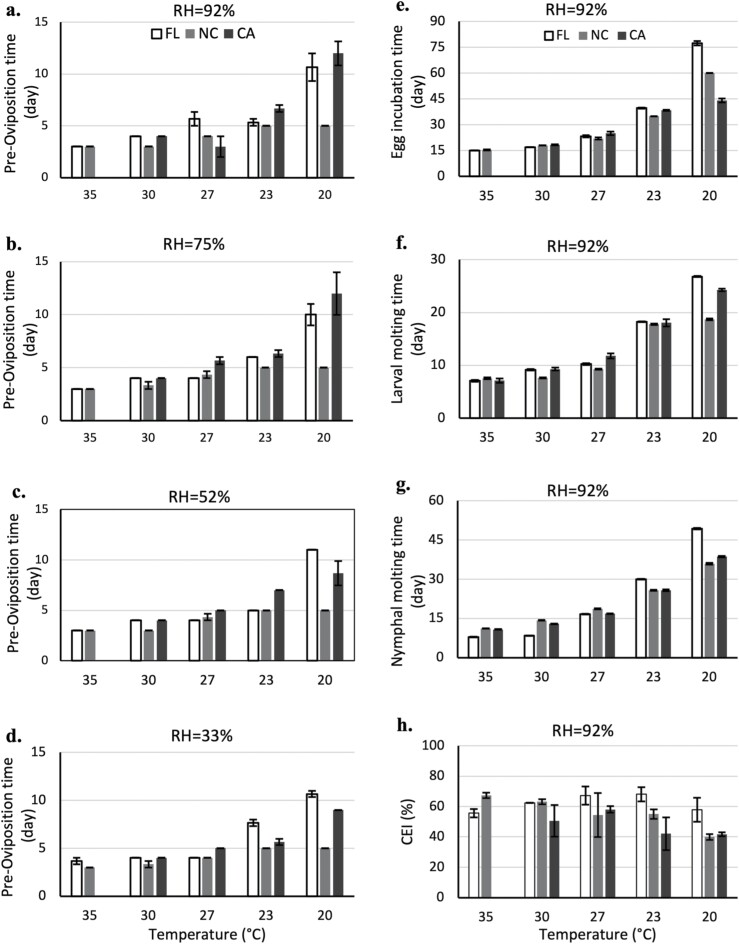
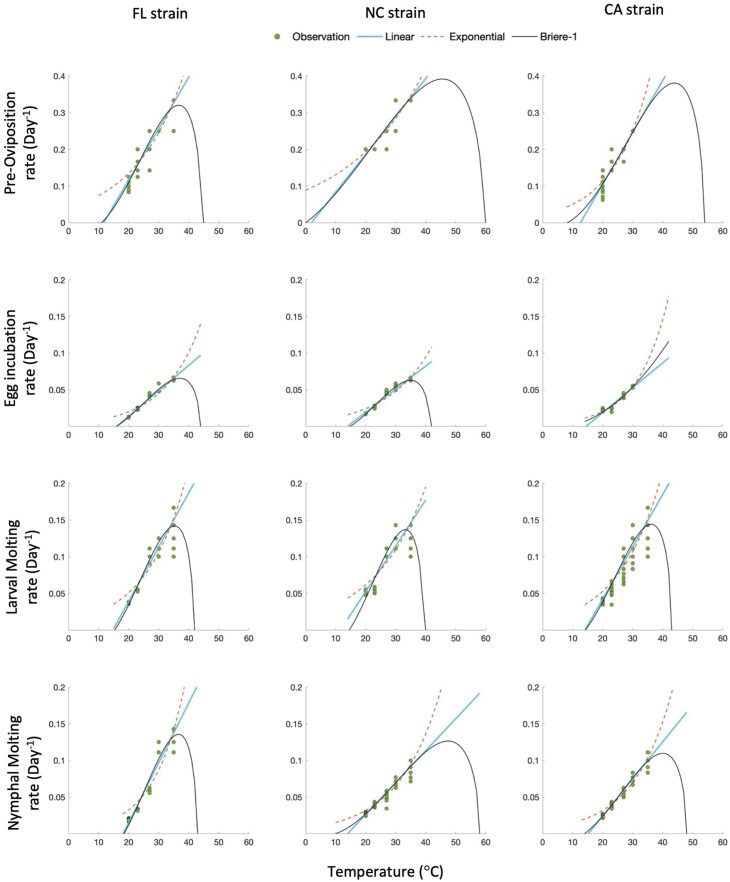
Rhipicephalus sanguineus s.l. (Latreille, 1806) can establish populations in residences and may lead to severe domestic and peridomestic infestations. Detection in the early infestation stage is challenging because of their small body size and the lack of visibility when ticks stay in sheltered refugia. The residents may believe that the infestation has been eliminated when no ticks are observed until ticks reappear when seeking hosts. Thus, it is necessary to improve our understanding of tick phenology to achieve more effective infestation management. In this study, the relationships between environmental conditions and tick development were explored in laboratory and using linear and nonlinear models. Three R. sanguineus s.l. strains, from one colony of the temperate lineage and two of the tropical lineage, were evaluated for the development of all life stages and conversion efficiency index (CEI) under five temperatures and four relative humidities (RHs). The development times differed between the three tick strains across stages and were primarily dependent on temperature. The CEIs had little variance explained by temperature, RH, or strains. Compared with the linear and exponential models with temperature as the only variable, the Brière-1 model was the best approximating model for most of the developmental rates. The developmental temperature thresholds for R. sanguineus s.l. development estimated by the Brière-1 model varied inconsistently across strains and life stages. We developed a more predictive relationship between environmental factors and R. sanguineus s.l. development, which can be utilized to predict tick development using temperature and develop appropriate control strategies.
血厉螨(Rhipicephalus sanguineus s.l.)(拉特雷耶,1806 年)可以在住宅中建立种群,并可能导致严重的家庭和家庭周围的感染。由于其体型小且当蜱虫躲在遮蔽的避难所时不易被发现,因此在早期感染阶段很难检测到。当没有发现蜱虫时,居民可能会认为感染已经消除,直到蜱虫再次出现寻找宿主时。因此,有必要提高我们对蜱虫物候学的理解,以实现更有效的感染管理。在这项研究中,我们在实验室中使用线性和非线性模型来探索环境条件与蜱虫发育之间的关系。评估了来自温带谱系的一个种群和热带谱系的两个种群的三个血厉螨(Rhipicephalus sanguineus s.l.)品系,以研究所有生命阶段的发育和转换效率指数(CEI)在五个温度和四个相对湿度(RH)下的情况。三个蜱虫品系在不同阶段的发育时间不同,主要取决于温度。CEI 受温度、RH 或品系的影响很小。与仅以温度为变量的线性和指数模型相比,Brière-1 模型是大多数发育率的最佳近似模型。Brière-1 模型估计的血厉螨(Rhipicephalus sanguineus s.l.)发育的发育温度阈值在不同品系和生命阶段不一致。我们开发了一种更具预测性的环境因素与血厉螨(Rhipicephalus sanguineus s.l.)发育之间的关系,可以利用温度来预测蜱虫的发育,并制定适当的控制策略。