The Second Department of Thoracic Oncology, Hunan Cancer Hospital/The Affiliated Cancer Hospital of Xiangya School of Medicine, Central South University, Changsha, People's Republic of China.
Department of Respiratory Medicine, National Key Clinical Specialty, Branch of National Clinical Research Center for Respiratory Disease, Xiangya Hospital, Central South University, Changsha, Hunan, People's Republic of China.
Oncologist. 2022 Mar 4;27(2):e116-e125. doi: 10.1093/oncolo/oyab044.
Pulmonary neuroendocrine tumors (pNETs) include typical carcinoid (TC), atypical carcinoid (AC), large cell neuroendocrine carcinoma (LCNEC), and small cell lung carcinoma (SCLC). The optimal treatment strategy for each subtype remains elusive, partly due to the lack of comprehensive understanding of their molecular features. We aimed to explore differential genomic signatures in pNET subtypes and identify potential prognostic and therapeutic biomarkers.
We investigated genomic profiles of 57 LCNECs, 49 SCLCs, 18 TCs, and 24 ACs by sequencing tumor tissues with a 520-gene panel and explored the associations between genomic features and prognosis.
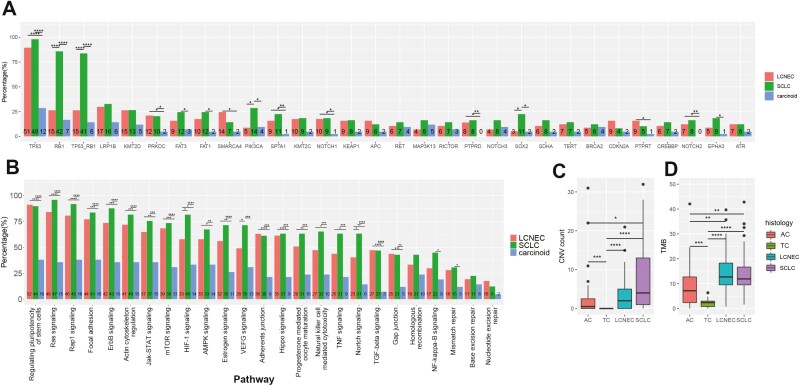
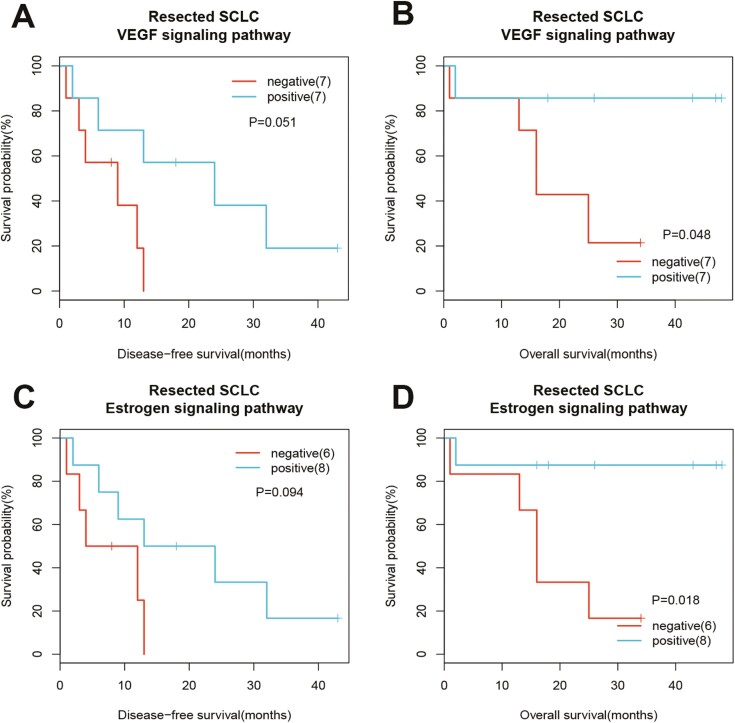
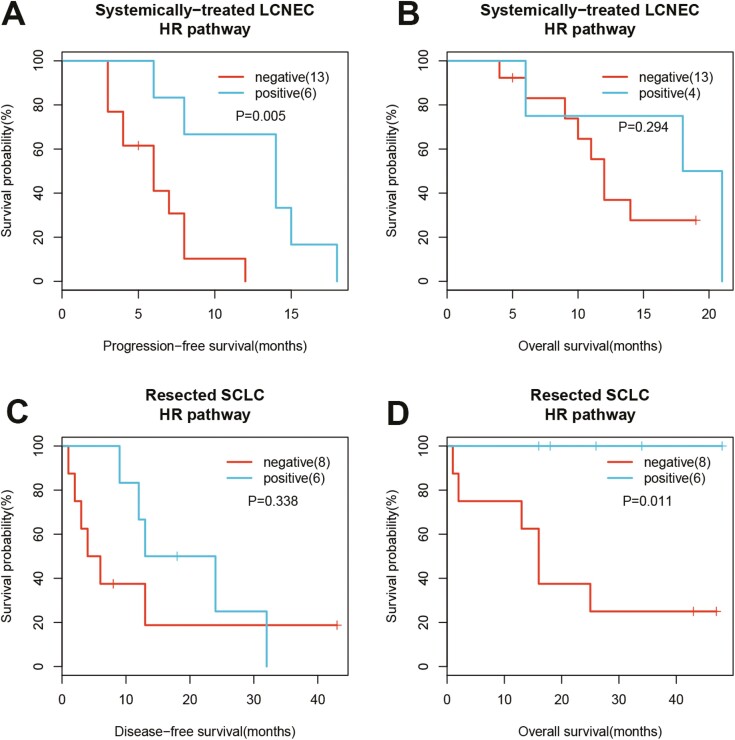
Both LCNEC and SCLC displayed higher mutation rates for TP53, PRKDC, SPTA1, NOTCH1, NOTCH2, and PTPRD than TC and AC. Small cell lung carcinoma harbored more frequent co-alterations in TP53-RB1, alterations in PIK3CA and SOX2, and mutations in HIF-1, VEGF and Notch pathways. Large cell neuroendocrine carcinoma (12.7 mutations/Mb) and SCLC (11.9 mutations/Mb) showed higher tumor mutational burdens than TC (2.4 mutations/Mb) and AC (7.1 mutations/Mb). 26.3% of LCNECs and 20.8% of ACs harbored alterations in classical non-small cell lung cancer driver genes. The presence of alterations in the homologous recombination pathway predicted longer progression-free survival in advanced LCNEC patients with systemic therapy (P = .005) and longer overall survival (OS) in SCLC patients with resection (P = .011). The presence of alterations in VEGF (P = .048) and estrogen (P = .018) signaling pathways both correlated with better OS in patients with resected SCLC.
We performed a comprehensive genomic investigation on 4 pNET subtypes in the Chinese population. Our data revealed distinctive genomic signatures in subtypes and provided new insights into the prognostic and therapeutic stratification of pNETs.
肺神经内分泌肿瘤(pNETs)包括典型类癌(TC)、非典型类癌(AC)、大细胞神经内分泌癌(LCNEC)和小细胞肺癌(SCLC)。由于对其分子特征缺乏全面了解,每种亚型的最佳治疗策略仍不明确。我们旨在探讨 pNET 亚型之间的差异基因组特征,并确定潜在的预后和治疗生物标志物。
我们通过对 57 例 LCNEC、49 例 SCLC、18 例 TC 和 24 例 AC 肿瘤组织进行 520 个基因面板测序,研究了它们的基因组图谱,并探讨了基因组特征与预后之间的关联。
LCNEC 和 SCLC 中 TP53、PRKDC、SPTA1、NOTCH1、NOTCH2 和 PTPRD 的突变率均高于 TC 和 AC。SCLC 中更频繁地出现 TP53-RB1、PIK3CA 和 SOX2 改变,以及 HIF-1、VEGF 和 Notch 通路的突变。LCNEC(12.7 个突变/Mb)和 SCLC(11.9 个突变/Mb)的肿瘤突变负担高于 TC(2.4 个突变/Mb)和 AC(7.1 个突变/Mb)。26.3%的 LCNEC 和 20.8%的 AC 存在经典非小细胞肺癌驱动基因的改变。同源重组途径的改变预示着接受系统治疗的晚期 LCNEC 患者的无进展生存期更长(P=0.005),而接受手术的 SCLC 患者的总生存期更长(P=0.011)。血管内皮生长因子(VEGF)(P=0.048)和雌激素(P=0.018)信号通路的改变均与接受手术的 SCLC 患者的总生存期延长相关。
我们在中国人群中对 4 种 pNET 亚型进行了全面的基因组研究。我们的数据揭示了不同亚型之间的独特基因组特征,并为 pNET 的预后和治疗分层提供了新的见解。