Center for Behavioral Science Research, Henry M. Goldman School of Dental Medicine, Boston University, 560 Harrison Avenue, 3rd Floor, Boston, MA, 02118, USA.
Department of General Dentistry and Health Policy and Health Services Research, Henry M. Goldman School of Dental Medicine, Boston University, Boston, MA, USA.
BMC Public Health. 2022 May 31;22(1):1074. doi: 10.1186/s12889-022-13427-y.
Effective smoking cessation programs exist but are underutilized by smokers, especially by disadvantaged smokers. Cessation interventions in dental settings have been shown to be effective, but are not consistently delivered due to provider burden and lack of training, especially on how to counsel smokers who are not motivated to quit.
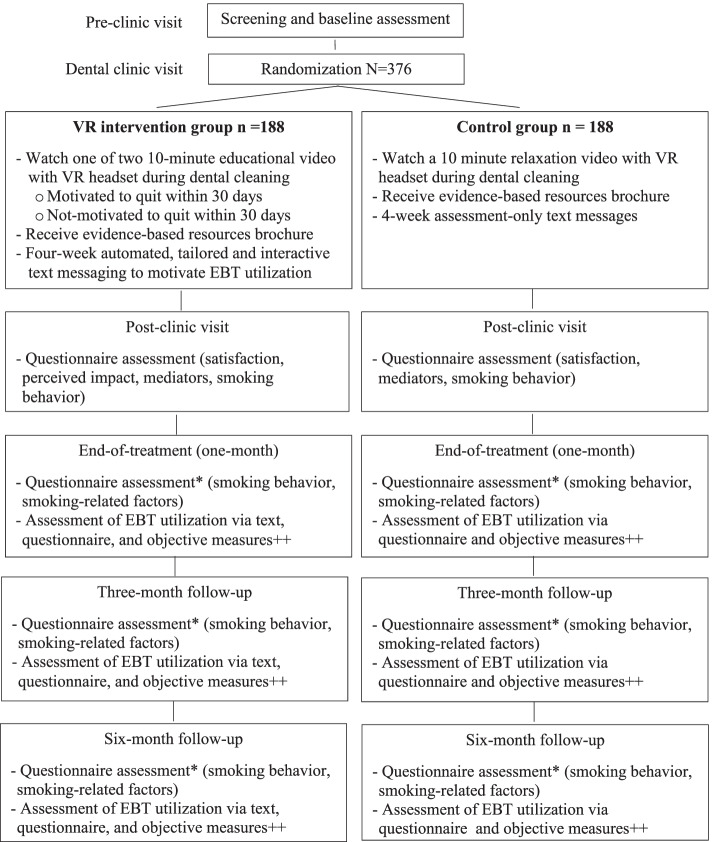
This study is a 2-arm, phase III longitudinal randomized controlled efficacy trial to motivate utilization of evidenced based treatments (EBTs) for smoking cessation (e.g., state quitline, clinic-based counseling, the National Cancer Institute's text message program, and pharmacotherapy). Patients attending an urban dental clinic (n = 376) will be randomized to an intervention group (INT; smoking cessation induction video delivered via VR headset during their teeth cleaning, brochure about EBTs, and a 4-week text message program) or control group (CTRL; relaxation video delivered via VR headset during teeth cleaning, the same brochure as INT, and assessment-only text messages). Assessments will occur at baseline, immediately after the clinic appointment, one-month post-appointment and 3-and 6 months later. We hypothesize INT will be more likely to contact EBTs vs CTRL and have greater utilization rates of EBTs. Secondary objectives are to test the efficacy of INT on point-prevalence smoking abstinence, quit smoking attempts, and motivation to quit vs. CTRL.
Incorporating smoking cessation into a dental clinic visit and targeting all smokers, regardless of motivation to quit, provides proactive reach to cigarette smokers who otherwise may not seek treatment for smoking.
NCT04524533 Registered August 24, 2020.
有效的戒烟计划已经存在,但吸烟者(尤其是处于不利地位的吸烟者)并未充分利用这些计划。在牙科环境中进行的戒烟干预措施已被证明是有效的,但由于提供者的负担和缺乏培训,这些干预措施并未得到持续实施,尤其是在如何为那些没有戒烟动机的吸烟者提供咨询方面。
本研究是一项为期 2 臂、3 期、纵向随机对照疗效试验,旨在促进使用基于证据的治疗方法(如州戒烟热线、诊所咨询、美国国家癌症研究所的短信计划和药物治疗)来戒烟。参加城市牙科诊所的患者(n=376)将被随机分配到干预组(INT;在牙齿清洁期间通过 VR 耳机播放戒烟诱导视频、有关 EBT 的小册子和为期 4 周的短信计划)或对照组(CTRL;在牙齿清洁期间通过 VR 耳机播放放松视频、与 INT 相同的小册子和仅评估短信)。评估将在基线时、就诊后立即、就诊后 1 个月、3 个月和 6 个月进行。我们假设 INT 比 CTRL 更有可能接触 EBTs,并且 EBTs 的利用率更高。次要目标是测试 INT 在即时点吸烟率、戒烟尝试和戒烟动机方面对 CTRL 的疗效。
将戒烟纳入牙科诊所就诊,并针对所有吸烟者,无论其戒烟动机如何,都为那些可能不会因吸烟而寻求治疗的吸烟者提供了积极的治疗途径。
NCT04524533 于 2020 年 8 月 24 日注册。