Department of Cardiothoracic Surgery, Jena University Hospital, Friedrich Schiller University, Jena, Germany.
Department of Radiology, Jena University Hospital, Friedrich Schiller University, Jena, Germany.
Interact Cardiovasc Thorac Surg. 2022 Jul 9;35(2). doi: 10.1093/icvts/ivac149.
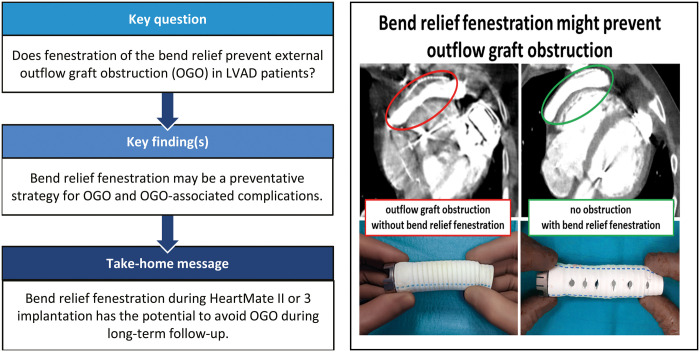
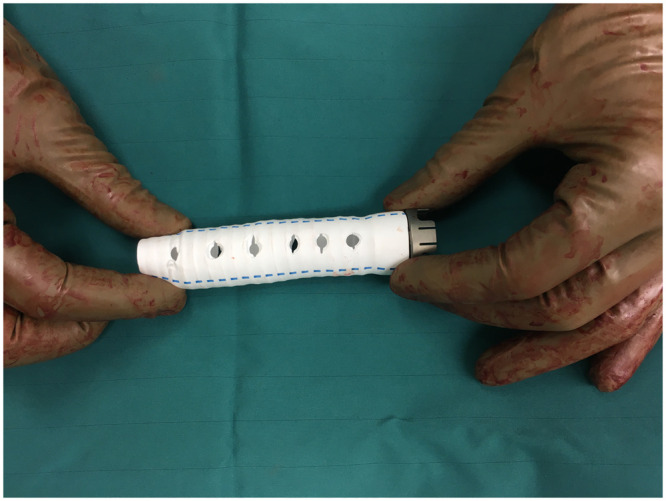
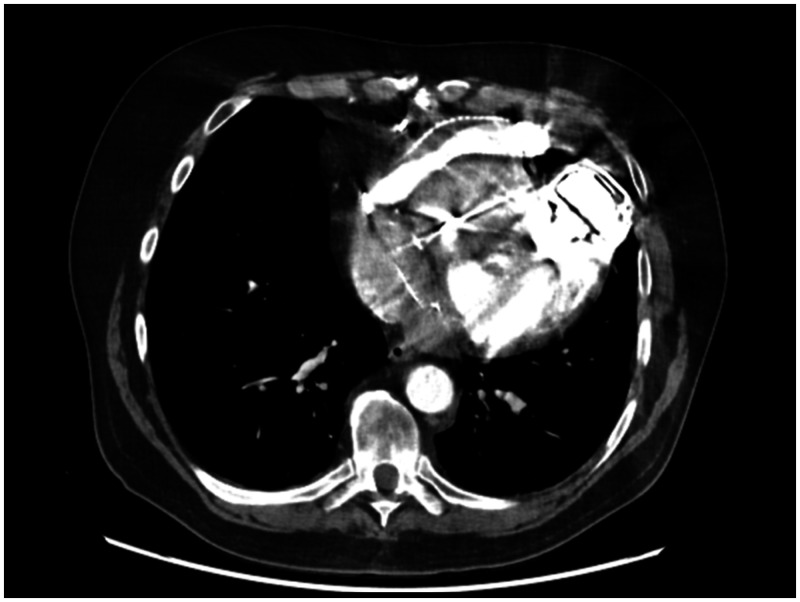
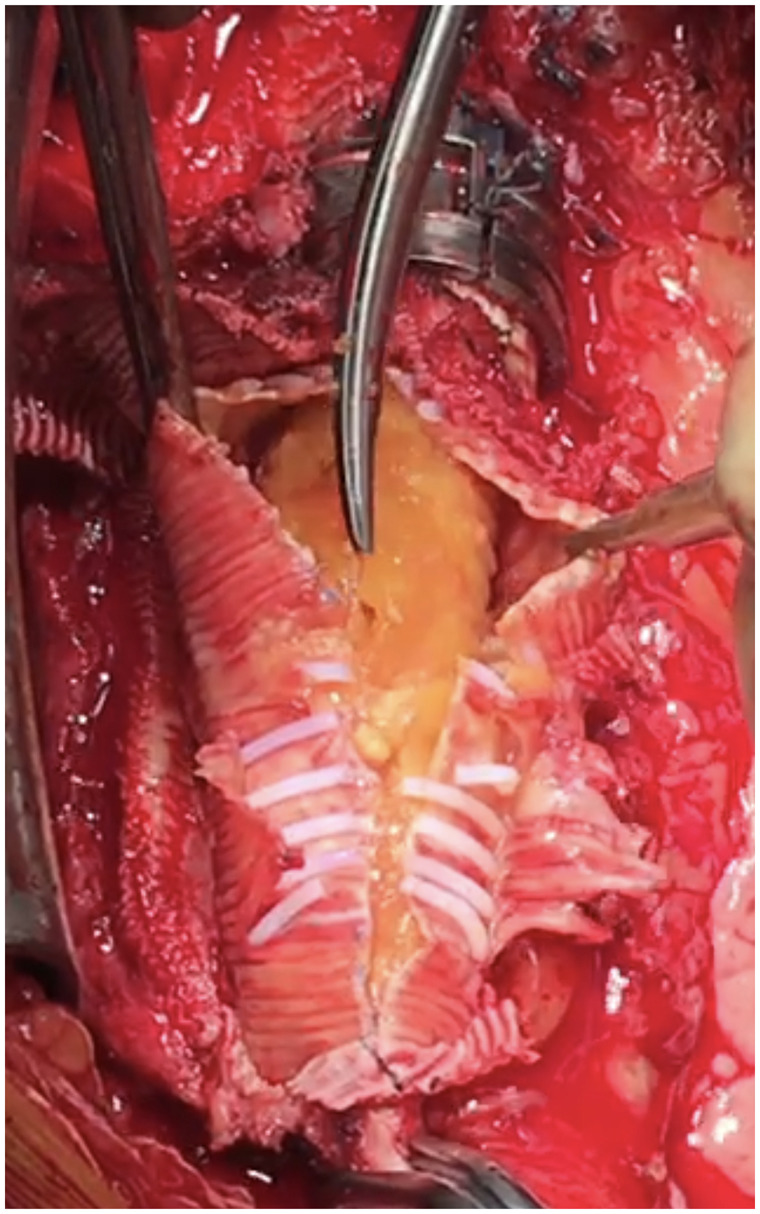
Patients with left ventricular assist devices may experience external obstruction of the outflow graft through a gelatinous substance within the bend relief (BR; a stiff tube graft guiding the outflow graft). Preventative strategies have been missing. Having faced this problem, we decided to fenestrate the BR to avoid outflow graft obstruction (OGO).
Since December 2010, 167 patients underwent left ventricular assist device implantation using HeartMate II or 3. BR fenestration was introduced on July 2018 (108 patients before, 59 after the introduction of BR fenestration). Follow-up computed tomography scans were obtained from all patients and were screened for OGO by 3 independent investigators. Results were correlated with log file history, echocardiographic and clinical outcomes.
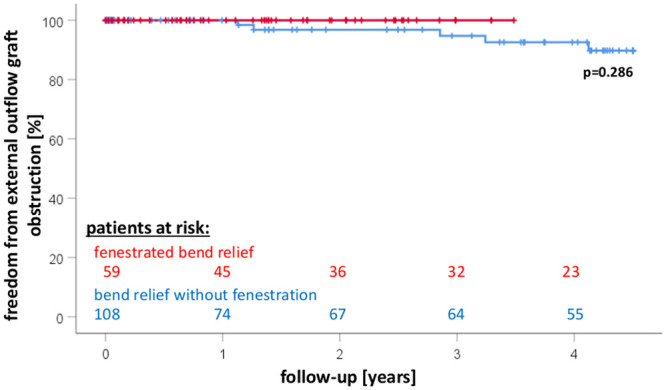
Demographic data were comparable between groups, with mostly male patients. Patients with BR fenestration were older [63 (standard deviation (SD):10.6) vs 58 (SD: 10.7) years] and had shorter support duration [494 (SD: 383) vs 951 (SD: 875) days]. OGO was observed in 5 patients and occurred only in patients without fenestration. Importantly, it occurred late on postoperative Days 412, 462, 1043, 1184 and 1506. Three patients are still asymptomatic. Surgical revision was required in the other 2 patients for pump thrombosis or continuous low flow. One of them died 36 days after revision due to right heart failure.
Our results suggest that fenestration of the BR may be a preventative strategy to avoid external OGO. OGO occurred late, which suggests a careful long-term follow-up.
左心室辅助装置(LVAD)患者可能会经历流出移植物在弯曲缓解(BR;引导流出移植物的刚性管移植物)内的凝胶状物质导致的外部阻塞。目前还缺乏预防策略。在面对这个问题时,我们决定对 BR 进行开窗以避免流出移植物阻塞(OGO)。
自 2010 年 12 月以来,167 名患者接受了 HeartMate II 或 3 型 LVAD 植入术。BR 开窗术于 2018 年 7 月引入(引入前 108 例,引入后 59 例)。所有患者均获得了随访 CT 扫描,并由 3 名独立研究人员对 OGO 进行筛查。结果与日志文件历史、超声心动图和临床结果相关联。
两组患者的人口统计学数据相似,主要为男性患者。BR 开窗组患者年龄较大[63(标准差[SD]:10.6)岁比 58(SD:10.7)岁],支持时间较短[494(SD:383)天比 951(SD:875)天]。有 5 例患者出现 OGO,仅在未开窗组患者中发生。重要的是,它发生在术后第 412、462、1043、1184 和 1506 天。其中 3 例患者仍无症状。另外 2 例患者因泵血栓形成或持续低流量而需要手术修复。其中 1 例在修复后 36 天因右心衰竭死亡。
我们的结果表明,BR 开窗可能是预防 OGO 的策略。OGO 发生较晚,提示需要进行仔细的长期随访。