Department of Molecular Genetics and Microbiology, UF Health Cancer Center, UF Genetics Institute, College of Medicine, University of Floridagrid.15276.37, Gainesville, Florida, USA.
Department of Pathology, Tulane University School of Medicine, Tulane Cancer Center, New Orleans, Louisiana, USA.
mBio. 2022 Jun 28;13(3):e0083622. doi: 10.1128/mbio.00836-22. Epub 2022 Jun 1.
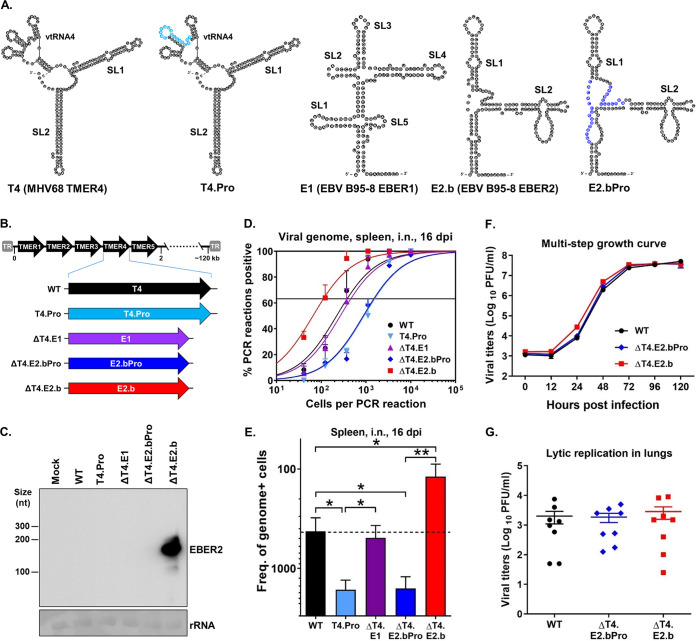
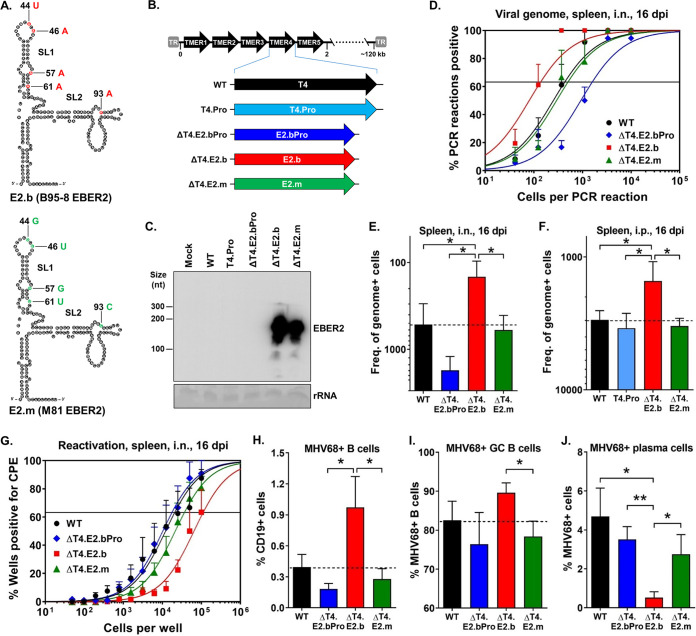
The oncogenic gammaherpesviruses, including human Epstein-Barr virus (EBV), human Kaposi's sarcoma-associated herpesvirus (KSHV), and murine gammaherpesvirus 68 (MHV68, γHV68, MuHV-4), are associated with numerous malignancies, including B cell lymphomas and nasopharyngeal carcinoma. These viruses employ numerous molecular strategies to colonize the host, including the expression of noncoding RNAs (ncRNAs). As the first viral ncRNAs identified, EBV-encoded RNA 1 and 2 (EBER1 and EBER2, respectively) have been investigated extensively for decades; however, their specific functions remain largely unknown. In work here, we used chimeric MHV68 viruses in an complementation system to test whether EBV EBER2 contributes to acute and/or chronic phases of infection. Expression of EBER2 derived from EBV strain B95-8 resulted in a significant expansion of latently infected B cells , which was accompanied by a decrease in virus-infected plasma cells. EBV strains typically carry one of two variants of EBER2, which differ primarily by a 5-nucleotide core polymorphism identified initially in the EBV strain M81. Strikingly, mutation of the 5 nucleotides that define this core polymorphism resulted in the loss of the infected B cell expansion and restored plasma cell infection. This work reveals that the B95-8 variant of EBER2 promotes the expansion of the latently infected B cell pool and may do so in part through inhibition of terminal differentiation. These findings provide new insight into mechanisms by which viral ncRNAs promote colonization and further and provide further evidence of the inherent tumorigenic risks associated with gammaherpesvirus manipulation of B cell differentiation. The oncogenic gammaherpesviruses, including human Epstein-Barr virus (EBV), human Kaposi's sarcoma-associated herpesvirus (KSHV), and murine gammaherpesvirus 68, employ numerous strategies to colonize the host, including expression of noncoding RNAs (ncRNAs). As the first viral ncRNAs ever identified, EBV-encoded RNA 1 and 2 (EBER1 and EBER2) have been investigated extensively for decades; however, their specific functions remain largely unknown. Work here reveals that an EBV EBER2 variant highly associated with B cell lymphoma promoted a significantly increased expansion of the infected B cell pool , which coincided with altered B cell differentiation. Mutation of the 5 nucleotides that define this EBER2 variant resulted in the loss of B cell expansion and normal B cell differentiation. These findings provide new insight into the mechanisms by which EBV manipulates B cells to retain infected cells in the high-risk B cell differentiation pathway where they are poised for tumorigenesis.
致癌性γ疱疹病毒,包括人类 Epstein-Barr 病毒(EBV)、人类卡波西肉瘤相关疱疹病毒(KSHV)和鼠γ疱疹病毒 68(MHV68、γHV68、MuHV-4),与多种恶性肿瘤有关,包括 B 细胞淋巴瘤和鼻咽癌。这些病毒采用多种分子策略来定植宿主,包括非编码 RNA(ncRNA)的表达。作为最初鉴定的病毒 ncRNA,EBV 编码的 RNA1 和 2(EBER1 和 EBER2)已经被研究了几十年;然而,它们的具体功能在很大程度上仍然未知。在这里的工作中,我们使用嵌合 MHV68 病毒在互补系统中测试 EBV EBER2 是否有助于感染的急性和/或慢性阶段。源自 EBV 株 B95-8 的 EBER2 的表达导致潜伏感染的 B 细胞显著扩增,同时感染的浆细胞减少。EBV 株通常携带 EBER2 的两种变体之一,这两种变体主要通过最初在 EBV 株 M81 中鉴定的 5 个核苷酸核心多态性来区分。引人注目的是,定义该核心多态性的 5 个核苷酸的突变导致感染的 B 细胞扩增丧失,并恢复了浆细胞感染。这项工作揭示了 B95-8 变体的 EBER2 促进了潜伏感染的 B 细胞池的扩增,并且可能部分通过抑制终末分化来实现。这些发现为病毒 ncRNA 促进定植的机制提供了新的见解,并进一步提供了与γ疱疹病毒对 B 细胞分化的操纵相关的固有致癌风险的进一步证据。致癌性γ疱疹病毒,包括人类 Epstein-Barr 病毒(EBV)、人类卡波西肉瘤相关疱疹病毒(KSHV)和鼠γ疱疹病毒 68,采用多种策略定植宿主,包括表达非编码 RNA(ncRNA)。作为最初鉴定的病毒 ncRNA,EBV 编码的 RNA1 和 2(EBER1 和 EBER2)已经被研究了几十年;然而,它们的具体功能在很大程度上仍然未知。这里的工作揭示了与 B 细胞淋巴瘤高度相关的 EBV EBER2 变体促进了感染 B 细胞池的显著扩增,同时伴随着 B 细胞分化的改变。定义该 EBER2 变体的 5 个核苷酸的突变导致 B 细胞扩增的丧失和正常的 B 细胞分化。这些发现为 EBV 操纵 B 细胞以保留感染细胞处于高危 B 细胞分化途径的机制提供了新的见解,在该途径中,它们有发生肿瘤的倾向。