J Am Dent Assoc. 2022 Jul;153(7):601-609. doi: 10.1016/j.adaj.2022.04.002. Epub 2022 May 25.
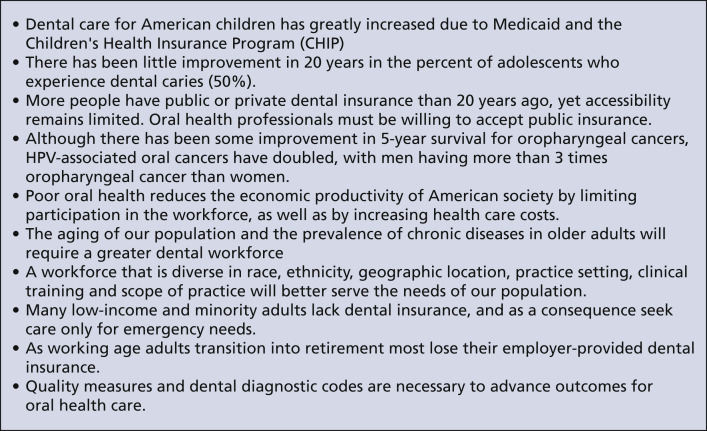
Important, but insufficient, gains have been achieved in access to and delivery of oral health care since the 2000 US surgeon general's report on oral health in America. Access to care has increased for children and young adults, but considerable work remains to meet the oral health care needs of all people equitably. The National Institutes of Health report, Oral Health in America: Advances and Challenges, reviews the state of the US oral health care system, achievements made since 2000, and remaining challenges. In this article, the authors highlight key advances and continuing challenges regarding oral health status, access to care and the delivery system, integration of oral and systemic health, financing of oral health care, and the oral health workforce.
Public insurance coverage has increased since 2000 but remains limited for many low-income, minority, and older adult populations. The oral health care workforce has expanded to include new dental specialties and allied professional models, increasing access to health promotion and preventive services. Practice gains made by women and Asian Americans have not extended to other minority demographic groups. Oral health integration models are improving access to and delivery of patient-centered care for some vulnerable populations.
Coordinated policies and additional resources are needed to further improve access to care, develop dental insurance programs that reduce out-of-pocket costs to lower-income adults, and improve the integration of oral and medical health care delivery targeting a common set of patient-centered outcomes. Dental care professionals need to fully participate in meaningful and system-wide change to meet the needs of the population equitably.
自 2000 年美国外科医生总报告发布以来,在获得和提供口腔保健方面取得了重要但仍不充分的进展。儿童和年轻人获得口腔保健的机会增加了,但要公平满足所有人的口腔保健需求,仍有大量工作要做。美国国立卫生研究院的报告《美国口腔健康:进展与挑战》审查了美国口腔保健系统的现状、2000 年以来取得的成就和仍然存在的挑战。在本文中,作者重点介绍了口腔健康状况、获得保健机会和提供系统、口腔和全身健康的整合、口腔保健的融资以及口腔保健劳动力等方面的关键进展和持续挑战。
自 2000 年以来,公共保险覆盖范围有所扩大,但对许多低收入、少数民族和老年人口群体来说仍然有限。口腔保健劳动力已扩大到包括新的牙科专业和联合专业模式,增加了获得健康促进和预防服务的机会。女性和亚裔美国人在实践中取得的进展并没有扩展到其他少数族裔群体。口腔健康整合模式正在改善一些弱势群体获得以患者为中心的护理的机会和提供这种护理。
需要协调政策和额外资源,以进一步改善获得保健的机会,制定减少低收入成年人自付费用的牙科保险计划,并改善针对共同的以患者为中心的结果的口腔和医疗保健提供的整合。牙科保健专业人员需要充分参与有意义的和系统范围内的变革,以公平地满足人口的需求。