Laboratory of Veterinary Parasitology, School of Veterinary Medicine, Kitasato University, Aomori, Japan.
Laboratory of Wildlife Science, School of Veterinary Medicine, Kitasato University, Aomori, Japan.
J Vet Med Sci. 2022 Jul 10;84(7):1015-1018. doi: 10.1292/jvms.22-0107. Epub 2022 May 30.
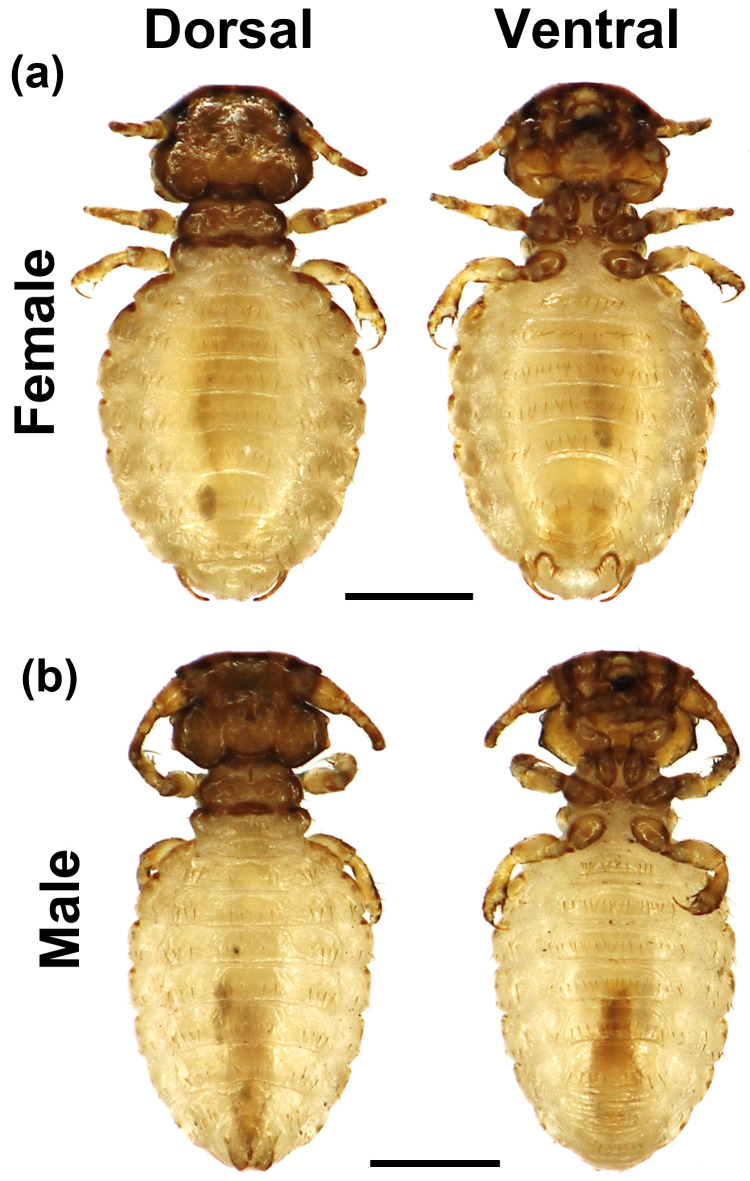
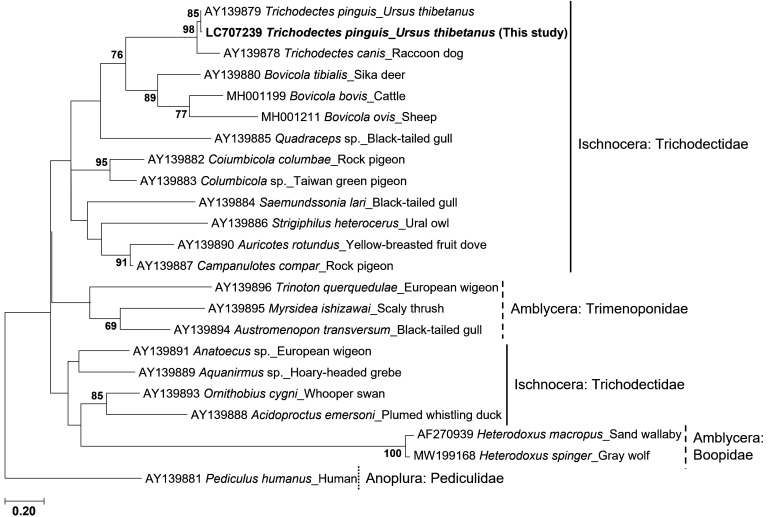
Trichodectes pinguis, referred to commonly as the bear-biting louse, has been reported in several bear species. However, graphical (blurred or coarse) and genetic information on the louse is limited. In this study, we identified T. pinguis collected from Japanese black bears in the Aomori Prefecture, Japan. We confirmed 12S rDNA sequences derived from the collected T. pinguis and performed molecular phylogenetic analysis based on 12S rDNA. The analysis revealed the parasitic louse to be T. pinguis. Interestingly, the body size of T. pinguis found in this study was smaller than the previous recorded body size of them in Japan and Turkey. To better understand the biting louse infesting bears, morphometric and genetic information from other bear hosts needs to be accumulated.
食虫蓖子,俗称熊咬虱,已在多种熊类中报告过。然而,关于虱子的图形(模糊或粗糙)和遗传信息有限。在这项研究中,我们从日本青森县的日本黑熊身上采集到了食虫蓖子。我们确认了从采集到的食虫蓖子中获得的 12S rDNA 序列,并基于 12S rDNA 进行了分子系统发育分析。分析表明寄生虱子为食虫蓖子。有趣的是,本研究中发现的食虫蓖子的体型比以前在日本和土耳其记录的体型小。为了更好地了解侵袭熊的咬虱,需要积累来自其他熊宿主的形态计量和遗传信息。