Moussa George, Qadir Muhammed Omar, Ch'ng Soon Wai, Lett Kim Son, Mitra Arijit, Tyagi Ajai K, Sharma Ash, Andreatta Walter
Birmingham Midlands Eye Centre, Sandwell and West Birmingham Hospitals NHS Trust, Dudley Road, 18 7QH Birmingham, UK.
Kantonsspital Winterthur, Brauerstrasse 15, 8400 Winterthur, Switzerland.
Spektrum Augenheilkd. 2023;37(1):1-8. doi: 10.1007/s00717-022-00521-0. Epub 2022 May 24.
To review the sustained effect of COVID-19 on rhegmatogenous retinal detachment (RRD) baseline characteristics and outcomes.
This was a retrospective consecutive case series at the Birmingham and Midlands Eye Centre including patients undergoing primary RRD repair between 23 March and 31 December 2017-2019 (Group 1) and 2020 (Group 2). The deciles of indices of multiple deprivation (IMD) were determined by postcode to group patients into least deprived (IMD1-5) and most deprived (IMD6-10).
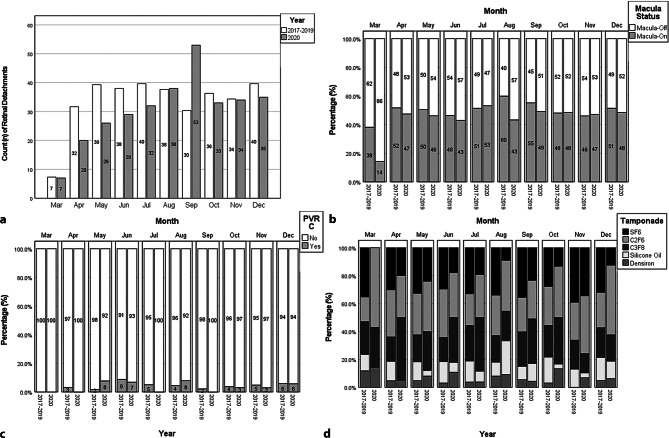
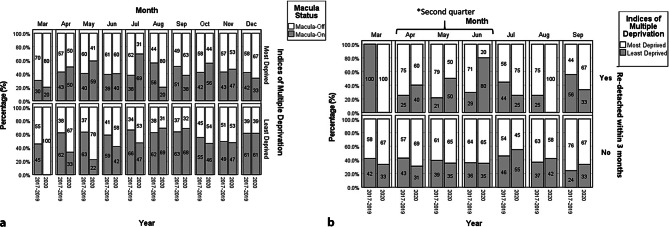
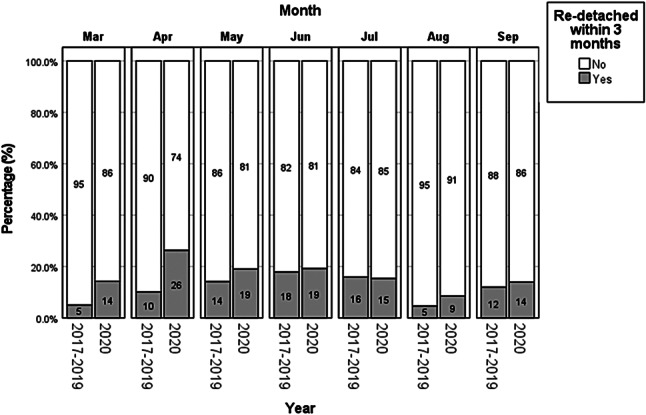
In total we reviewed 1310 patients, 1003 in Group 1 and 307 in Group 2. Relative to 2017-2019, during the first lockdown, we observed (a) a reduction in the number of patients with RRD, (b) an increase in macula-off detachments, (c) an increase in RRD primary failure, and (d) that the least deprived had proportionately higher primary failure than the most deprived ( = 0.049) with a higher detachment rate than the pre-COVID-19 period ( = 0.010) and increased presentations of macula-off detachment. During the second lockdown, these differences were not observed.
The previously observed findings of lower presentation rates of RRD during the beginning of the first lockdown and the decreased number of macula-on RRD were not sustained over a longer period of observation or found to recur after a second national lockdown. Patients from areas with the least socioeconomic deprivation seemed to be more negatively affected by the first lockdown, with later presentation and higher rates of re-detachments compared with the most deprived during the first lockdown. Our findings offer reassurance that patient behaviour and health services had adapted to the pandemic by the second national lockdown.
The online version of this article (10.1007/s00717-022-00521-0) contains supplementary material, which is available to authorized users.
回顾新冠病毒病(COVID-19)对孔源性视网膜脱离(RRD)基线特征及治疗结果的持续影响。
这是一项在伯明翰和米德兰兹眼科中心进行的回顾性连续病例系列研究,纳入了2017 - 2019年3月23日至12月31日(第1组)以及2020年(第2组)接受原发性RRD修复手术的患者。通过邮政编码确定多重贫困指数(IMD)的十分位数,将患者分为最不贫困组(IMD1 - 5)和最贫困组(IMD6 - 10)。
我们共回顾了1310例患者,其中第1组1003例,第2组307例。与2017 - 2019年相比,在首次封锁期间,我们观察到:(a)RRD患者数量减少;(b)黄斑脱离的患者数量增加;(c)RRD初次手术失败率增加;(d)最不贫困组的初次手术失败率相对高于最贫困组(P = 0.049),脱离率高于COVID - 19大流行前时期(P = 0.010),黄斑脱离的病例数增加。在第二次封锁期间,未观察到这些差异。
在首次封锁开始时观察到的RRD就诊率较低以及黄斑在位RRD病例数减少的情况,在更长时间的观察中并未持续,也未在第二次全国封锁后再次出现。与首次封锁期间最贫困的患者相比,社会经济剥夺程度最低地区的患者似乎受首次封锁的负面影响更大,就诊时间更晚,再脱离率更高。我们的研究结果表明,到第二次全国封锁时,患者行为和医疗服务已适应了疫情。
本文的在线版本(10.1007/s00717 - 022 - 00521 - 0)包含补充材料,授权用户可获取。