Beg Sarwar, Malik Ankit K, Ansari Mohammad Javed, Malik Asrar A, Ali Ahmed Mahmoud Abdelhaleem, Theyab Abdulrahman, Algahtani Mohammad, Almalki Waleed H, Alharbi Khalid S, Alenezi Sattam K, Barkat Md Abul, Rahman Mahfoozur, Choudhry Hani
Department of Pharmaceutics, School of Pharmaceutical Education and Research, Nanomedicine Research Lab, Jamia Hamdard, New Delhi 110062, India.
Department of Pharmaceutics, College of Pharmacy, Prince Sattam Bin Abdulaziz University, Al-kharj 16278, Saudi Arabia.
ACS Omega. 2022 May 10;7(20):16968-16979. doi: 10.1021/acsomega.1c07254. eCollection 2022 May 24.
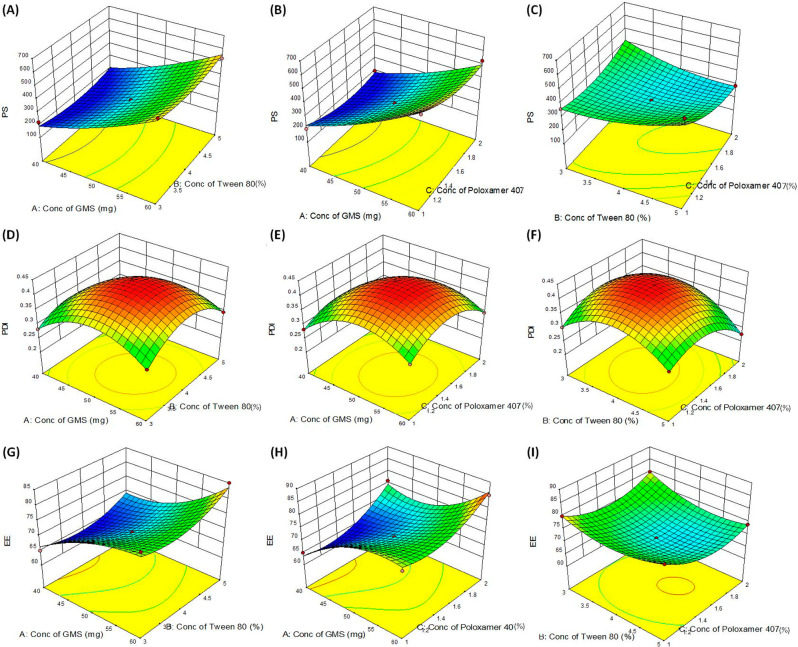
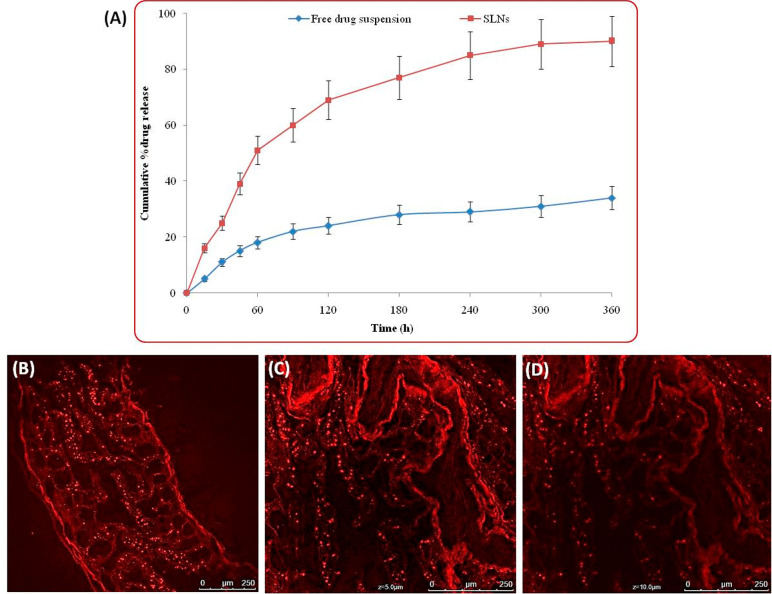
In the present work, an attempt was undertaken to improve the oral bioavailability and anticancer activity of abiraterone acetate. Solid lipid nanoparticles (SLNs) were developed using the quality by design (QbD) principles and evaluated through , , and studies. Solid lipid suitability was evaluated by equilibrium solubility study, while surfactant and cosurfactant were screened based on the ability to form microemulsion with the selected lipid. SLNs were prepared by emulsion/solvent evaporation method using glyceryl monostearate, Tween 80, and Poloxamer 407 as the solid lipid, surfactant, and cosurfactant, respectively. Box-Behnken design was applied for optimization of material attributes and evaluating their impact on particle size, polydispersity index, zeta potential, and entrapment efficiency of the SLNs. drug release study was evaluated in simulated gastric and intestinal fluids. Cell culture studies on PC-3 cells were performed to evaluate the cytotoxicity of the drug-loaded SLNs in comparison to the free drug suspension. Qualitative uptake was evaluated for Rhodamine B-loaded SLNs and compared with free dye solution. permeability was evaluated on Wistar rat intestine and pharmacokinetic evaluation on Wistar rats for SLNs and free drug suspension. Concisely, the SLNs showed potential for significant improvement in the biopharmaceutical performance of the selected drug candidate over the existing formulations of abiraterone acetate.
在本研究中,人们尝试提高醋酸阿比特龙的口服生物利用度和抗癌活性。采用质量源于设计(QbD)原则制备了固体脂质纳米粒(SLNs),并通过 、 和 研究进行了评估。通过平衡溶解度研究评估固体脂质的适用性,同时根据与所选脂质形成微乳液的能力筛选表面活性剂和助表面活性剂。分别使用单硬脂酸甘油酯、吐温80和泊洛沙姆407作为固体脂质、表面活性剂和助表面活性剂,通过乳液/溶剂蒸发法制备SLNs。采用Box-Behnken设计优化材料属性,并评估它们对SLNs的粒径、多分散指数、zeta电位和包封率的影响。在模拟胃液和肠液中进行 药物释放研究。对PC-3细胞进行细胞培养研究,以评估载药SLNs与游离药物悬浮液相比的细胞毒性。对罗丹明B标记的SLNs进行定性摄取评估,并与游离染料溶液进行比较。在Wistar大鼠肠道上评估 渗透性,并对Wistar大鼠进行SLNs和游离药物悬浮液的 药代动力学评估。简而言之,与现有的醋酸阿比特龙制剂相比,SLNs在所选候选药物的生物药剂学性能方面显示出显著改善的潜力。