Department of Nuclear Medicine, University Hospital Würzburg, Oberdürrbacherstraße 6, 97080, Würzburg, Germany.
Department of Urology and Paediatric Urology, University Hospital Würzburg, Oberdürrbacherstraße 6, 97080, Würzburg, Germany.
Eur J Nucl Med Mol Imaging. 2022 Oct;49(12):4262-4270. doi: 10.1007/s00259-022-05853-2. Epub 2022 Jun 2.
Radioligand therapy (RLT) with Lu-labeled prostate-specific membrane antigen (PSMA) ligands is associated with prolonged overall survival (OS) in patients with advanced, metastatic castration-resistant prostate cancer (mCRPC). A substantial number of patients, however, are prone to treatment failure. We aimed to determine clinical baseline characteristics to predict OS in patients receiving [Lu]Lu-PSMA I&T RLT in a long-term follow-up.
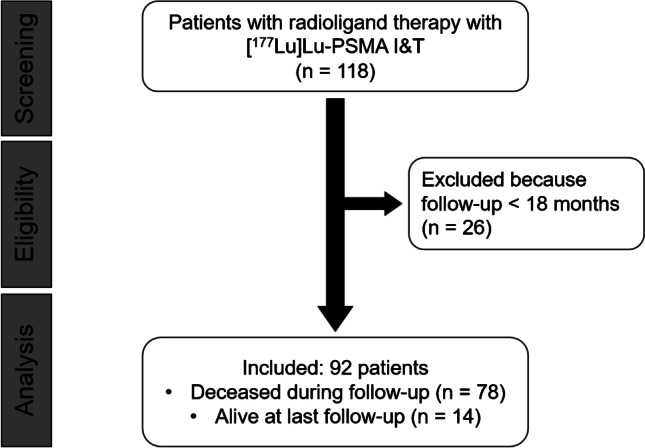
Ninety-two mCRPC patients treated with [Lu]Lu-PSMA I&T with a follow-up of at least 18 months were retrospectively identified. Multivariable Cox regression analyses were performed for various baseline characteristics, including laboratory values, Gleason score, age, prior therapies, and time interval between initial diagnosis and first treatment cycle (interval, per 12 months). Cutoff values for significant predictors were determined using receiver operating characteristic (ROC) analysis. ROC-derived thresholds were then applied to Kaplan-Meier analyses.
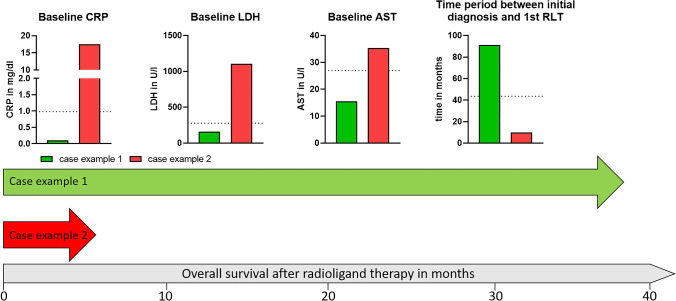
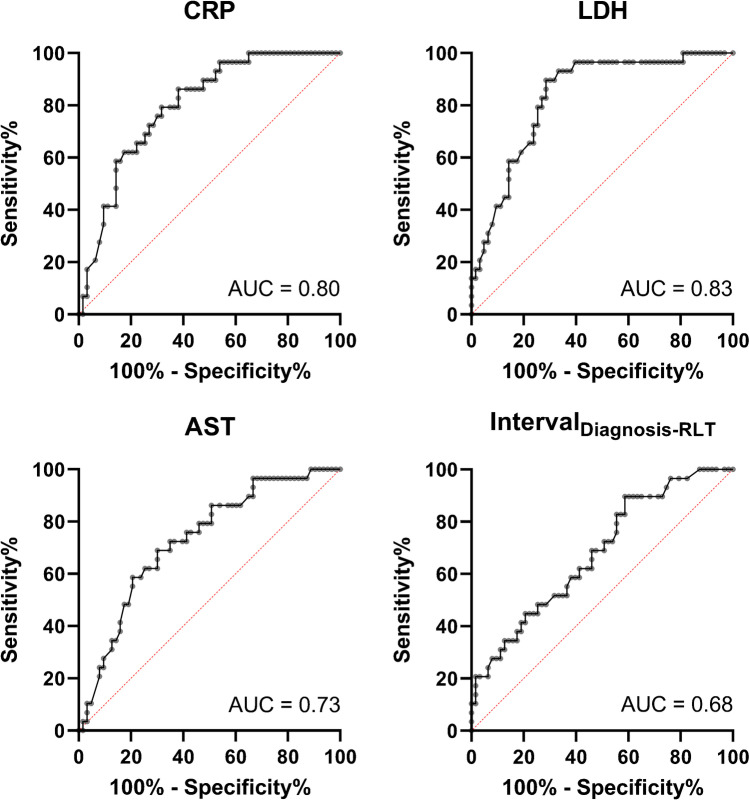
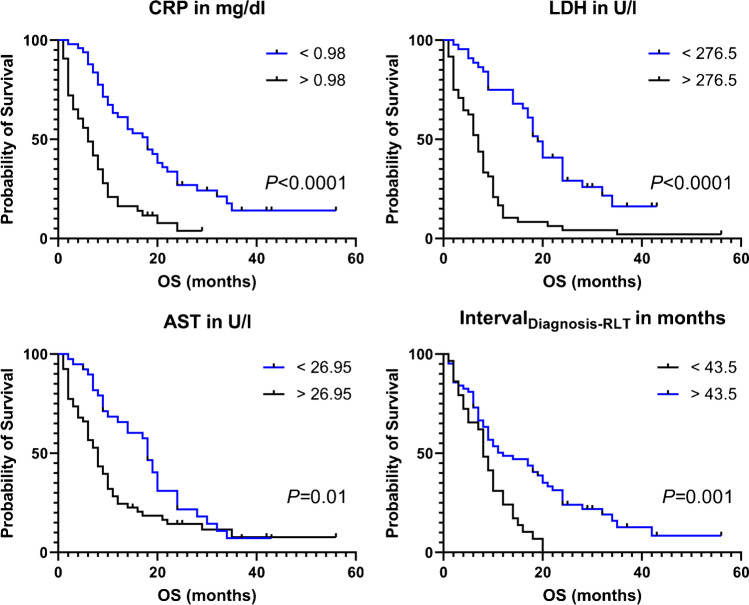
Baseline C-reactive protein (CRP; hazard ratio [HR], 1.10, 95% CI 1.02-1.18; P = 0.01), lactate dehydrogenase (LDH; HR, 1.07, 95% CI 1.01-1.11; P = 0.01), aspartate aminotransferase (AST; HR, 1.16, 95% CI 1.06-1.26; P = 0.001), and interval (HR, 0.95, 95% CI 0.91-0.99; P = 0.02) were identified as independent prognostic factors for OS. The following respective ROC-based thresholds were determined: CRP, 0.98 mg/dl (area under the curve [AUC], 0.80); LDH, 276.5 U/l (AUC, 0.83); AST, 26.95 U/l (AUC, 0.73); and interval, 43.5 months (AUC, 0.68; P < 0.01, respectively). Respective Kaplan-Meier analyses demonstrated a significantly longer median OS of patients with lower CRP, lower LDH, and lower AST, as well as prolonged interval (P ≤ 0.01, respectively).
In mCRPC patients treated with [Lu]Lu-PSMA I&T, baseline CRP, LDH, AST, and time interval until RLT initiation (thereby reflecting a possible indicator for tumor aggressiveness) are independently associated with survival. Our findings are in line with previous findings on [Lu]Lu-PSMA-617, and we believe that these clinical baseline characteristics may support the nuclear medicine specialist to identify long-term survivors.
用 Lu 标记的前列腺特异性膜抗原(PSMA)配体进行放射性配体治疗(RLT)可延长晚期转移性去势抵抗性前列腺癌(mCRPC)患者的总生存期(OS)。然而,大量患者易发生治疗失败。我们旨在确定临床基线特征,以预测接受 [Lu]Lu-PSMA I&T RLT 治疗的患者的 OS。
回顾性确定了 92 名接受 [Lu]Lu-PSMA I&T 治疗的 mCRPC 患者,随访时间至少为 18 个月。对各种基线特征进行多变量 Cox 回归分析,包括实验室值、Gleason 评分、年龄、既往治疗和初始诊断与首次治疗周期之间的时间间隔(间隔,每 12 个月)。使用受试者工作特征(ROC)分析确定显著预测因子的截断值。然后将 ROC 衍生的阈值应用于 Kaplan-Meier 分析。
基线 C 反应蛋白(CRP;风险比 [HR],1.10,95%CI 1.02-1.18;P=0.01)、乳酸脱氢酶(LDH;HR,1.07,95%CI 1.01-1.11;P=0.01)、天冬氨酸氨基转移酶(AST;HR,1.16,95%CI 1.06-1.26;P=0.001)和间隔(HR,0.95,95%CI 0.91-0.99;P=0.02)被确定为 OS 的独立预后因素。确定了以下基于 ROC 的相应阈值:CRP,0.98mg/dl(曲线下面积 [AUC],0.80);LDH,276.5U/l(AUC,0.83);AST,26.95U/l(AUC,0.73);间隔,43.5 个月(AUC,0.68;P<0.01,分别)。各自的 Kaplan-Meier 分析表明,CRP、LDH 和 AST 水平较低以及间隔时间较长的患者的中位 OS 明显更长(P≤0.01,分别)。
在接受 [Lu]Lu-PSMA I&T 治疗的 mCRPC 患者中,基线 CRP、LDH、AST 和开始 RLT 之前的时间间隔(从而反映肿瘤侵袭性的可能指标)与生存相关。我们的发现与之前关于 [Lu]Lu-PSMA-617 的发现一致,我们认为这些临床基线特征可能有助于核医学专家识别长期生存者。