Department of Anesthesiology and Critical Care Medicine, Peking University First Hospital, Beijing, China.
Outcomes Research Consortium, Cleveland, Ohio, USA.
CNS Neurosci Ther. 2022 Aug;28(8):1147-1167. doi: 10.1111/cns.13873. Epub 2022 Jun 1.
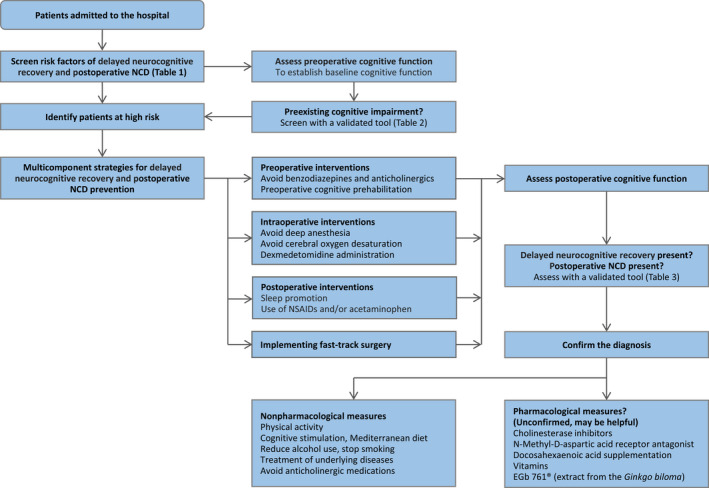
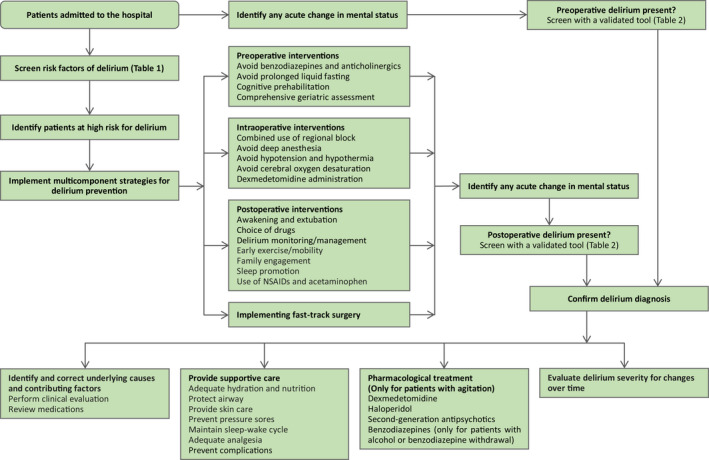
Perioperative neurocognitive disorders (NCDs) refer to neurocognitive abnormalities detected during the perioperative periods, including preexisting cognitive impairment, preoperative delirium, delirium occurring up to 7 days after surgery, delayed neurocognitive recovery, and postoperative NCD. The Diagnostic and Statistical Manual of Mental Disorders-5th edition (DSM-5) is the golden standard for diagnosing perioperative NCDs. Given the impracticality of using the DSM-5 by non-psychiatric practitioners, many diagnostic tools have been developed and validated for different clinical scenarios. The etiology of perioperative NCDs is multifactorial and includes predisposing and precipitating factors. Identifying these risk factors is conducive to preoperative risk stratification and perioperative risk reduction. Prevention for perioperative NCDs should include avoiding possible contributors and implementing nonpharmacologic and pharmacological interventions. The former generally includes avoiding benzodiazepines, anticholinergics, prolonged liquid fasting, deep anesthesia, cerebral oxygen desaturation, and intraoperative hypothermia. Nonpharmacologic measures include preoperative cognitive prehabilitation, comprehensive geriatric assessment, implementing fast-track surgery, combined use of regional block, and sleep promotion. Pharmacological measures including dexmedetomidine, nonsteroidal anti-inflammatory drugs, and acetaminophen are found to have beneficial effects. Nonpharmacological treatments are the first-line measures for established perioperative NCDs. Pharmacological treatments are still limited to severely agitated or distressed patients.
围手术期神经认知障碍(NCD)是指围手术期期间检测到的神经认知异常,包括术前认知障碍、术前谵妄、术后 7 天内发生的谵妄、延迟性神经认知恢复和术后 NCD。《精神障碍诊断与统计手册-第 5 版》(DSM-5)是诊断围手术期 NCD 的金标准。鉴于非精神科医生使用 DSM-5 的不切实际性,已经开发和验证了许多诊断工具,用于不同的临床情况。围手术期 NCD 的病因是多因素的,包括易患因素和诱发因素。识别这些危险因素有助于术前风险分层和围手术期风险降低。围手术期 NCD 的预防应包括避免可能的诱因和实施非药物和药物干预。前者通常包括避免苯二氮䓬类药物、抗胆碱能药物、长时间液体禁食、深度麻醉、脑氧饱和度降低和术中低体温。非药物措施包括术前认知康复、全面老年评估、实施快速康复外科、联合使用区域阻滞和促进睡眠。发现右美托咪定、非甾体抗炎药和对乙酰氨基酚等药物具有有益作用。非药物治疗是既定围手术期 NCD 的一线措施。药物治疗仍仅限于严重躁动或痛苦的患者。