Department of Clinical Pharmacology, University of Helsinki and Helsinki University Hospital, Helsinki, Finland.
Individualized Drug Therapy Research Program, University of Helsinki, Helsinki, Finland.
Clin Pharmacol Ther. 2022 Sep;112(3):676-686. doi: 10.1002/cpt.2674. Epub 2022 Jun 24.
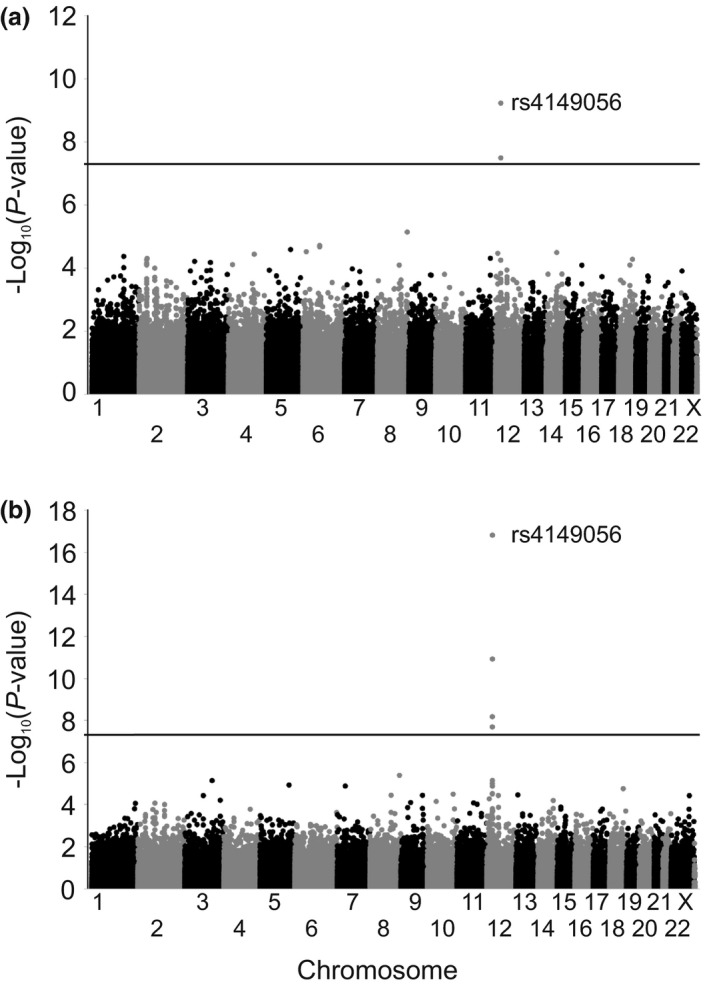
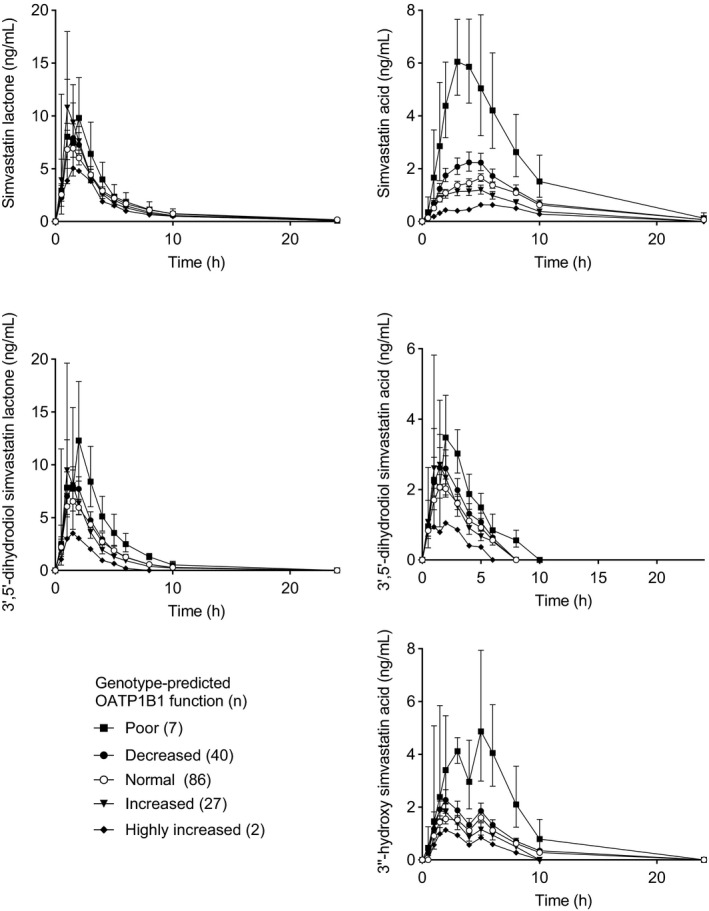
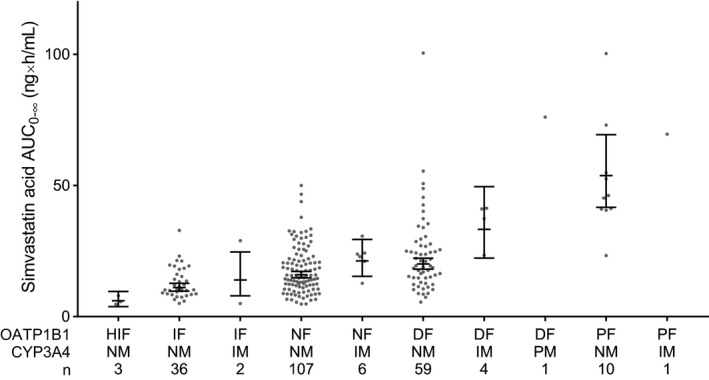
We investigated genetic determinants of single-dose simvastatin pharmacokinetics in a prospective study of 170 subjects and a retrospective cohort of 59 healthy volunteers. In a microarray-based genomewide association study with the prospective data, the SLCO1B1 c.521T>C (p.Val174Ala, rs4149056) single nucleotide variation showed the strongest, genomewide significant association with the area under the plasma simvastatin acid concentration-time curve (AUC; P = 6.0 × 10 ). Meta-analysis with the retrospective cohort strengthened the association (P = 1.6 × 10 ). In a stepwise linear regression candidate gene analysis among all 229 participants, SLCO1B1 c.521T>C (P = 1.9 × 10 ) and CYP3A4 c.664T>C (p.Ser222Pro, rs55785340, CYP3A42, P = 0.023) were associated with increased simvastatin acid AUC. Moreover, the SLCO1B1 c.463C>A (p.Pro155Thr, rs11045819, P = 7.2 × 10 ) and c.1929A>C (p.Leu643Phe, rs34671512, P = 5.3 × 10 ) variants associated with decreased simvastatin acid AUC. Based on these results and the literature, we classified the volunteers into genotype-predicted OATP1B1 and CYP3A4 phenotype groups. Compared with the normal OATP1B1 function group, simvastatin acid AUC was 273% larger in the poor (90% confidence interval (CI), 137%, 488%; P = 3.1 × 10 ), 40% larger in the decreased (90% CI, 8%, 83%; P = 0.036), and 67% smaller in the highly increased function group (90% CI, 46%, 80%; P = 2.4 × 10 ). Intermediate CYP3A4 metabolizers (i.e., heterozygous carriers of either CYP3A42 or CYP3A4*22 (rs35599367)), had 87% (90% CI, 39%, 152%, P = 6.4 × 10 ) larger simvastatin acid AUC than normal metabolizers. These data suggest that in addition to no function SLCO1B1 variants, increased function SLCO1B1 variants and reduced function CYP3A4 variants may affect the pharmacokinetics, efficacy, and safety of simvastatin. Care is warranted if simvastatin is prescribed to patients carrying decreased function SLCO1B1 or CYP3A4 alleles.
我们在一项前瞻性研究的 170 名受试者和 59 名健康志愿者的回顾性队列中,研究了单剂量辛伐他汀药代动力学的遗传决定因素。在一项基于微阵列的全基因组关联研究中,使用前瞻性数据,SLCO1B1 c.521T>C(p.Val174Ala,rs4149056)单核苷酸变异与血浆辛伐他汀酸浓度-时间曲线下面积(AUC;P=6.0×10)显示出最强的全基因组显著相关性。与回顾性队列的荟萃分析加强了这种关联(P=1.6×10)。在所有 229 名参与者的逐步线性回归候选基因分析中,SLCO1B1 c.521T>C(P=1.9×10)和 CYP3A4 c.664T>C(p.Ser222Pro,rs55785340,CYP3A42,P=0.023)与辛伐他汀酸 AUC 增加有关。此外,SLCO1B1 c.463C>A(p.Pro155Thr,rs11045819,P=7.2×10)和 c.1929A>C(p.Leu643Phe,rs34671512,P=5.3×10)变体与辛伐他汀酸 AUC 降低有关。基于这些结果和文献,我们将志愿者分为预测 OATP1B1 和 CYP3A4 表型的基因型。与正常 OATP1B1 功能组相比,辛伐他汀酸 AUC 在功能较差的个体中增加了 273%(90%置信区间(CI),137%,488%;P=3.1×10),在功能降低的个体中增加了 40%(90% CI,8%,83%;P=0.036),在功能高度增加的个体中降低了 67%(90% CI,46%,80%;P=2.4×10)。中间 CYP3A4 代谢物(即 CYP3A42 或 CYP3A4*22(rs35599367)杂合携带者)的辛伐他汀酸 AUC 比正常代谢物增加了 87%(90% CI,39%,152%;P=6.4×10)。这些数据表明,除了无功能 SLCO1B1 变体外,功能增加的 SLCO1B1 变体和功能降低的 CYP3A4 变体可能会影响辛伐他汀的药代动力学、疗效和安全性。如果辛伐他汀被开给携带功能降低的 SLCO1B1 或 CYP3A4 等位基因的患者,应谨慎使用。