Department of Hematology, Amsterdam University Medical Centers, Location VUmc, De Boelelaan 1117, 1081 HV, Amsterdam, The Netherlands.
Curr Oncol Rep. 2022 Nov;24(11):1387-1400. doi: 10.1007/s11912-022-01299-9. Epub 2022 Jun 2.
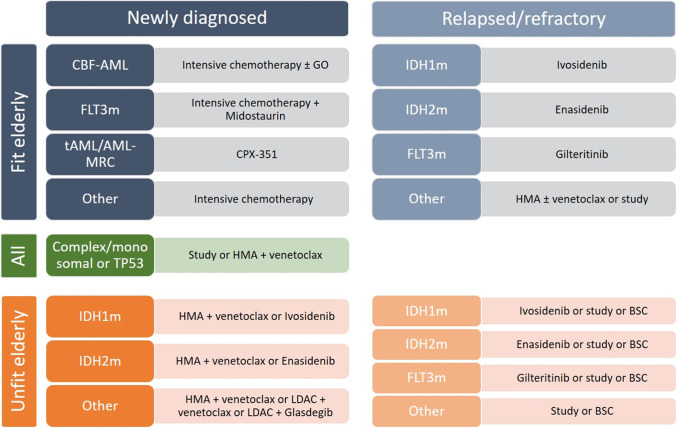
Treatment of elderly patients with acute myeloid leukemia is a known challenge for hematologists due to patient diversity, heterogeneous disease biology, and a rapidly evolving treatment landscape. Here, we highlight the importance of determining fitness, review the latest therapeutic developments, and discuss clinical scenarios to provide guidance on individualized treatment for older AML patients.
Several factors, like age, performance status, and comorbidities, play a role in fitness and are associated with outcome. Comorbidity scoring systems and geriatric assessments are tools to help physicians select the most appropriate treatment for each patient. The addition of venetoclax, targeted therapy with IDH1/2 and FLT3 inhibitors, and enhanced formulas of existing drugs like CPX-351 and oral azacitidine have improved responses and outcomes. New drugs and combination therapies have increased the therapeutic options for elderly AML patients but determination of fitness and disease biology is essential to select patient-tailored treatments.
由于患者的多样性、疾病生物学的异质性以及治疗领域的快速发展,老年急性髓系白血病患者的治疗对血液科医生来说是一个已知的挑战。在这里,我们强调了确定患者体能状态的重要性,回顾了最新的治疗进展,并讨论了临床情况,为老年 AML 患者的个体化治疗提供指导。
体能状态与预后相关,一些因素,如年龄、身体状况和合并症,在体能状态评估中起作用。合并症评分系统和老年评估是帮助医生为每个患者选择最合适治疗方法的工具。维奈托克、IDH1/2 和 FLT3 抑制剂的靶向治疗以及 CPX-351 和口服阿扎胞苷等现有药物的改良配方的应用改善了反应和结果。新的药物和联合治疗方案增加了老年 AML 患者的治疗选择,但确定患者的体能状态和疾病生物学特征对于选择个体化治疗至关重要。