Shergill Jaspreet, Makaroff Katherine E, Lauzon Marie, Spiegel Brennan M R, Almario Christopher V
Department of Medicine, Cedars-Sinai Medical Center, Los Angeles, CA, USA.
Cedars-Sinai Center for Outcomes Research and Education (CS-CORE), Los Angeles, CA, USA.
Prev Med Rep. 2022 May 13;27:101825. doi: 10.1016/j.pmedr.2022.101825. eCollection 2022 Jun.
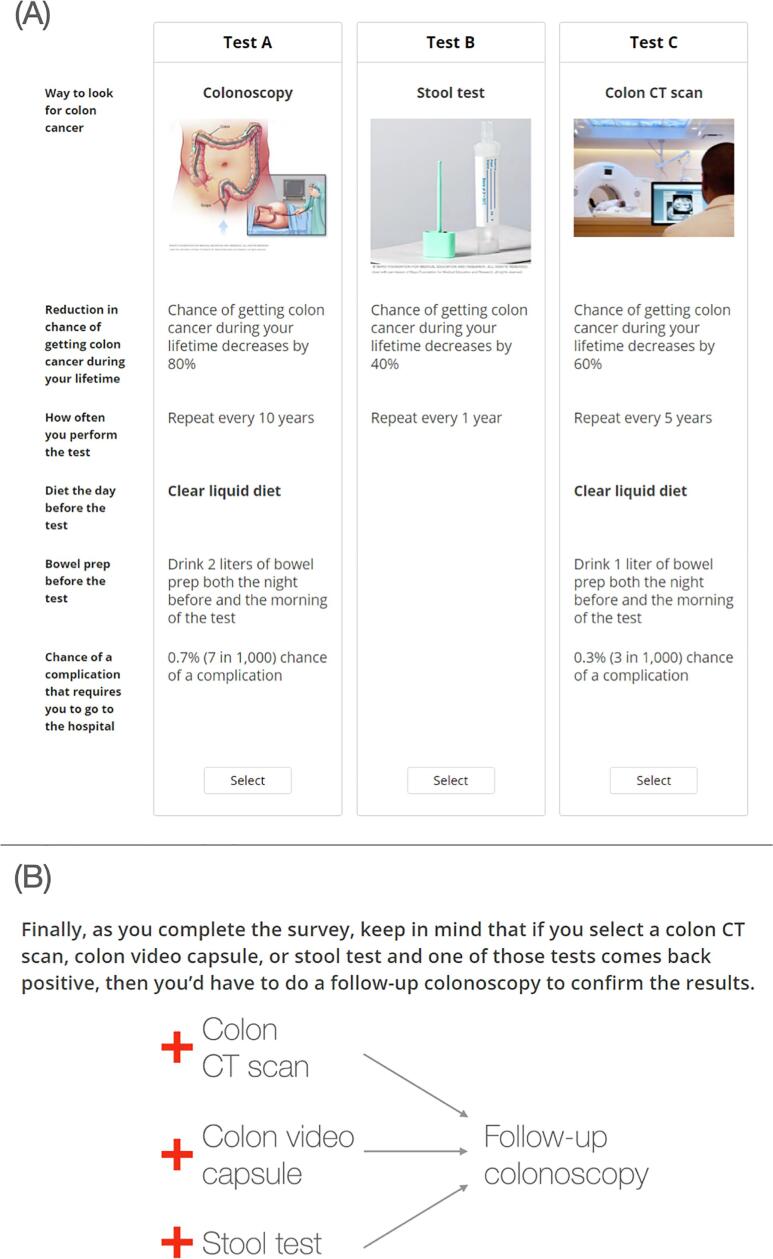
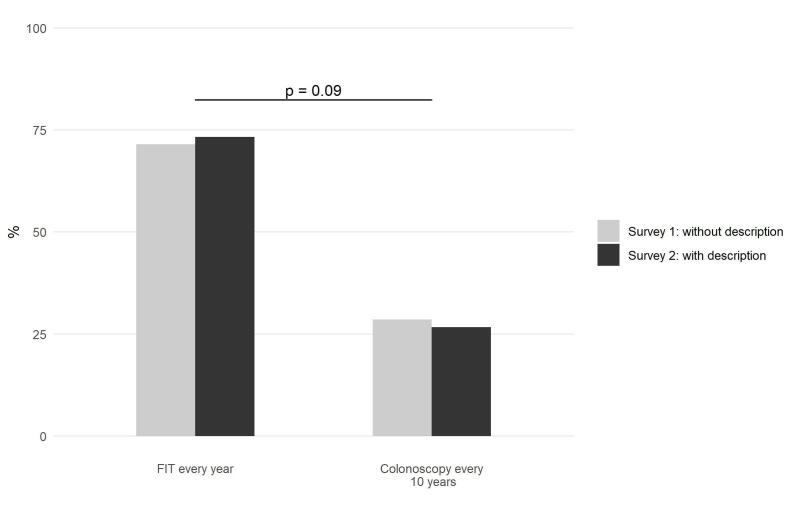
Although many people prefer fecal immunochemical test (FIT) over colonoscopy due to its noninvasive nature, it is unclear whether FIT would still be preferred for colorectal cancer (CRC) screening if they were explicitly informed that + FIT requires follow-up colonoscopy. To address this gap, we administered two conjoint analysis surveys-one that explained the need for a follow-up colonoscopy after + FIT while the other did not-to a US nationwide sample of Americans and then assessed whether there were differences in colonoscopy/FIT preferences between cohorts. We recruited adults ≥ 40yo who had not undergone CRC screening via an online survey research firm. We deployed two surveys that used conjoint analysis to assess decision making surrounding CRC screening tests: Survey 1 (4/2-4/15/2021)-did not inform participants that they need a colonoscopy following a + FIT; Survey 2 (4/29-6/2/2021)-informed respondents of the potential need. Using the conjoint analysis data, we determined the proportion of those who preferred FIT or colonoscopy and then used logistic regression to assess for differences in colonoscopy/FIT preferences between the cohorts. Overall, 501 and 1,000 individuals completed Survey 1 (without description of need for colonoscopy after + FIT) and Survey 2 (with description), respectively. There was no difference in test preference between cohorts after adjusting for covariates in the logistic regression (adjusted p = 0.09): Survey 1 (without description)-colonoscopy 28.5%, FIT 71.5%; Survey 2 (with description)-colonoscopy 26.7%, FIT 73.3%. Thus, knowledge that a + FIT requires a follow-up colonoscopy does not alter people's strong preference for non-invasive stool testing with FIT.
尽管许多人因粪便免疫化学检测(FIT)是非侵入性的而更喜欢它,而非结肠镜检查,但如果明确告知他们阳性FIT结果后需要进行后续结肠镜检查,FIT是否仍会是结直肠癌(CRC)筛查的首选尚不清楚。为了填补这一空白,我们进行了两项联合分析调查——一项解释了阳性FIT结果后需要进行后续结肠镜检查,另一项没有——针对美国全国范围内的美国人样本,然后评估不同队列在结肠镜检查/FIT偏好上是否存在差异。我们通过一家在线调查研究公司招募了年龄≥40岁且未接受过CRC筛查的成年人。我们开展了两项使用联合分析来评估围绕CRC筛查测试的决策的调查:调查1(2021年4月2日至4月15日)——未告知参与者阳性FIT结果后需要进行结肠镜检查;调查2(2021年4月29日至6月2日)——告知了受访者可能需要进行后续结肠镜检查。利用联合分析数据,我们确定了更喜欢FIT或结肠镜检查的人群比例,然后使用逻辑回归来评估不同队列在结肠镜检查/FIT偏好上的差异。总体而言,分别有501人和1000人完成了调查1(未描述阳性FIT结果后需要进行结肠镜检查)和调查2(描述了需要进行后续结肠镜检查)。在逻辑回归中调整协变量后,不同队列之间的测试偏好没有差异(调整后p = 0.09):调查1(未描述)——结肠镜检查28.5%,FIT 71.5%;调查2(描述了需要进行后续结肠镜检查)——结肠镜检查26.7%,FIT 73.3%。因此,知道阳性FIT结果后需要进行后续结肠镜检查并不会改变人们对FIT这种非侵入性粪便检测的强烈偏好。