UCSF Helen Diller Family Comprehensive Cancer Center, San Francisco, CA.
Memorial Sloan Kettering Cancer Center, New York, NY.
J Clin Oncol. 2023 Feb 20;41(6):1265-1274. doi: 10.1200/JCO.22.00842. Epub 2022 Jun 4.
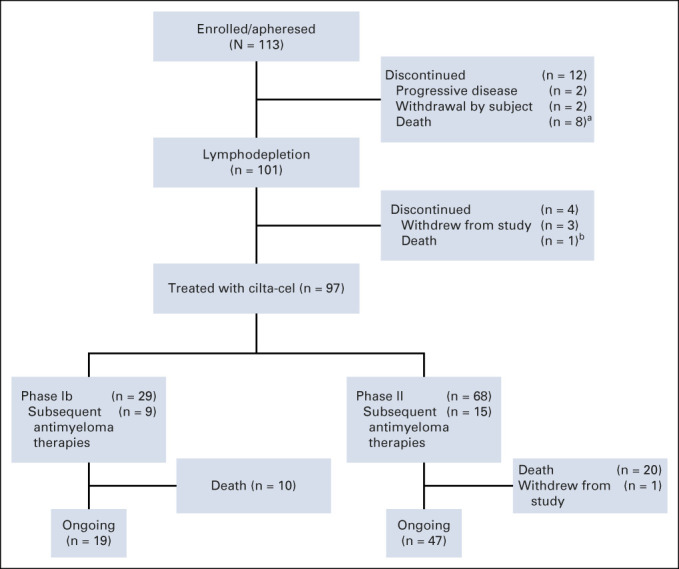
CARTITUDE-1, a phase Ib/II study evaluating the safety and efficacy of ciltacabtagene autoleucel (cilta-cel) in heavily pretreated patients with relapsed/refractory multiple myeloma, yielded early, deep, and durable responses at 12 months. Here, we present updated results 2 years after last patient in (median follow-up [MFU] approximately 28 months), including analyses of high-risk patient subgroups.
Eligible patients had relapsed/refractory multiple myeloma, had received ≥ 3 prior lines of therapy or were double refractory to a proteasome inhibitor and immunomodulatory drug and had received prior proteasome inhibitor, immunomodulatory drug, and anti-CD38 therapy. Patients received a single cilta-cel infusion 5-7 days after lymphodepletion. Responses were assessed by an independent review committee.
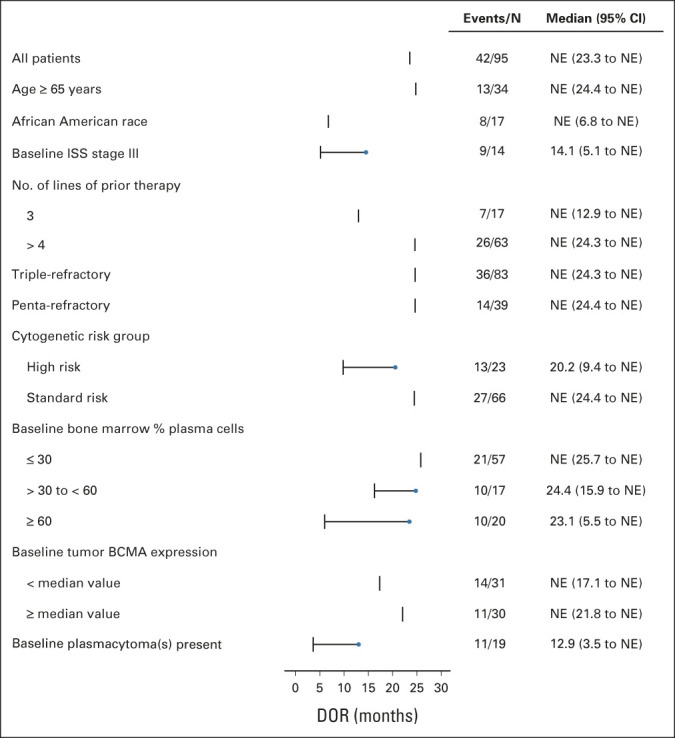
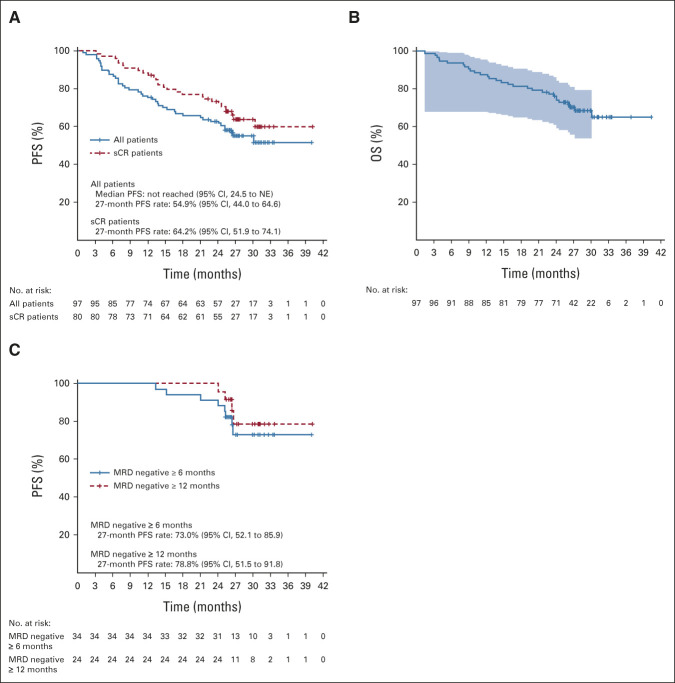
At a MFU of 27.7 months (N = 97), the overall response rate was 97.9% (95% CI, 92.7 to 99.7); 82.5% (95% CI, 73.4 to 89.4) of patients achieved a stringent complete response. Median duration of response was not estimable. Median progression-free survival (PFS) and overall survival (OS) were not reached; 27-month PFS and OS rates were 54.9% (95% CI, 44.0 to 64.6) and 70.4% (95% CI, 60.1 to 78.6), respectively. Overall response rates were high across all subgroups (95.1%-100%). Duration of response, PFS, and/or OS were shorter in patients with high-risk cytogenetics, International Staging System stage III, high tumor burden, or plasmacytomas. The safety profile was manageable with no new cilta-cel-related cytokine release syndrome and one new case of parkinsonism (day 914 after cilta-cel) since the last report.
At approximately 28 months MFU, patients treated with cilta-cel maintained deep and durable responses, observed in both standard and high-risk subgroups. The risk/benefit profile of cilta-cel remained favorable with longer follow-up.
CARTITUDE-1 是一项 Ib/II 期研究,评估了 cilta-cel(西达基奥仑赛)在既往接受过大量治疗的复发/难治性多发性骨髓瘤患者中的安全性和疗效,在 12 个月时产生了早期、深度和持久的应答。在此,我们在最后一位患者入组后约 28 个月(中位随访 [MFU] 约 28 个月)时报告了更新的结果,包括对高危患者亚组的分析。
符合条件的患者患有复发/难治性多发性骨髓瘤,已接受≥3 线治疗,或对蛋白酶体抑制剂和免疫调节剂双重耐药且已接受过蛋白酶体抑制剂、免疫调节剂和抗 CD38 治疗。患者在淋巴细胞耗竭后 5-7 天接受单次 cilta-cel 输注。反应由独立审查委员会评估。
在 MFU 为 27.7 个月时(N=97),总缓解率为 97.9%(95%CI,92.7 至 99.7);82.5%(95%CI,73.4 至 89.4)的患者达到严格的完全缓解。中位缓解持续时间不可估计。中位无进展生存期(PFS)和总生存期(OS)未达到;27 个月的 PFS 和 OS 率分别为 54.9%(95%CI,44.0 至 64.6)和 70.4%(95%CI,60.1 至 78.6)。所有亚组的总体缓解率均较高(95.1%-100%)。高危细胞遗传学、国际分期系统 III 期、高肿瘤负荷或浆细胞瘤患者的缓解持续时间、PFS 和/或 OS 较短。在最后一次报告后,cilta-cel 相关细胞因子释放综合征无新增病例,仅有 1 例新发生帕金森病(cilta-cel 后第 914 天),安全性可控。
在 MFU 约 28 个月时,接受 cilta-cel 治疗的患者保持了深度和持久的应答,在标准和高危亚组中均观察到。随着随访时间的延长,cilta-cel 的风险/获益情况仍然有利。